SpaceX Starship reaches orbit, deploys 26 Starlink V3 satellites

Synopsis
SpaceX's Starship completed an orbital flight on 28 September — surviving a mid-ascent engine failure — and successfully deployed 26 Starlink V3 satellites capable of 1 Tbps downlink speeds. It is the clearest proof yet that Starship can handle real-world anomalies and still deliver, bringing NASA's Moon landing and an eventual Mars mission meaningfully closer.
Key Takeaways
SpaceX Starship successfully reached orbit on 28 September 2026 , one of the most significant milestones in its development history.
One of six Raptor Vacuum engines shut down during ascent; engineers cleared the mission to continue after assessing remaining engine health.
All 26 Starlink V3 satellites were deployed and confirmed operating nominally.
Each V3 satellite supports up to 1 Tbps downlink and 160 Gbps uplink — a 10x and 22x improvement over Starlink V2, respectively.
New beamforming chips increase modem throughput by 64 times compared with earlier systems.
Starship is scheduled to complete six orbits over roughly 10 hours before splashing down in the Pacific Ocean west of Chile .
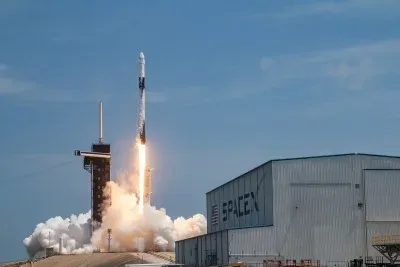
SpaceX's Starship spacecraft successfully reached orbit on Monday, 28 September 2026, achieving a landmark moment in commercial spaceflight as the vehicle completed its ascent and deployed 26 next-generation Starlink V3 satellites — marking one of the most consequential milestones in the company's drive to build a fully reusable launch system for Moon and Mars missions.
Key Developments
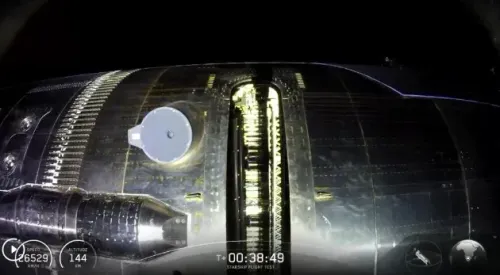
The mission was not without drama. During the ascent phase, one of Starship's six Raptor Vacuum (RVac) engines shut down unexpectedly, triggering tense moments in mission control. After engineers evaluated the health and performance of the remaining five engines, they cleared the spacecraft to continue its journey to orbit — a decision that ultimately proved correct.
SpaceX confirmed that Starship is scheduled to complete six orbits over a flight lasting approximately 10 hours before splashing down in the Pacific Ocean west of Chile.
Starlink V3 Satellite Deployment
A central objective of the mission was deploying the first batch of Starlink V3 operational satellites. SpaceX confirmed via a post on social media platform X that 'All 26 Starlink V3 operational satellites deployed and operating nominally.' The company says the new satellites will significantly improve connectivity speeds, network reliability, and overall system capacity on a global scale.
Each Starlink V3 satellite is designed to support up to 1 terabit per second (Tbps) of downlink capacity and 160 gigabits per second (Gbps) of uplink capacity. That represents a tenfold increase in downlink capability and a 22-fold improvement in uplink performance compared with the previous Starlink V2 generation — a generational leap in broadband infrastructure delivered from low-Earth orbit.
How the V3 Technology Works
Following deployment, the satellites will unfold their antennas, extend solar arrays, and establish initial communications with ground stations and the broader Starlink network through both radio frequency and laser links. Onboard thrusters will then gradually raise each satellite to its operational orbit.
Underpinning the enhanced performance are next-generation beamforming chips developed in-house by SpaceX. The upgraded chipset enables more efficient routing of data traffic across multiple beams and increases modem throughput capacity by 64 times compared with earlier systems — allowing the network to dynamically adjust capacity across densely populated urban centres and remote regions alike.
What This Means for Future Missions
Starship's successful orbital flight is far more than a communications milestone. The vehicle is central to NASA's Artemis Moon programme, for which SpaceX holds a Human Landing System contract. A proven, reusable Starship is also the cornerstone of the company's long-term ambition to send crewed missions to Mars. This comes amid intensifying competition in the heavy-lift launch market from ULA, Blue Origin, and emerging international players. Notably, Starship has now demonstrated that it can sustain an engine anomaly mid-ascent and still complete a complex orbital mission — a resilience milestone that matters as much as the satellite deployment itself.
Point of View
But the real story is the engine failure that wasn't. Starship shrugging off a mid-ascent RVac shutdown and completing a six-orbit mission is the kind of operational resilience that NASA's Artemis programme — and any crewed Mars architecture — absolutely requires. SpaceX has now proved that hardware redundancy works under live conditions, not just in simulation. The V3 satellite specs are extraordinary on paper, but their true test will be whether ground-level throughput gains materialise for users in underserved regions, where Starlink's promise has historically outpaced delivery. The broader competitive implication is stark: no rival launch vehicle today can match Starship's combination of payload volume, reusability ambition, and in-mission fault tolerance.
NationPress
29 Sept 2026
Frequently Asked Questions
What did SpaceX's Starship achieve on 28 September 2026?
SpaceX's Starship spacecraft successfully reached orbit on 28 September 2026, completing a multi-orbit mission and deploying 26 next-generation Starlink V3 satellites. It is one of the most significant milestones in the vehicle's development as a fully reusable launch system.
What happened with the engine failure during the Starship launch?
One of Starship's six Raptor Vacuum engines shut down unexpectedly during the ascent phase, creating concern for mission controllers. After reviewing the health and performance of the remaining five engines, SpaceX engineers decided to continue the mission, which proceeded successfully to orbit.
How do Starlink V3 satellites differ from Starlink V2?
Starlink V3 satellites support up to 1 terabit per second of downlink capacity and 160 gigabits per second of uplink capacity — a tenfold improvement in downlink and a 22-fold improvement in uplink over V2. New beamforming chips also increase modem throughput by 64 times compared with earlier systems.
Where will Starship land after its orbital mission?
SpaceX has scheduled Starship to splash down in the Pacific Ocean west of Chile after completing six orbits over an approximately 10-hour flight.
Why does Starship's successful orbital flight matter beyond internet satellites?
Starship is the vehicle NASA has contracted for its Artemis Human Landing System to return astronauts to the Moon, and it is central to SpaceX's long-term Mars mission plans. Proving it can complete a complex orbital mission — including surviving an engine anomaly — is a critical step toward those crewed deep-space objectives.