SpaceX Starship reliability doubts grow in China ahead of IPO
Synopsis
SpaceX's Starship suffered engine failures in both stages during its latest test flight, prompting Chinese space-sector observers to question whether the rocket can achieve the launch reliability needed to justify its ambitious promises — and its looming IPO.
Key Takeaways
SpaceX described the Starship test flight of Friday, 23 May 2026 as 'mostly successful' despite engine failures in both the first and second stages.
The Super Heavy Booster hit the Gulf of Mexico at high speed; Starship 'barely made it' to its return zone in the Indian Ocean , per Chinese social media observers.
Reliability of the upgraded Raptor 3 engines — redesigned for higher thrust and lower weight — has been identified as the programme's key unresolved issue.
SpaceX has not confirmed a listing date, but multiple reports point to an IPO as early as June 12, 2026 , reportedly on Nasdaq .
Commentators in China 's space sector warn that high-frequency, reliable Starship launches — essential for orbital data centres, Moon , and Mars missions — remain 'out of sight'.
SpaceX's Starship — the world's most powerful rocket — is facing mounting scepticism within China's space sector over whether it can overcome persistent engineering and financial hurdles, with concerns intensifying just weeks before the company's anticipated stock market debut.
Engine failures cloud 'mostly successful' test
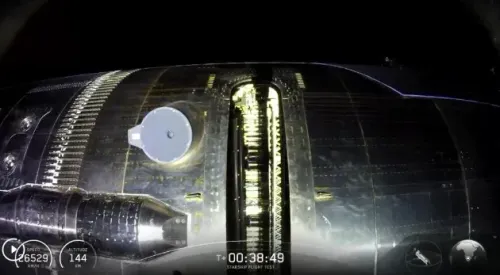
The latest Starship test flight, conducted on Friday, 23 May 2026, was described as 'mostly successful' by SpaceX after engine failures were recorded in both the first and second stages. The Super Heavy Booster first stage entered the Gulf of Mexico at high speed, while Starship itself 'barely made it' to its designated return area in the Indian Ocean, according to observers posting on Chinese social media.
The dual-stage failures have amplified questions about the readiness of the upgraded Raptor 3 engines, which were redesigned to deliver higher thrust at lower weight. One prominent space commentator noted the results pointed squarely at engine reliability as the programme's central unresolved challenge.
Why it matters: IPO timing under pressure
'A fine scientific experiment, but not a perfect story for a much-anticipated IPO,' the online commenter wrote, capturing a sentiment now circulating widely in China's aerospace community. SpaceX has not officially confirmed a listing date, but multiple media reports indicate the company is targeting a public offering as early as June 12, 2026, reportedly on the Nasdaq.
The proximity of the troubled test flight to the prospective IPO window has drawn scrutiny from analysts and space watchers alike, who argue that investor confidence will hinge on demonstrable launch cadence — something Starship has yet to establish.
The competitive backdrop
China's own next-generation heavy-lift programmes are advancing in parallel, giving domestic observers a competitive lens through which to assess Starship's stumbles. Historically, large reusable rockets have faced long development timelines; the Soviet Union's N1 rocket serves as a cautionary precedent for programmes undone by engine-cluster reliability failures.
SpaceX's workhorse Falcon family demonstrated that iterative development can eventually yield operational reliability, but Starship's ambitions — orbital data centres, crewed Moon landings, and eventual Mars missions — demand a far higher reliability bar than cargo launches to low Earth orbit.
What's next
'High frequency and reliability launches of Starship — as a must for delivering big promises such as orbital data centres and Moon and Mars landings — are still out of sight,' the same commentator added, according to posts reviewed by reporters. SpaceX founder and CEO Elon Musk has staked the company's long-term vision, and now its public valuation, on resolving those challenges at pace.
Whether the Raptor 3 engine programme can demonstrate consistent performance before the prospective June 2026 listing will be the defining variable for both the rocket's credibility and the IPO's reception.
Point of View
Point-to-point cargo, NASA lunar contracts — all require launch reliability an order of magnitude beyond what any single 'mostly successful' test can demonstrate. China's scepticism is also strategically motivated: domestic heavy-lift programmes benefit every time Starship's timeline slips. The deeper risk is that SpaceX is attempting to compress a decade of reliability-building into a public-market narrative, and the Raptor 3 engine's teething problems suggest that compression has limits.
NationPress
19 Sept 2026
Frequently Asked Questions
What happened during SpaceX's latest Starship test flight?
The Starship test flight conducted on Friday, 23 May 2026 experienced engine failures in both the first and second stages. SpaceX described the outcome as 'mostly successful,' but observers noted the Super Heavy Booster hit the Gulf of Mexico at high speed and Starship 'barely made it' to its Indian Ocean return zone.
Why are Chinese space experts sceptical about Starship?
Commentators in China 's space sector argue that repeated engine reliability issues with the Raptor 3 suggest Starship is far from the high-frequency launch cadence required to fulfil promises around orbital data centres, Moon landings, and Mars missions. The proximity of these failures to a prospective IPO has sharpened that criticism.
When is the SpaceX IPO expected?
SpaceX has not officially confirmed a listing date. Multiple media reports indicate the company is targeting a public offering as early as June 12, 2026 , reportedly on the Nasdaq , though no formal announcement has been made.
What is the Raptor 3 engine and why does it matter?
The Raptor 3 is an upgraded version of SpaceX 's main Starship engine, redesigned to produce higher thrust at a lower weight. Its reliability is considered the central engineering challenge for the programme, as consistent performance across dozens of engines per flight is essential for safe, repeatable launches.
How does Starship compare to historical heavy-lift rocket programmes?
Observers have drawn comparisons to the Soviet Union 's N1 rocket, which failed repeatedly due to engine-cluster reliability problems before being cancelled. SpaceX 's own Falcon family shows that iterative development can produce reliable rockets, but Starship 's far greater complexity and ambition raise the reliability bar significantly.