Unitree humanoid robots wow America's Got Talent as Congress eyes ban
Synopsis
Unitree's G1 humanoid robots earned a standing ovation and unanimous judges' approval on NBC's America's Got Talent premiere — even as Congress advances legislation to ban Chinese robots from US soil, exposing a stark gap between public enthusiasm and political intent.
Key Takeaways
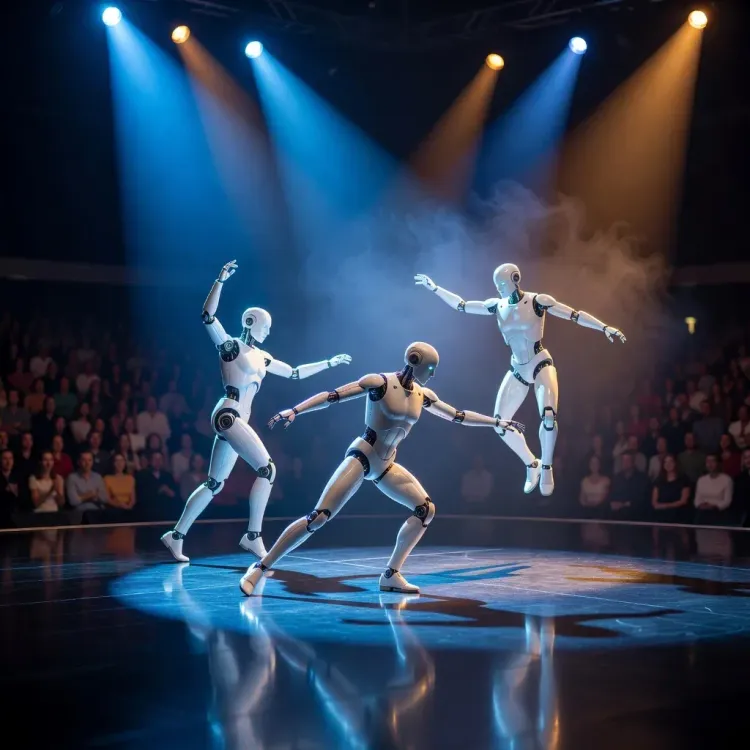
Eight Unitree G1 humanoid robots performed a dance routine alongside Wu Yufei on NBC 's America's Got Talent season premiere on Tuesday, June 3, 2026 .
The act received unanimous approval from judges Simon Cowell , Sofia Vergara , Howie Mandel , and Mel B to advance in the competition, which offers a US$1 million grand prize.
Simon Cowell called the performance 'nuts, but brilliant' ; Mel B said the robots were 'perfect' .
America's Got Talent averaged close to 6 million viewers per episode in its previous season, according to Nielsen data.
Legislation including the American Security Robotics Act and the Guard Act is advancing in Congress , with the House Select Committee on China led by John Moolenaar flagging Chinese robotics firms as national-security concerns.
Analysts, including researchers at the Brookings Institution and analyst Kyle Chan , say the appearance could drive mainstream acceptance of Chinese robots in the US .
Unitree's G1 humanoid robots drew a standing ovation on NBC's America's Got Talent season premiere on Tuesday, June 3, 2026, exposing a widening divide between American public enthusiasm for Chinese robotics and Washington's push to legislate them out of the country. Analysts say the prime-time appearance could accelerate mainstream acceptance of Chinese robots in the United States, even as Congress advances legislation to restrict them.
The performance that captivated prime-time America
Eight G1 humanoid robots from Hangzhou-based Unitree performed an elaborate dance routine alongside Wu Yufei, a dancer from Sichuan province, in what was the show's season-opening audition segment. The act, competing under the Unitree banner, earned unanimous approval from the four-person judging panel — Simon Cowell, Sofia Vergara, Howie Mandel, and Mel B — to advance to the next round of the competition, which carries a grand prize of US$1 million.
Simon Cowell, known for his unsparing critiques, called the performance 'nuts, but brilliant', while former Spice Girls star Mel B declared the robots 'perfect'. America's Got Talent, which launched in 2006, averaged close to 6 million viewers per episode during its previous season, according to data from Nielsen.
Why it matters: public opinion vs. Capitol Hill
The prime-time moment arrives at a fraught juncture. Legislation targeting Chinese robots is advancing in Washington, with measures including the American Security Robotics Act and the Guard Act under consideration. The House Select Committee on China, led by John Moolenaar, has flagged Chinese robotics firms as potential national-security risks, citing concerns over data collection and supply-chain dependencies.
Analysts note that the gulf between the studio audience's reaction and the legislative posture in Congress reflects a broader tension: consumer-facing technology from China often builds popular goodwill faster than policy can respond. Researchers at the Brookings Institution and analysts including Kyle Chan have pointed to this dynamic as a recurring feature of US-China tech competition.
The competitive backdrop
Unitree has emerged as one of China's most prominent humanoid robotics companies, with its G1 platform drawing comparisons to offerings from US rivals. The company's appearance on a mainstream entertainment platform — rather than a trade show floor — marks a strategic shift in how Chinese robotics firms are projecting soft power. Separately, Nvidia has been cited in industry discussions as a key supplier of chips used in training humanoid robot models, a relationship that adds complexity to any blanket legislative restrictions.
Rating figures for the season premiere had not been announced at the time of reporting. If viewership tracks near prior-season averages, the Unitree segment will have reached an audience orders of magnitude larger than any robotics trade event.
What's next
Wu Yufei and the Unitree G1 robots are set to advance further into the competition, meaning the act could return to NBC prime time in subsequent weeks, compounding public exposure. Meanwhile, the trajectory of the American Security Robotics Act and the Guard Act through Congress will determine whether legislative sentiment hardens before the competition concludes. How Washington reconciles a nationally televised standing ovation with its national-security framing of Chinese robotics will be the defining tension to watch.
Frequently Asked Questions
What did Unitree robots do on America's Got Talent?
Eight Unitree G1 humanoid robots performed an elaborate dance routine alongside Chinese dancer Wu Yufei on the season premiere of NBC 's America's Got Talent on June 3, 2026 . The act earned a standing ovation from the studio audience and unanimous approval from all four judges to advance in the competition.
Why is Congress trying to ban Chinese robots?
Legislation including the American Security Robotics Act and the Guard Act is advancing in Congress over national-security concerns. The House Select Committee on China , led by John Moolenaar , has flagged Chinese robotics firms as potential risks related to data collection and supply-chain dependencies.
How popular is America's Got Talent?
America's Got Talent is one of the most-watched shows on US television, averaging close to 6 million viewers per episode during its previous season, according to Nielsen data. The show, broadcast by NBC , has aired since 2006 and offers a grand prize of US$1 million .
What did the judges say about the Unitree robot performance?
All four judges — Simon Cowell , Sofia Vergara , Howie Mandel , and Mel B — voted to advance the act. Simon Cowell called it 'nuts, but brilliant' , while Mel B described the robots as 'perfect' .
Who is Unitree and where is the company based?
Unitree is a Chinese humanoid robotics company headquartered in Hangzhou, China , and one of the country's most prominent players in the sector. Its G1 platform has drawn international attention and is now competing on a mainstream US entertainment stage amid escalating geopolitical scrutiny of Chinese tech firms .