US to Partner AI Firms Against China's Tech-Stealing Campaigns
Synopsis
The White House has revealed that China-linked entities are running 'industrial-scale' distillation attacks on US AI firms — creating thousands of fake accounts to jailbreak and clone proprietary AI models. OSTP chief Michael Kratsios is now mobilizing a government-industry intelligence-sharing alliance to fight back, marking a dramatic new front in the US-China tech war.
Key Takeaways
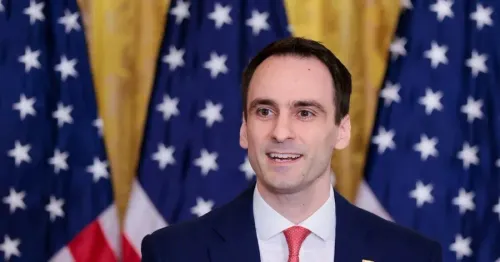
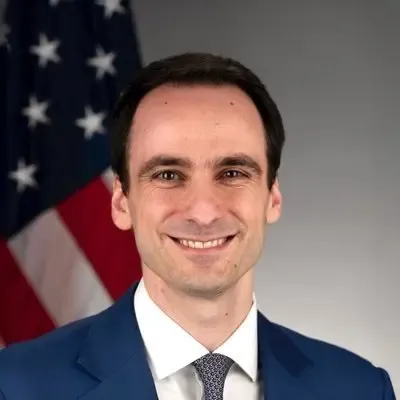
Michael Kratsios , director of the White House OSTP , issued an internal memo revealing "industrial-scale" AI distillation campaigns by China-linked foreign entities targeting US AI firms.
The distillation technique involves running thousands of fake accounts on US AI platforms to jailbreak models and extract proprietary training data for use in rival AI development.
The White House will now share classified intelligence on distillation tactics directly with US AI companies and develop a formal industry-wide security playbook.
In March 2025 , Anthropic accused DeepSeek , Minimax , and Moonshot AI — three Chinese unicorns — of illegally cloning capabilities from its Claude AI model .
China's Embassy in Washington DC denied all allegations, attributing its AI progress to domestic effort and legitimate international cooperation.
The US administration is exploring accountability mechanisms — potentially including sanctions — to hold foreign actors responsible for distillation attacks.
The United States administration has announced a major escalation in its effort to protect American artificial intelligence technology, pledging to deepen cooperation with US AI companies to combat what it describes as "industrial-scale campaigns" orchestrated by "foreign entities, principally based in China," to steal cutting-edge technological advancements. The announcement, detailed in an internal memo, signals a significant hardening of Washington's posture on AI security as the global race for AI dominance intensifies.
The Memo That Triggered the Alert
Michael Kratsios, director of the White House Office of Science and Technology Policy (OSTP), authored the internal memo revealing new intelligence about foreign exploitation of US AI firms through a technique known as "distillation." The memo, reported by BBC, alleges that these campaigns are systematic, coordinated, and designed to hollow out America's AI research advantage.
Kratsios stated that the Chinese-linked strategy aims to "systematically undermine American research and development" and gain unauthorized access to proprietary AI model data. This is not a fringe concern — it reflects a pattern of economic espionage that US intelligence agencies have flagged for years, now accelerating in the AI domain.
How 'Distillation' Attacks Actually Work
The distillation technique is both sophisticated and difficult to detect. Foreign-linked operators reportedly run thousands of individual accounts on US AI platforms — chatbots, APIs, and developer tools — making them appear as ordinary users to evade detection.
These accounts then execute coordinated "jailbreaking" attempts — probing AI models to expose internal logic, training data signatures, and proprietary model behaviors that are not meant to be publicly accessible. The extracted information is then used to train and refine rival AI systems, effectively allowing foreign actors to leapfrog years of expensive R&D investment.
This practice is particularly damaging because it allows adversaries to build AI capabilities at a fraction of the cost while undermining the competitive moat of US companies that have invested billions in model development.
White House Response: Intelligence Sharing and Accountability
In response, the White House has outlined a multi-pronged strategy. First, it will share more granular intelligence with US AI companies about the "tactics employed and actors involved" in distillation campaigns — a move that represents an unusual degree of government-industry intelligence sharing in the private tech sector.
Second, the administration plans to improve real-time coordination between government agencies and AI firms to mount faster, more effective defenses against these intrusions. Third, it will develop a formal set of "best practices to identify, mitigate, and remediate" distillation attacks — essentially creating an industry-wide security playbook.
Perhaps most significantly, the White House has signaled it will "explore" accountability mechanisms to hold foreign actors responsible — a phrase that could encompass sanctions, trade restrictions, or diplomatic consequences, though specifics remain undefined.
Kratsios warned that foreign actors building AI capabilities on distillation-derived foundations "should have little confidence in the integrity and reliability of the models they produce," suggesting that such stolen knowledge may itself be flawed or incomplete.
China Denies Allegations; Anthropic Had Already Raised the Alarm
A spokesperson for China's Embassy in Washington DC flatly rejected the allegations, asserting that China's technological progress is the result of "its own dedication and effort as well as international cooperation" — a standard denial that mirrors Beijing's response to previous US accusations of IP theft.
Notably, this White House action follows a high-profile accusation made in March 2025 by Anthropic, a leading US-based AI company, which alleged that three prominent Chinese AI unicorns — DeepSeek, Minimax, and Moonshot AI — had illegally extracted capabilities from its proprietary Claude model to accelerate development of their own systems. That accusation was among the most direct and specific ever made by a US AI firm against Chinese competitors.
This comes amid a broader US-China technology decoupling effort that includes export controls on advanced semiconductors, restrictions on AI chip sales, and heightened scrutiny of Chinese investment in American tech startups. The distillation threat represents a new front in this ongoing technology cold war — one that bypasses hardware restrictions entirely by targeting software and model intelligence.
Broader Implications for the Global AI Race
The stakes of this confrontation extend well beyond corporate competition. AI model superiority is increasingly tied to national security, military applications, economic productivity, and geopolitical influence. A foreign actor that successfully replicates or surpasses US AI capabilities through distillation effectively neutralizes billions of dollars in American R&D investment.
For India, which is positioning itself as a third-pole AI power and hosts major R&D centers for global tech firms, the US crackdown on AI theft carries indirect implications — particularly around data governance, model security standards, and the emerging global framework for AI intellectual property protection.
As the White House moves to formalize its AI security framework, industry observers expect further regulatory guidance, potential legislation, and expanded use of export control tools to protect America's AI frontier. The coming months will be critical in determining whether the US government's intelligence-sharing model can keep pace with increasingly sophisticated foreign intrusion campaigns.
Point of View
Suggesting the government finally has enough evidence to move from accusation to action. The deeper irony is that the very openness that made US AI ecosystems innovative — public APIs, developer access, research sharing — has become the attack surface that adversaries exploit. Washington must now decide how much openness it can afford in a technology domain that has become a national security asset.
NationPress
18 Sept 2026
Frequently Asked Questions
What is AI distillation and how is China using it to steal US technology?
AI distillation is a technique where foreign-linked operators run thousands of fake accounts on US AI platforms to systematically probe and extract proprietary model data through coordinated jailbreaking attempts. According to a White House memo, Chinese-linked entities are using this method to replicate US AI capabilities without the associated R&D investment.
What is the White House doing to protect US AI companies from China?
The White House, led by OSTP director Michael Kratsios, plans to share intelligence with US AI firms about distillation tactics, improve government-industry coordination, and develop best practices to detect and counter these attacks. It is also exploring accountability measures, potentially including sanctions, against foreign actors involved.
Did Anthropic accuse Chinese AI companies of stealing its technology?
Yes. In March 2025, Anthropic accused three Chinese AI unicorns — DeepSeek, Minimax, and Moonshot AI — of illegally extracting capabilities from its Claude model to develop their own AI systems. This was one of the most specific public accusations made by a US AI firm against Chinese competitors.
How has China responded to US allegations of AI technology theft?
China's Embassy in Washington DC denied the allegations, stating that China's technological development is the result of 'its own dedication and effort as well as international cooperation.' Beijing has consistently rejected US accusations of state-sponsored IP theft.
Why does AI technology theft matter for national security?
AI model superiority is directly linked to military capabilities, economic competitiveness, and geopolitical influence, making it a critical national security asset. If foreign actors successfully replicate US AI systems through distillation, it effectively neutralizes billions of dollars in American R&D and erodes the technological edge that underpins US strategic dominance.