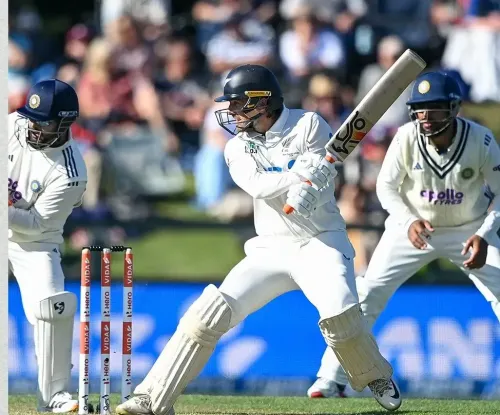
Akash Deep's stump-line plan nets Latham, Ravindra; NZ 246/5

Synopsis
Akash Deep called it ‘self-realisation’. After a loose outing in Wellington, he bowled closer to the stumps in Christchurch, made batters play 80-90% of deliveries, and removed Tom Latham and Rachin Ravindra in just over two overs as New Zealand slid from 110/1 to 110/4. Jasprit Bumrah's new conventional run-up added a curious subplot.
Key Takeaways
Akash Deep took 2-52 in 21 overs on Day 1 of the second Test at Hagley Oval , Christchurch, on 27 November 2026 .
New Zealand ended Day 1 on 246/5 from 85 overs .
Akash dismissed captain Tom Latham (59) and Rachin Ravindra (nine-ball duck) as NZ went from 110/1 to 110/4 .
Anshul Kamboj removed Henry Nicholls for 16 during the same collapse.
Akash said his plan was to make batters play 80-90% of deliveries by bowling a stump-to-stump line.
Jasprit Bumrah bowled with a more conventional run-up, which Akash said he had practised before the match.
India fast bowler Akash Deep has described his shift to a tighter, stump-to-stump line as an act of “self-realisation” after taking 2 for 52 on Day 1 of the second Test against New Zealand at Hagley Oval, Christchurch, on Friday, 27 November 2026. His two wickets, captain Tom Latham and Rachin Ravindra, came on near-unplayable deliveries. New Zealand closed the day on 246/5 from 85 overs.
The seamer changed his approach from the first Test in Wellington. At Hagley Oval he bowled closer to the stumps in his opening spell, forcing the batters to play far more often. That discipline was rewarded later in the day.
The Twin Strikes That Changed Day 1
Akash removed Latham and Ravindra within a little over two overs. In that period New Zealand slipped from 110/1 to 110/4. Anshul Kamboj added to the collapse by dismissing Henry Nicholls for 16 in between.
Against Latham, Akash hit a good length with a delivery that angled in and held its line. The Kiwi skipper was forced to play and edged it to wicketkeeper Rishabh Pant, departing for 59. Ravindra followed soon after. Bowling from round the wicket to the left-hander, Akash angled one in and seamed it away. Ravindra nicked it behind and fell for a nine-ball duck.
Akash finished with 2-52 from 21 overs, troubling the New Zealand top order throughout the day.
What Akash Deep Said About His Plan
Speaking to reporters after stumps, Akash explained the reasoning behind the change. “Yes, exactly, we knew today there was help for the fast bowlers on a Day 1 pitch. So we wanted to utilise that... So it was my self-realisation of how much we can make the batter play. So that was the plan in my first spell; I tried to make sure the batter plays 80-90% of the balls,” he said.
He also explained how he used the width of the crease to unsettle the batters, who had been leaving a large number of deliveries. “I was trying to bowl four balls from one place and two balls from there. That was to create doubt in the batsmen's minds. They were leaving a lot of balls. So I was going out a little to create doubt,” he said.
Moisture, Patience and the Afternoon Session
Akash said early moisture on the surface slowed the ball in the morning, so edges were not carrying to the cordon. “It was fresh today, so it helped us. But in the first session, there was a bit of moisture, so the ball wasn't coming out with pace. So the edges were not getting carried,” he said.
India adjusted after lunch. “So after lunch, we decided to bowl the ball in a good area. So our plan was to put the ball in a good area and play with patience. So we did that, and we got three wickets (in the afternoon session),” he added.
Bumrah's New Run-Up
Day 1 also brought an unusual change from India's pace spearhead Jasprit Bumrah. He bowled with a more conventional run-up instead of his familiar action. Akash said Bumrah had been practising the change before the match.
“He is Jasprit Bumrah. If he's doing it, there must be something. What can we comment on him? He was practising this kind of bowling before the match. Maybe he has some planning in his mind. That's why he's doing it,” Akash said.
What Lies Ahead
With New Zealand five down and the new-ball conditions still offering assistance, India's seamers will want early breakthroughs on Day 2. Akash Deep's tighter line is likely to remain central to that plan at Hagley Oval.
Point of View
But the fix should be part of team planning, not something left to individual introspection. Bumrah experimenting with his run-up in a live Test is the bigger story. If it is about workload or long-term fitness, India owe fans more clarity than ‘he must have some plan’.
NationPress
27 Nov 2026
Frequently Asked Questions
How many wickets did Akash Deep take on Day 1 of the Christchurch Test?
Akash Deep took 2 wickets for 52 runs in 21 overs on Day 1 of the second Test against New Zealand at Hagley Oval. His victims were captain Tom Latham and Rachin Ravindra.
What was New Zealand's score at stumps on Day 1?
New Zealand finished Day 1 of the second Test on 246/5 from 85 overs. At one stage they slipped from 110/1 to 110/4.
What change did Akash Deep make to his bowling in Christchurch?
Akash Deep bowled closer to the stumps, aiming to make batters play 80-90% of deliveries. He called the change ‘self-realisation’ and also varied his position on the crease to create doubt in the batters' minds.
Why did Jasprit Bumrah use a different run-up in Christchurch?
No official reason has been given for Bumrah's more conventional run-up. Akash Deep said Bumrah had been practising this style before the match and probably had a plan in mind.
How were Tom Latham and Rachin Ravindra dismissed?
Both were caught behind by Rishabh Pant off Akash Deep. Latham edged an angled-in delivery that held its line after scoring 59, and Ravindra nicked one that seamed away from round the wicket, out for a nine-ball duck.