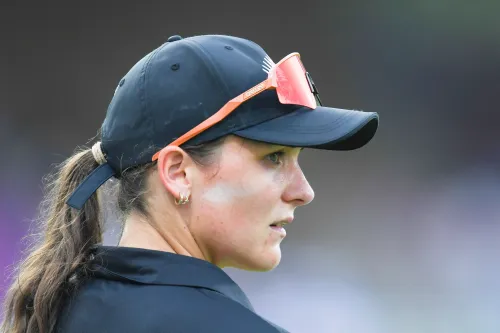
How Did Amelia Kerr Overcome Her Darkest Days?

Synopsis
In a candid revelation, Amelia Kerr, the New Zealand and Mumbai Indians all-rounder, shares her journey through depression and anxiety. This heartfelt narrative not only highlights her struggles but also emphasizes the vital role of family and teammates in her recovery, redefining success in cricket through resilience and openness.
Key Takeaways
Amelia Kerr 's journey highlights the importance of mental health awareness.
Support from family and teammates can be vital during tough times.
Seeking help is a sign of strength, not weakness.
Resilience and self-belief are key to overcoming challenges.
Success is not just about accolades but also personal growth.
New Delhi, Jan 28 (NationPress) New Zealand and Mumbai Indians all-rounder Amelia Kerr opened up about her battle with depression and anxiety, revealing that she experienced her ‘lowest’ point in life in 2020. She expressed gratitude towards her family and teammates for their support during this challenging time, which she refers to as a ‘dark phase.’
Now recognized as a prominent figure in women’s cricket, Amelia first gained international acclaim as a teenage sensation. She made her international debut at the age of 16, and just a year later, delivered an unforgettable performance by scoring a record-setting 232 in a one-day international—a milestone that remains the highest individual score in women’s cricket, alongside a five-wicket haul in the same match.
Although she received numerous accolades following New Zealand’s World Cup triumph and her two Women’s Premier League (WPL) championships, her most significant narrative lies within the years that spanned these achievements.
“Cricket was never a burden for me. While it is a challenging sport filled with failures, it has always been my happy place,” Amelia shared during an interview with the Mumbai Indians.
Coming from a family deeply entrenched in cricket, with her grandfather, parents, and older sister all having played professionally, Amelia seemed destined for success. However, by 2020, just four years into her international career, the pressure began to mount, leading to personal struggles.
“Cricket was a refuge and a joyful realm for her, yet in between games and training, she grappled with many moments of sorrow,” her sister and White Ferns teammate Jess Kerr stated.
This internal battle peaked in 2020 when Amelia was diagnosed with depression and anxiety, describing this period as the darkest chapter of her life.
“In 2020, I was diagnosed with depression and anxiety. The burden became overwhelming. I lost a sense of myself; it felt as though my soul had been extracted, leaving me empty. It was undoubtedly the lowest point I’ve ever faced,” she recounted.
“A pivotal moment occurred when I was sent home from a training camp with New Zealand for safety reasons. Witnessing my dad cry, something I rarely saw while growing up, shattered me completely. It felt like attending my own funeral,” Amelia recalled.
During her recovery, Amelia heavily relied on her family, learning the significance of open communication and establishing a support network within her team. Senior players were instrumental in guiding her back to mental wellness.
“At first, she hesitated to share her feelings with the senior players. However, after a particularly difficult incident, she quickly realized that keeping it all in was not the right approach,” remarked Suzie Bates, New Zealand captain and Amelia's long-time idol.
Amelia credits her readiness to seek help as a transformative moment in her healing process.
“Recovery takes substantial effort and a solid support system, but ultimately, you must be willing to help yourself. I take pride in being able to do that even at my lowest,” she emphasized.
Throughout this journey, cricket transformed back into her anchor—not a source of stress, but a sanctuary for healing.
“During my toughest times, cricket was my safe haven. It motivated me to return, despite the fear. Over that period, the challenging days began to diminish,” Amelia noted.
Today, she stands not only as a multiple title winner but also as a role model for aspiring athletes globally, admired for both her candor and her accomplishments. Her connection with Mumbai Indians fans, in particular, highlights this bond.
“When people call me Mumbai-Kerr, it feels more like a connection than just a nickname. It’s like being embraced by something inclusive. I’ve learned that loving cricket doesn’t mean losing oneself to it; it’s about evolving with it and embracing its challenges.”
“Our path doesn’t have to be flawless to hold significance. You only need to continually strive to reconnect with what feels authentic,” she added.
By sharing her story, Amelia has redefined success in cricket, demonstrating that resilience, transparency, and self-belief can be just as valuable as any record or medal.
Point of View
Amelia Kerr's story is a compelling reminder of the importance of mental health awareness in sports. As she openly discusses her struggles, she encourages others to seek help and emphasizes that success is not solely defined by accolades, but by the strength to overcome personal challenges. NationPress supports such narratives that foster understanding and resilience among athletes and the general public.
NationPress
21 Oct 2026
Frequently Asked Questions
What challenges did Amelia Kerr face?
Amelia Kerr faced significant challenges including depression and anxiety, particularly during the year 2020, which she describes as the lowest point in her life.
How did Amelia Kerr find support during her struggles?
Amelia found support through her family and teammates, learning the importance of open communication and building a strong support network.
What role did cricket play in Amelia's recovery?
Cricket served as a source of comfort and healing for Amelia, motivating her to return to the sport during her toughest times.
What message does Amelia Kerr want to convey?
Amelia emphasizes that resilience, honesty, and self-belief are crucial components of success, and that it’s important to seek help during difficult times.
How has Amelia Kerr's story impacted others?
Amelia's openness about her mental health struggles has inspired many, showing that personal challenges can lead to growth and redefine success.