MCC Clarifies Controversial Run-Out of Salman Agha in ODI Match
Synopsis
The MCC has officially confirmed the legality of Salman Agha's run-out during the Bangladesh-Pakistan ODI. The statement emphasizes the adherence to cricket laws while acknowledging the option to uphold the Spirit of Cricket, stirring discussions on sportsmanship.
Key Takeaways
The MCC affirmed the legality of Salman Agha's run-out.
The fielding side had the option to withdraw their appeal.
The incident highlights the balance between cricket laws and sportsmanship.
Collisions between players do not render the ball dead.
The upcoming dead-ball law will not alter the ruling in this case.
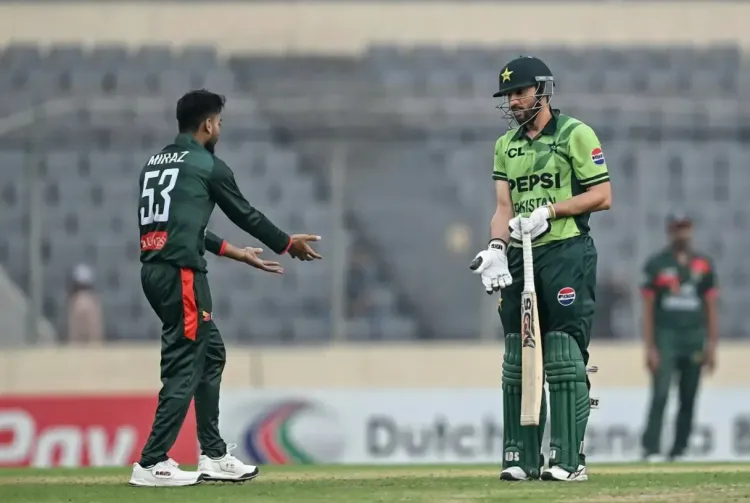
New Delhi, March 17 (NationPress) The Marylebone Cricket Club (MCC) has announced that the contentious run-out of Salman Ali Agha during the second ODI between Bangladesh and Pakistan in Dhaka was ruled correctly according to the Laws of Cricket. The MCC emphasized that the fielding team had the option to withdraw their appeal in alignment with the Spirit of Cricket.
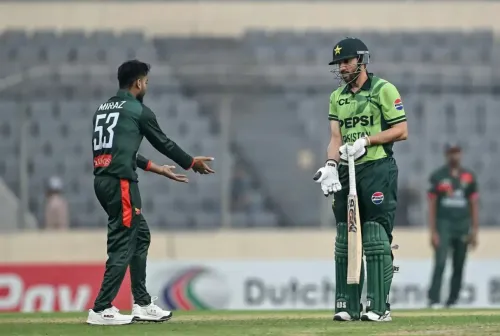
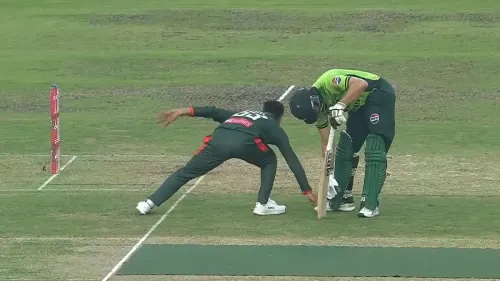
The incident transpired when Mehidy Hasan Miraz, a Bangladesh all-rounder, attempted to field a shot from Mohammad Rizwan. As Miraz traversed the pitch to secure the ball, he collided with Agha, who was backing up at the non-striker’s end. In the ensuing confusion, Agha leaned down as if to retrieve the ball to return it to the bowler, mistakenly believing that play had halted.
Nevertheless, Miraz swiftly collected the ball and broke the stumps while Agha was still outside his crease, resulting in the dismissal of the Pakistan captain. Following the match, Agha remarked on the Spirit of Cricket, saying he would have acted differently had he been the fielder, opting for “sportsmanship.”
In light of the discussions surrounding the incident, the MCC released a statement affirming the correctness of the on-field ruling. “According to the Laws, there was little that the umpires could have done differently. The non-striker was evidently out of his ground when the wicket was broken, and the ball was active. Therefore, it is out,” the statement indicated.
The MCC also noted that Agha had increased his own risk by attempting to handle the ball.
“It is important to mention that the non-striker had departed his ground while the ball was in play and had just begun to try to return to his ground when he collided with Mehidy. Additionally, no batter should try to pick up the ball without the fielding side's approval, as this could lead to an Obstructing the Field dismissal. In hindsight, he should have utilized that moment to try to regain his ground,” the statement elaborated.
In response to claims that the ball should have been declared dead after the collision, the MCC dismissed that notion, clarifying that the Laws do not allow for such a ruling in this context.
“There have been suggestions that the ball should be considered Dead. This is not feasible under the Laws; a ball does not become dead due to player collisions. If it did, this could incentivize players to create collisions for strategic advantage. There was no indication of a serious injury, thus a Dead ball call was unwarranted. The umpire could not have assumed that all players had ceased to view the ball as live, as Mehidy clearly believed it was in play, even if Agha did not. Furthermore, it could not have been definitively determined to be in the hands of the bowler or wicket-keeper since it was on the ground.”
The MCC further clarified that even the updated dead-ball law, set to be implemented in October, would not have affected the incident's outcome.
“Under the upcoming Laws, effective in October, an umpire will have the ability to declare that the ball is finally settled if it is stationary on the ground. However, it is difficult to argue that the ball is finally settled if the nearest fielder is attempting to run out the non-striker, who is out of his ground.
“Consequently, there is no case to argue that this was Not Out under the Law, nor that the Law could be modified to make a situation like this Not Out.”
While endorsing the legality of the dismissal, the MCC acknowledged that Bangladesh could have opted to recall the batter to uphold the Spirit of Cricket.
“Nonetheless, many have expressed sympathy for Agha and argued that this dismissal contradicted the Spirit of Cricket.
“It would have certainly been within Mehidy’s rights, as Bangladesh captain, to retract his appeal. Agha clearly perceived the ball as dead and was trying to assist the fielding team after an unintentional collision, which complicated his efforts to return to his ground. The Laws do allow for a withdrawal in cases where the batter is out according to Law, but the fielding side believes it is more appropriate, in line with the Spirit of Cricket, to permit them to continue.”
Point of View
I view the MCC's clarification on the Salman Agha run-out as a crucial moment in cricket. It underscores the importance of upholding the Laws of Cricket while also recognizing the need for sportsmanship. The incident has sparked vital conversations about the balance between rules and spirit in the game.
NationPress
17 Sept 2026
Frequently Asked Questions
What was the MCC's verdict on Salman Agha's run-out?
The MCC confirmed that the run-out was correctly adjudged under the Laws of Cricket, emphasizing that the fielding side could have chosen to withdraw their appeal.
Did the MCC consider the Spirit of Cricket in their statement?
Yes, the MCC noted that the fielding team had the option to withdraw their appeal in line with the Spirit of Cricket.
What caused the run-out of Salman Agha?
The run-out occurred when Agha collided with fielder Mehidy Hasan Miraz while backing up at the non-striker's end.
Could the ball have been declared dead after the collision?
The MCC stated that the ball does not become dead due to player collisions, and this ruling was consistent with the Laws.
What does the updated dead-ball law entail?
The updated dead-ball law, effective in October, allows umpires to declare a ball finally settled if it is stationary on the ground, but this would not have changed the outcome in Agha's case.