Asian Senior Fencing 2026: South Korea wins Women's Sabre, Kazakhstan takes Men's Epee Team gold
Synopsis
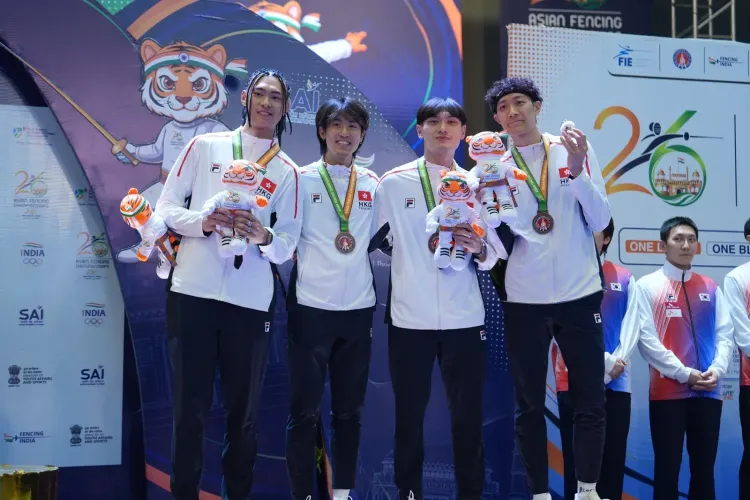
Kazakhstan pulled off a historic upset in Men's Epee, toppling a Japanese team anchored by an Olympic gold medallist, while South Korea swept the Women's Sabre title at the 26th Asian Senior Fencing Championship in New Delhi. With Asian Games qualification points at stake, Day 5 separated the continent's true fencing powers — and India's performance hinted at a programme quietly closing the gap.
Key Takeaways
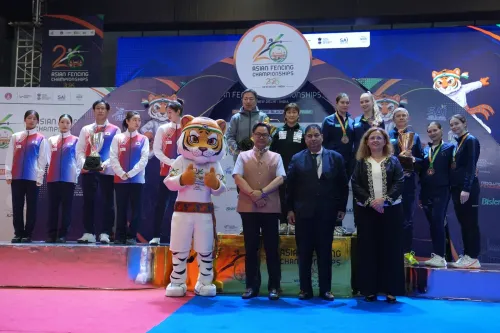
South Korea won the Women's Sabre Team gold at the 26th Asian Senior Fencing Championship 2026 on 23 June at Bharat Mandapam, New Delhi .
Kazakhstan claimed a historic Men's Epee Team gold, defeating a Japanese side anchored by Olympic gold medallist Kano Koki .
Bhavani Devi led the Indian Women's Sabre team, which was eliminated by an East Asian opponent but showed strong technical cohesion.
The Indian Men's Epee squad, led by Joseph Bennet , avoided a heavy defeat and gathered tactical data against dominant Central Asian sides.
Results carry Aichi-Nagoya Asian Games qualification points, raising the stakes across all team events.
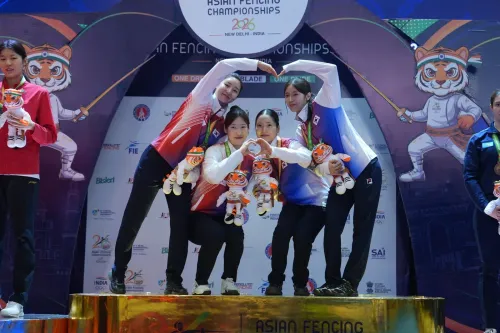
South Korea claimed gold in the Women's Sabre Team event while Kazakhstan secured the top spot in Men's Epee Team competition on Day 5 of the 26th Asian Senior Fencing Championship 2026 at Bharat Mandapam, New Delhi on Tuesday, 23 June. The fifth day marked a decisive shift from individual bouts to high-stakes team relay formats, with crucial Aichi-Nagoya Asian Games qualification points on the line.
Women's Sabre Team Final
The Women's Sabre team event delivered a breathless sequence of momentum swings and tactical substitutions. South Korea, spearheaded by individual silver-medallist Choi Sebin, imposed right-of-way dominance from the early knockout rounds all the way to the gold medal bout. Japan, led by individual continental champion Sano Yui, mounted a disciplined tactical resistance through the bracket before meeting South Korea in the final. Rotation after rotation produced high-class exchanges, but it was the Korean squad that ultimately prevailed to claim the gold.
Men's Epee Team Final: Kazakhstan's Historic Win
The full-body target area of Men's Epee produced a slow-burning, agonisingly tense contest. Japan — anchored by individual champion Yamada Masaru and Olympic gold medallist Kano Koki — operated with clinical precision to reach the final. Facing them were the Kazakh fencers, led by the veteran composure of Ruslan Kurbanov, who cut through the bracket with ruthless efficiency. Despite Japan's considerable experience and tactical depth, Kazakhstan emerged victorious after a gruelling contest to claim what is described as a historic gold medal in the discipline.
India's Performance on Day 5
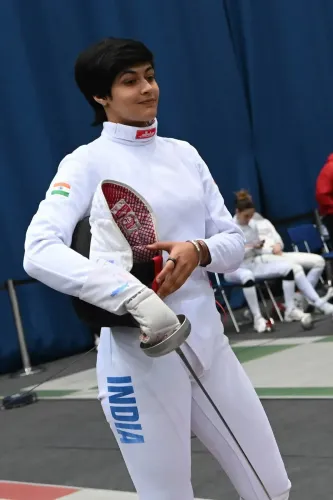
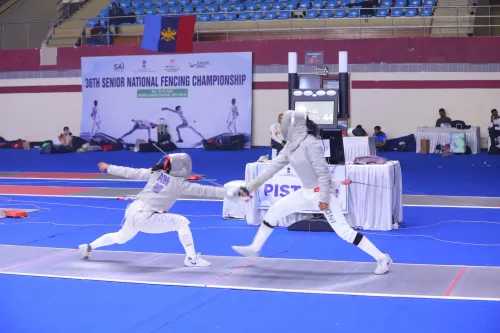
The Indian Women's Sabre team entered the direct elimination grid with a blend of veteran international exposure and emerging domestic talent. C.A. Bhavani Devi anchored the squad with her signature aggressive flèche attacks, generating crucial point swings during her relay legs, while teammates Shreya Gupta, Jefarlin J.S., and Shruti Joshi matched the blade-speed of their opponents in the opening rotations. The team was ultimately eliminated by a heavily favoured East Asian contingent, but their technical cohesion and point aggregation signalled a narrowing gap with the regional elite.
In Men's Epee, Joseph Bennet teamed with Sherjin Rajendran Shanthimol, Aloshious Koovakkal Joshy, and Shaurya Ashwini to navigate a grid dominated by Central Asian and Japanese systems. Sherjin and Joseph anchored the critical middle legs to keep point margins competitive, while Shaurya and Aloshious held their ground in high-pressure defensive standoffs. The podium remained out of reach, but the squad avoided a heavy defeat and, according to team management, established a structural benchmark for future development.
Road to LA 2028
With individual and core team events in these weapons now concluded at the 2026 Asian Senior Fencing Championships, the continental field has been pushed to its limit. For Team India, the collective discipline displayed on Day 5 is expected to inform preparations as the national programme builds toward the LA 2028 Olympic Games. The final high-intensity phases of the tournament are set to follow in the coming days.
Point of View
One that will complicate qualification calculus ahead of Aichi-Nagoya. For India, the more honest takeaway from Day 5 is not the absence of medals but the presence of a coherent team structure: Bhavani Devi's relay anchor role and the Men's Epee squad's passivity management suggest a programme that is learning, even if it is not yet winning. The gap to the podium is real, but it is no longer structural — it is competitive, which is a different and more solvable problem.
NationPress
22 Sept 2026
Frequently Asked Questions
Who won the Women's Sabre Team gold at the 2026 Asian Senior Fencing Championship?
South Korea won the Women's Sabre Team gold at the 26th Asian Senior Fencing Championship 2026, held at Bharat Mandapam in New Delhi on 23 June. The squad was spearheaded by individual silver-medallist Choi Sebin and defeated Japan in the final.
Who won the Men's Epee Team gold at the 2026 Asian Fencing Championship?
Kazakhstan claimed the Men's Epee Team gold, defeating Japan in a gruelling final. The Kazakh team was led by veteran fencer Ruslan Kurbanov, while Japan's squad included individual champion Yamada Masaru and Olympic gold medallist Kano Koki.
How did India perform on Day 5 of the Asian Senior Fencing Championship 2026?
India did not reach the medal rounds in either the Women's Sabre or Men's Epee team events. C.A. Bhavani Devi anchored the women's squad, while Joseph Bennet led the men's epee team; both sides showed competitive discipline but were eliminated by higher-ranked East Asian and Central Asian opponents.
Where is the 26th Asian Senior Fencing Championship 2026 being held?
The 26th Asian Senior Fencing Championship 2026 is being held at Bharat Mandapam in New Delhi, India. Day 5 of the competition took place on Tuesday, 23 June 2026.
Why are the Asian Senior Fencing Championship results significant?
The results carry qualification points for the Aichi-Nagoya Asian Games, making every team event outcome directly relevant to nations' Games berths. The championship also serves as a key performance benchmark on the road to the LA 2028 Olympic Games.