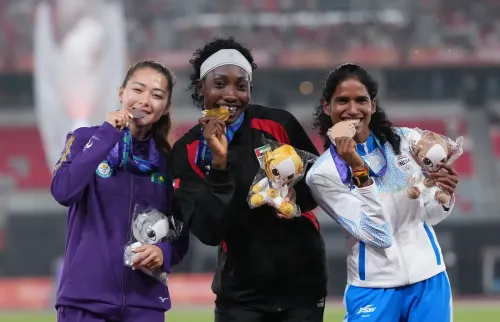
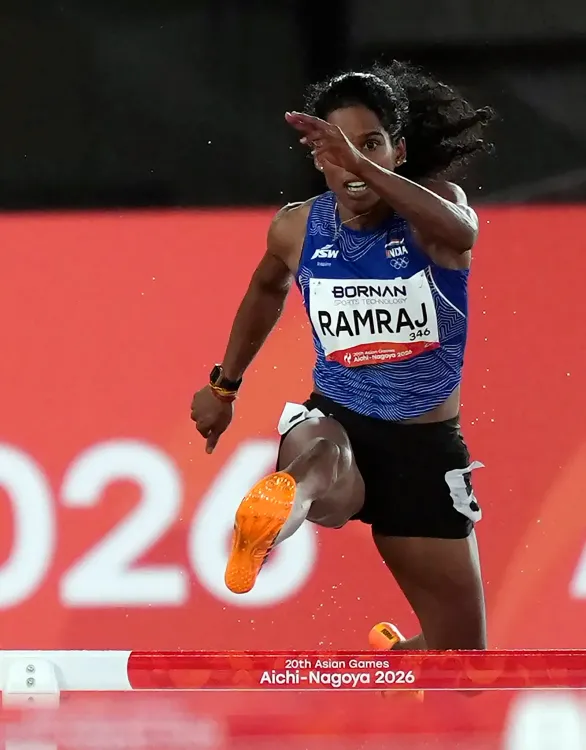
Vithya Ramraj breaks PT Usha's 42-year record, wins Asian Games bronze
Synopsis
For 42 years, P. T. Usha's 400m hurdles national record survived everything Indian athletics could throw at it. In Nagoya on Monday, Vithya Ramraj finally ended that wait — clocking 54.75 seconds for Asian Games bronze and rewriting history. The achievement is as much about a ₹15,000-a-month driver father and a twin sister's quiet support as it is about a stopwatch.
Key Takeaways
Vithya Ramraj clocked 54.75 seconds in the women's 400m hurdles final at the Asian Games 2026 in Nagoya on 28 September 2026 .
Usha's 42-year-old national record of 55.42 seconds , set at the 1984 Los Angeles Olympics .
Vithya dedicated the medal to her twin sister Vidya Ramraj , citing her constant personal support.
She credited TOPS , her state government, JSW , and Indian Railways for funding and stability that enabled her to train without financial pressure.
Her father, a driver earning ₹15,000 a month , funded her early athletic career despite significant financial hardship.
This is Vithya's second successive Asian Games bronze in the event, after her medal at Hangzhou 2023 .
Vithya Ramraj on Monday, 28 September 2026 shattered a 42-year-old national record set by legendary sprinter P. T. Usha, clocking 54.75 seconds to win the bronze medal in the women's 400 metres hurdles at the Asian Games 2026 in Nagoya. The performance erased Usha's mark of 55.42 seconds, set at the 1984 Los Angeles Olympics — one of the longest-standing records in Indian athletics.
A Dedication and a Backstory
In the immediate aftermath of the race, Vithya had one person on her mind. 'I dedicate this medal to my twin sister, Vidya Ramraj,' she said. 'Because she is always there for me. She always supports me. Whenever I ask her for anything, she sends it to me. I'm happy.'
The dedication underlines a bond that stretches back to a childhood of financial hardship. Vithya recalled that her family lived in a rented house and that her father — who worked as a driver earning around ₹15,000 a month — faced social pressure over raising three daughters. 'When we were growing up, people used to say, "The children are getting older, what are you going to do?" Even my grandmother and father were told, "You have three girls, so what are you going to do with them?"' she said.
Despite tight finances, her father continued investing in his daughters' athletic careers. 'Even the shoes used to cost ₹2,000 to ₹5,000 back in 2009. He still spent that money on us. When my twin sister and I were doing two sports together, everything — dresses, shoes and equipment — cost too much, but he managed to do it. That's why we are here,' Vithya said.
The Coach Who Believed First
Vithya, now 28, credited her coach as the first to believe she could crack the 55-second barrier — a milestone she herself had doubted. 'No, I didn't believe it. Only my coach believed it. I believe in my coach, so whatever he says, I do. For so many years, I have been doing what he has told me to do. That's what happened,' she said.
The trust paid off in Nagoya, where Vithya ran the race of her life on a track she described as unusually fast. 'The track is so, so good. I feel like it is a speed track, so I'm very happy with the track,' she said.
Government and Corporate Support
Vithya also acknowledged the institutional backing that eased her path to the podium. She credited the Target Olympic Podium Scheme (TOPS), her state government, JSW, and Indian Railways — where she is employed — as pillars of support. 'TOPS is supporting me so much, and my state government is supporting me so much. JSW and Indian Railways are also supporting me so much. That's why I came here, and now I'm so happy. I'm not facing any struggles nowadays,' she said.
Her remarks point to the growing role of public-private partnerships in Indian athletics — a shift that has allowed athletes from modest backgrounds to focus entirely on training and competition.
Race Result and Competition
Mariam Kareem of the UAE won gold in a Games record time of 54.31 seconds, while Adelina Zems of Kazakhstan took silver with a personal best of 54.58 seconds. Fellow Indian Anu Raghavan finished fifth, improving her personal best to 55.88 seconds from a previous 56.54 seconds.
Notably, Vithya had also won bronze in the same event at the 2023 Asian Games in Hangzhou, where she matched Usha's time without bettering it. Three years on, she finally went past the mark — making this her second successive Asian Games medal and first national record in the event.
What This Means for Indian Athletics
Usha's 400m hurdles record had stood for 42 years, surviving multiple generations of Indian sprinters. Its erasure signals a new ceiling for Indian women's track athletics and will likely intensify focus on the event ahead of the 2028 Los Angeles Olympics — the very venue where Usha set the original benchmark. With TOPS funding and Railway employment providing stability, Vithya's story may also serve as a template for how India nurtures athletes from economically vulnerable backgrounds.
Point of View
Indian athletics has a narrative gift — and a competitive obligation to match it.
NationPress
29 Sept 2026
Frequently Asked Questions
What record did Vithya Ramraj break at the Asian Games 2026?
Vithya Ramraj broke P. T. Usha's national record of 55.42 seconds in the women's 400 metres hurdles, which had stood since the 1984 Los Angeles Olympics. Her new mark of 54.75 seconds, set in Nagoya on 28 September 2026, is now the fastest ever by an Indian woman in the event.
Why did Vithya Ramraj dedicate her medal to Vidya Ramraj?
Vithya dedicated the bronze medal to her twin sister Vidya because, in her words, 'she is always there for me' and provides unconditional support. The two sisters trained together from a young age, and Vidya's continued backing has been a source of strength throughout Vithya's career.
What support did Vithya Ramraj receive on her journey to the Asian Games?
Vithya received support from the Target Olympic Podium Scheme (TOPS), her state government, JSW, and Indian Railways, where she is employed. She has said this backing removed the financial pressures she and her family faced earlier in her career.
How did Vithya Ramraj's family overcome financial hardship to support her athletics?
Vithya's father worked as a driver earning approximately ₹15,000 a month, yet continued to fund running shoes costing ₹2,000 to ₹5,000 and other equipment for both Vithya and her twin sister during their early training years from around 2009. The family also lived in a rented house and faced social scrutiny for investing in three daughters' futures.
Who won gold and silver in the women's 400m hurdles at Asian Games 2026?
Mariam Kareem of the UAE won gold in a Games record time of 54.31 seconds, and Adelina Zems of Kazakhstan took silver with a personal best of 54.58 seconds. Vithya Ramraj of India finished third with 54.75 seconds, breaking the national record in the process.