Did Rovman Powell Aim for Maximum Sixes in His 100th T20I?

Synopsis
In an electrifying start to the T20I series against Bangladesh, the West Indies claimed a 16-run victory, led by the remarkable performances of Shai Hope and Rovman Powell. Celebrating his 100th T20I, Powell shared insights into his batting strategy and praised his teammates and bowlers for their crucial contributions.
Key Takeaways
Rovman Powell celebrated his 100th T20I with a remarkable performance.
The West Indies secured a 16-run victory against Bangladesh in their opening match.
Effective bowling by Jayden Seales and Jason Holder played a critical role in restricting the opposition.
Powell's strategy involves maximizing sixes during the last five overs.
The team must adapt to varying pitch conditions for future matches.
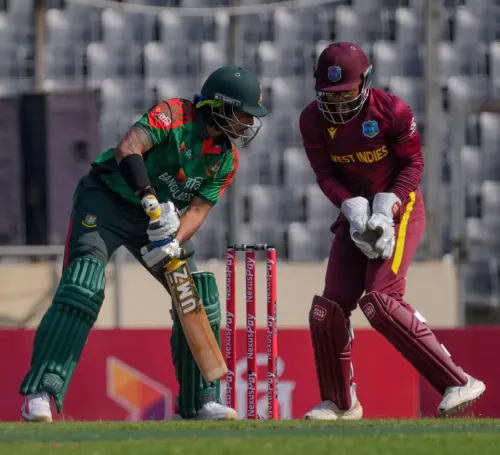
Chattogram, Oct 28 (NationPress) The West Indies launched their T20I series against Bangladesh with an impressive performance, as Shai Hope and Rovman Powell's explosive batting led the team to a 16-run victory. Powell expressed his joy over his notable performance in his 100th T20I appearance for the nation.
After being awarded the Player of the Match for his dynamic innings, Powell reflected on the batting strategy he has adopted over the last couple of years, noting that his dedication has finally yielded results.
"I am extremely thrilled. Not everyone gets the opportunity to play 100 T20Is, particularly for the West Indies. It reflects the dedication I've put into my career. I owe a lot to my family, friends, and the teammates I've shared these 100 matches with. Receiving the Man-of-the-Match award in my 100th game is truly special.
"I believe in the batting approach I have implemented over the past year or two. It has brought me significant success. My aim is to establish a solid start and then, during the last five overs, to hit as many sixes as possible," Powell stated after the match.
The middle-order batsman also praised the bowlers for their timely strikes that kept the opposition’s run chase within reach. Bangladesh was dismissed for 149 in 19.4 overs, thanks to three wickets each from Jayden Seales and Jason Holder.
“Had one of the key Bangladeshi batsmen batted longer, we could have faced pressure. It was quite damp towards the end. Nonetheless, we owe a lot to our bowlers who adhered to their strategies and took wickets at crucial moments. We had insights about the ground conditions, but we weren’t prepared for how wet it became. Perhaps we should factor that into our future plans,” he concluded.
Point of View
It is evident that their blend of solid batting and effective bowling strategies has set a positive tone. Rovman Powell's milestone performance serves as a reminder of the talent within the team, and it is crucial for them to continue this momentum throughout the series. NationPress remains committed to delivering insightful coverage of our national teams' journeys in the international arena.
NationPress
22 Sept 2026
Frequently Asked Questions
What was Rovman Powell's achievement in the match?
Rovman Powell celebrated his 100th T20I match and was awarded the Player of the Match for his impactful innings.
How did the West Indies perform against Bangladesh?
The West Indies secured a 16-run victory against Bangladesh, showcasing strong performances from key players.
Who were the key bowlers for the West Indies?
Jayden Seales and Jason Holder were the standout bowlers, each taking three wickets to restrict Bangladesh's scoring.
What batting strategy did Powell emphasize?
Powell mentioned focusing on getting a strong start and aiming to hit as many sixes as possible in the final overs.
What challenges did the bowlers face during the match?
The bowlers had to contend with wet conditions towards the end of the game, which could have influenced the match's dynamics.