Government Launches 30 kW Indigenous Drive System to Enhance EV Mobility
Synopsis
In a groundbreaking initiative, the government has unveiled a 30 kW Integrated Drive System designed to bolster electric vehicle mobility in India. This development promises to reduce import dependency and foster local manufacturing capabilities.
Key Takeaways
30 kW Integrated Drive System developed to enhance EV technology.
Collaborative effort between C-DAC, IIT Madras, and Lucas TVS.
Aims to reduce import dependency for EV components.
Supports India's vision of becoming a leader in electric mobility.
Aligns with the ‘Make in India’ initiative for local manufacturing.
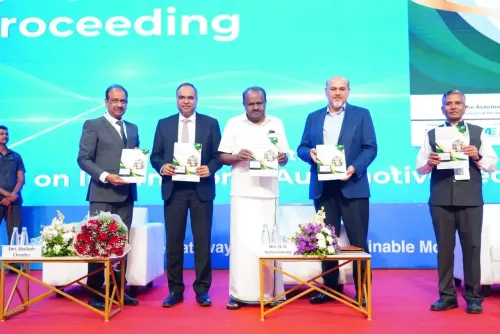
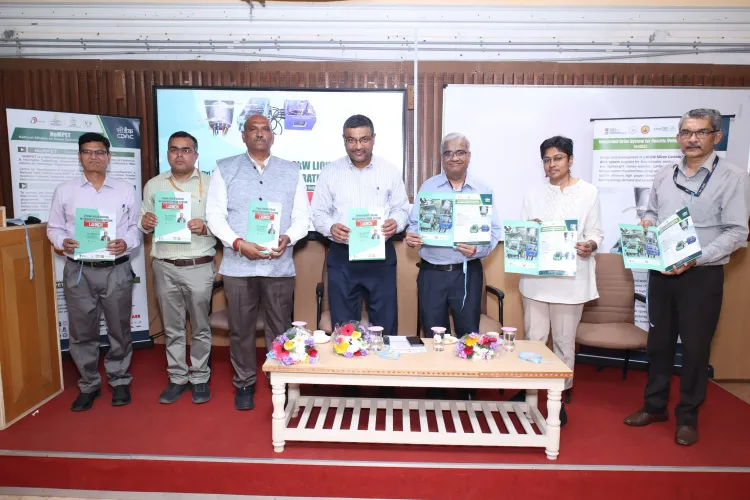
New Delhi, March 2 (NationPress) In a significant move to enhance local expertise in advanced power electronics, the government on Monday introduced a 30 kW Wide Band Gap (WBG)-based Integrated Drive System (IDS) for electric vehicles (EVs) at IIT Madras.
This innovative system has been created by the Centre for Development of Advanced Computing (C-DAC) in Thiruvananthapuram, in partnership with the Indian Institute of Technology Madras and Lucas TVS, as part of the National Mission on Power Electronics Technology (NaMPET), as reported by the Ministry of Electronics and Information Technology (MeitY).
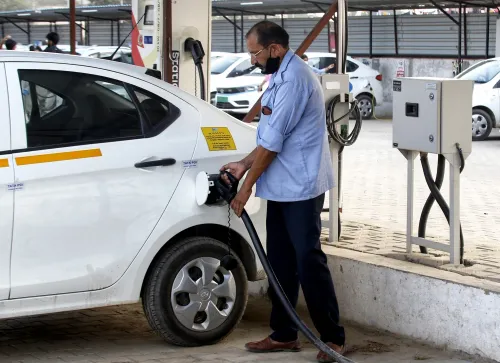
The 30 kW power class is especially pertinent to India's rapidly expanding electric passenger vehicle market, which encompasses compact cars and fleet mobility services.
Currently, a significant portion of high-performance EV powertrain systems and key semiconductor-based drive components are imported.
The local development of such integrated systems is anticipated to diminish import reliance, reduce system costs via localization, and foster scalable manufacturing in line with national programs like the Production-Linked Incentive (PLI) schemes, according to the ministry.
During the technology launch, IT Secretary S. Krishnan remarked that Prime Minister Narendra Modi’s vision of “Make in India, Make for the World” is being actualized with the local advancement of sophisticated power electronics technologies.
Krishnan emphasized that India's evolution from a technology-importing nation to one that develops and exports technology is being fortified through collaborative innovation among research institutions, academic circles, and industry.
The introduction of the 30 kW Integrated Drive System marks a crucial milestone in India's quest for ‘Aatmanirbhar Bharat’ in electric mobility and strategic electronics.
This system consolidates the electric motor and inverter into a single compact unit with high power density, replacing the traditional separate motor-drive setup. Design-driven innovation in India is expected to foster robust domestic intellectual property, expedite the startup ecosystem, and bolster high-value manufacturing in the EV sector,” Krishnan added.
The government believes that the successful integration of this drive technology could significantly fortify India's EV supply chain, create opportunities for MSMEs in power electronics manufacturing, thermal systems, and control hardware, and elevate India’s competitiveness on a global scale in semiconductor-driven electric mobility solutions.
Point of View
The unveiling of the 30 kW Integrated Drive System represents a pivotal shift in India's approach to electric mobility. It highlights the government's commitment to fostering indigenous technology and reducing dependence on imports, which is crucial for economic growth and sustainability.
NationPress
28 Sept 2026
Frequently Asked Questions
What is the significance of the 30 kW Integrated Drive System?
The 30 kW Integrated Drive System is significant as it enhances India's capabilities in electric vehicle technology, reduces import dependency, and supports local manufacturing initiatives.
Who developed the Integrated Drive System?
The system was developed by the Centre for Development of Advanced Computing (C-DAC) in collaboration with IIT Madras and Lucas TVS.
How does this technology impact the electric vehicle market in India?
This technology is expected to support the rapidly growing electric passenger vehicle segment, including compact cars and fleet mobility, by providing a more efficient powertrain solution.
What are the benefits of indigenous development in power electronics?
Indigenous development is anticipated to lower costs, reduce reliance on imports, and foster innovation in the manufacturing sector.
How does this initiative align with national policies?
This initiative aligns with national policies such as the Production-Linked Incentive (PLI) schemes aimed at boosting local manufacturing and technology development.