400 Indian-origin scholars from 27 nations condemn 'anarchic' street protests

Synopsis
Over 400 Indian-origin scholars at elite global universities — from MIT and Oxford to Harvard and LSE — have signed a statement titled 'Spare India from Anarchy', warning that street protests are being weaponised to delegitimise India's constitutional institutions. Invoking Ambedkar's warning against 'the grammar of anarchy', the statement spans 27 countries and reads as a pointed rebuke to opposition protest politics.
Key Takeaways
Over 400 Indian-origin students, researchers, and alumni from 27 countries signed the statement titled 'Spare India from Anarchy' on 19 October 2026 .
Signatories are affiliated with MIT , Oxford , Cambridge , Harvard , Stanford , Yale , Princeton , Columbia , LSE , and the National University of Singapore , among others.
The statement condemns the use of street protests and 'sub-judice matters' to undermine confidence in Indian constitutional institutions.
The signatories invoke Dr B.R.
Ambedkar's warning against the 'grammar of anarchy' to make their case for constitutional methods of dissent.
Named signatories include scholars from Harvard , Stanford , Cambridge , and Oxford , spread across the US, UK, South Korea, and beyond.
More than 400 Indian-origin students, researchers, and alumni from universities across 27 countries have signed a joint statement condemning what they describe as a coordinated effort to undermine confidence in India's constitutional institutions, and the deployment of 'anarchic' street protests to delegitimise democratic processes. The statement, titled 'Spare India from Anarchy', was circulated on Monday, 19 October 2026.
Who Signed and Where They Come From
The signatories are affiliated with some of the world's most prominent academic institutions, including the Massachusetts Institute of Technology (MIT), University of Oxford, University of Cambridge, Princeton University, Harvard University, Yale University, Stanford University, Columbia University, the London School of Economics (LSE), and the National University of Singapore.
They are currently based in or have studied in the US, UK, Canada, Australia, Germany, France, the Netherlands, Ireland, Italy, Spain, Sweden, Norway, Poland, Ukraine, Russia, South Korea, Japan, Singapore, Malaysia, Israel, the UAE, Kazakhstan, Georgia, and the Philippines, among others.
Key Arguments in the Statement
The statement warns against what the signatories call an attempt to subvert constitutional democracy under the pretext of defending it. It states: 'An unconscionable and devious plan of sowing seeds of doubt in Indian democracy has been hatched by weaponising sub-judice matters, which is then amplified on the streets by leaning on anarchist forces, which have historically and philosophically never believed in constitutional form of governance. All in the name of saving democracy. We remain amazed at the irony of all.'
The scholars invoked Dr B.R. Ambedkar, the principal architect of the Indian Constitution, who had cautioned future generations to 'hold fast to constitutional methods… abandon the bloody methods of revolution (which are) the grammar of anarchy.' The signatories argue that anarchy is increasingly becoming an expression of political choice, threatening to supplant constitutional values.
The Call to Action
The statement urges all social and political forces to resolve differences through dialogue within constitutional frameworks. 'We urge all social and political forces to take cognisance of our distress and desires and resolve differences through debate, discussion, dialogue and dissent under the roof of constitutional institutions that our venerable founding fathers created for us. India needs to set an example for the democratic world, for all the right reasons. We hope wisdom will prevail,' the statement reads.
The signatories describe themselves as people who 'travel the world identifying as Indians' and say they are 'deeply anguished' at the current state of affairs.
Named Signatories
Among the identified signatories are Surabhi Hodigere of Harvard University; Devansh Sharma and Samyukta Shrivatsa of Stanford University; Ashik Mayakonda of the University of Cambridge; Nitish Rai Parwani, Ashish Gaurav, Shaoni Kar, and Mukund Madhav Sharma of the University of Oxford; Niyati Yadav of the University of Manchester; and Rajneesh Kumar Mishra of Yeungnam University (YNU).
Broader Context
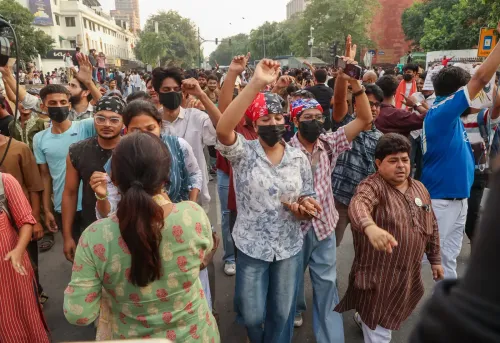
The statement comes amid heightened political tensions in India, with opposition groups holding street protests over what they describe as threats to democratic institutions. Notably, this is not the first time diaspora academics have weighed in on India's domestic democratic debate — but a coordinated sign-on spanning 27 countries and elite institutions across multiple continents marks a significant escalation in the volume and reach of such interventions. Whether the statement shifts the political conversation or is absorbed into existing partisan frameworks remains to be seen.
Point of View
One that the statement's detractors will argue selectively weaponises the Constitution's architect. The breadth of institutions represented — from MIT to LSE — lends the statement credibility in Western academic circles, though critics will question whether scholars based abroad are best placed to judge the conditions that drive domestic protests. What the statement does not do is engage with the substance of the grievances animating those protests, which risks making it read as a procedural argument rather than a substantive rebuttal. The real test is whether this kind of diaspora intervention influences the political centre in India, or merely reinforces existing camps.
NationPress
19 Oct 2026
Frequently Asked Questions
What is the 'Spare India from Anarchy' statement?
It is a joint statement signed by over 400 Indian-origin students, researchers, and alumni from universities across 27 countries, condemning what they describe as the use of street protests and sub-judice matters to undermine India's constitutional institutions. The statement was circulated on 19 October 2026.
Which universities are represented among the signatories?
The signatories are affiliated with institutions including MIT, Harvard, Stanford, Yale, Princeton, Columbia, the University of Oxford, the University of Cambridge, the London School of Economics, and the National University of Singapore, among others.
Why do the scholars invoke Dr B.R. Ambedkar?
The scholars cite Ambedkar's warning to future generations to 'hold fast to constitutional methods' and avoid 'bloody methods of revolution,' which he called 'the grammar of anarchy.' They use this to argue that current street protests are antithetical to the constitutional values Ambedkar espoused.
Which countries are the signatories based in?
The signatories are based in or have studied in over 27 countries, including the US, UK, Canada, Australia, Germany, France, Japan, South Korea, Singapore, Israel, the UAE, and the Philippines, among others.
What do the signatories want political parties and social groups to do?
The signatories urge all social and political forces to resolve differences through 'debate, discussion, dialogue, and dissent' within constitutional institutions, rather than through street protests or by amplifying sub-judice matters in the public domain.