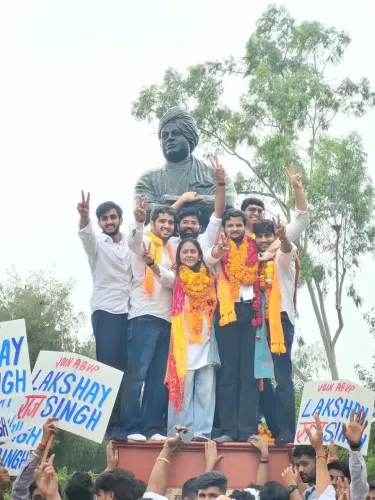
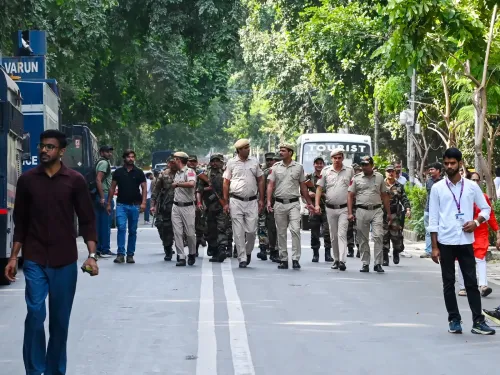
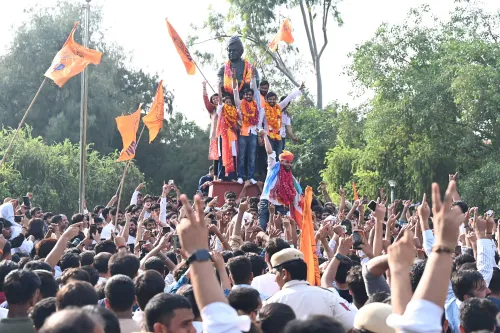
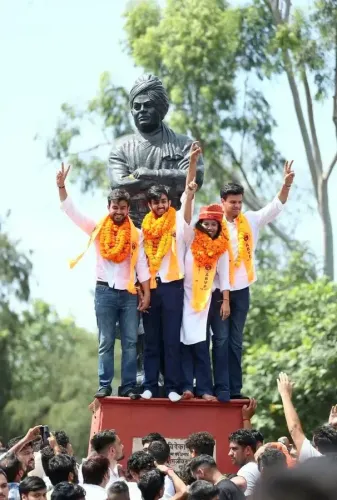
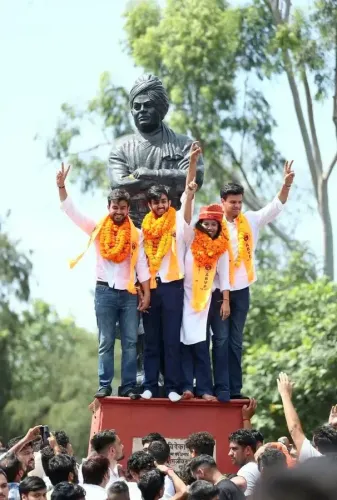
ABVP wins DUSU 2026: President, secretary and joint secretary posts swept

Synopsis
ABVP has swept the DUSU 2026 elections, taking president, secretary and joint secretary — a clean shut-out for the NSUI at a university BJP calls 'mini-India'. The BJP is framing the result as proof that nationalist, growth-oriented politics resonates with young voters, while critics caution against over-reading a campus poll as a national mandate.
Key Takeaways
The ABVP won the president , secretary , and joint secretary posts in the DUSU 2026 elections.
The NSUI , which had dominated DUSU politics in earlier decades, is reported to have won zero posts in this contest.
Delhi University is regarded as a 'mini-India', drawing students from diverse regions and backgrounds across the country.
The ABVP reportedly performed strongly in North Campus , which includes institutions such as SRCC , Hindu College , and Hansraj College .
BJP leaders have framed the results as evidence of youth alignment with nationalist and growth-oriented values.
The Akhil Bharatiya Vidyarthi Parishad (ABVP) has secured a decisive sweep in the Delhi University Students' Union (DUSU) elections, claiming the posts of president, secretary, and joint secretary. The results, declared on 19 September 2026, are being read by political observers as a reflection of shifting youth preferences at one of India's most nationally representative universities.
Why Delhi University Results Carry National Weight
Delhi University is widely described as a 'mini-India' — drawing students from diverse regions, social backgrounds, and communities across the country. Analysts note that its cosmopolitan character makes electoral outcomes there far more politically significant than those at most other institutions. According to observers, the ABVP's performance at such a diverse campus carries a political message that extends well beyond the university's gates.
The ABVP's reported dominance in North Campus has further amplified the significance of the result. The area houses some of India's most reputed colleges, including Shri Ram College of Commerce (SRCC), Hindu College, Hansraj College, Kirori Mal College (KMC), Ramjas College, and the Faculty of Law. Analysts argue that strong support in these institutions — known for their academically diverse and aspirational student bases — lends added credibility to the outcome.
ABVP's Political Reading of the Mandate
Bharatiya Janata Party (BJP) leaders have framed the results as evidence of youth resonance with growth-oriented and nationalist values. In their assessment, the outcome signals that young, aspirational voters across India's most mainstream university are aligning with a particular political and ideological direction.
The ABVP has also used the results to sharpen its critique of the Indian National Congress and its student wing. The organisation argues that attempts to influence young voters through what it characterises as misleading political messaging — invoking the phrase 'Jhooth Ki Goonj' — failed to find traction at Delhi University. According to BJP leaders, the outcome demonstrates that 'Congress-style politics' has lost its hold on India's youth.
The NSUI Factor and a Shifting Student Politics Landscape
The contest also marks a notable moment in the historical rivalry between the ABVP and the National Students' Union of India (NSUI). The NSUI, which had dominated DUSU politics during extended stretches in earlier decades, is described in BJP's political assessment as having been reduced to zero wins in the current elections. Critics, however, caution that student union results — often influenced by local campus dynamics, candidate popularity, and voter turnout patterns — should not be read too broadly as a national political verdict.
What Political Observers Are Saying
Political analysts note that the results offer the ABVP a platform to reinforce its narrative connecting with students who identify with themes of national pride and economic aspiration. However, observers also point out that student union elections frequently turn on local issues, college-level loyalties, and organisational strength on the ground rather than purely ideological alignment. The ABVP's deep organisational presence across Delhi University campuses has historically been a structural advantage in these contests.
As student politics at India's premier universities continues to evolve, the DUSU 2026 result sets the stage for intensified competition between student outfits ahead of the broader political calendar.
Point of View
But the BJP's leap from a student union result to a national youth mandate deserves scrutiny. Delhi University elections are as much about campus networks, candidate visibility, and booth management as they are about ideology — the ABVP has long held a structural ground advantage here. That the NSUI was shut out is significant, but the Congress's student wing has been in organisational decline for years; the result reflects that slide as much as any ideological tide. The more meaningful question is whether the ABVP can translate campus dominance into durable policy engagement with youth concerns — jobs, education costs, and campus safety — rather than using the win purely as a political messaging exercise.
NationPress
19 Sept 2026
Frequently Asked Questions
Which posts did the ABVP win in the DUSU 2026 elections?
The ABVP won the president, secretary, and joint secretary posts in the Delhi University Students' Union (DUSU) 2026 elections. The results were declared on 19 September 2026.
What happened to the NSUI in the DUSU 2026 elections?
According to BJP leaders, the NSUI — which had dominated DUSU politics during extended periods in earlier decades — was reduced to zero wins in the current contest. The party has characterised this as a sign that Congress-aligned student politics has lost its connect with youth.
Why are the DUSU election results seen as politically significant?
Delhi University is widely described as a 'mini-India' due to its diverse, pan-India student base. Political observers note that electoral outcomes at such a mainstream institution are often read as broader indicators of youth political sentiment, beyond just campus politics.
How has the ABVP performed in Delhi University's North Campus?
The ABVP reportedly performed strongly in North Campus, which houses institutions such as SRCC, Hindu College, Hansraj College, Kirori Mal College, Ramjas College, and the Faculty of Law. Analysts say strong support in these academically reputed colleges adds to the significance of the sweep.
What is the ABVP's political message from the DUSU win?
The ABVP and BJP leaders have framed the result as evidence that growth-oriented and nationalist values resonate with young, aspirational voters. The ABVP also argued that attempts to influence students through what it calls misleading political messaging — described using the phrase 'Jhooth Ki Goonj' — did not succeed at Delhi University.