AIADMK reconciliation talks gain ground after TN Cabinet expansion
Synopsis
AIADMK's internal rebellion is showing signs of cooling — but reunification comes with strings attached. The EPS camp wants the rebel faction's Election Commission petition withdrawn first; dissidents want sacked functionaries reinstated. With TN CM Vijay's Cabinet expansion apparently shifting rebel calculations, both sides are talking — just not yet face to face.
Key Takeaways
Informal 'negotiation teams' of senior AIADMK well-wishers are maintaining back-channel contacts between the EPS camp and the rebel group led by C.
The EPS faction has reportedly demanded withdrawal of the rebel camp's petition before the Election Commission of India as a pre-condition for talks.
Rebel leaders have demanded reinstatement of party functionaries removed in recent disciplinary action before formal discussions begin.
The rebel faction clarified that its ECI petition under Paragraph 15 of the Election Symbols Order was not intended to freeze the 'Two Leaves' symbol and can be withdrawn if both sides reach an understanding.
Joseph Vijay expanded his Cabinet to 35 members , inducting VCK MLA Vanni Arasu and IUML MLA A.M.
Shahjahan , a move seen as altering rebel calculations.
Velumani publicly denied any party split and urged EPS to discuss the AIADMK's electoral performance — a widely noted shift in tone.
Reconciliation efforts within the AIADMK are gaining momentum in Chennai, with informal back-channel contacts activated between the faction led by party general secretary Edappadi K. Palaniswami (EPS) and the rebel group headed by C. Ve. Shanmugam and S.P. Velumani. The thaw, political observers note, follows the apparent loss of steam in the internal rebellion after Tamil Nadu Chief Minister C. Joseph Vijay completed his Cabinet expansion by inducting legislators from alliance partners VCK and IUML.
Back-Channel Contacts and Competing Conditions
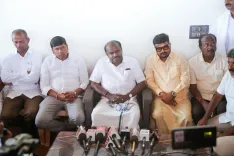
According to party sources, 'negotiation teams' comprising senior well-wishers and leaders are working behind the scenes to bridge the divide. The intermediaries are maintaining contacts with both camps, though formal unity talks are yet to begin.
The EPS camp has reportedly set a firm pre-condition: the rebel faction must withdraw its representation before the Election Commission of India (ECI) before any reconciliation process can advance. The dissidents, in turn, are said to have demanded the reinstatement of party functionaries removed during recent disciplinary action before formal discussions proceed.
The Election Commission Petition Explained
The dispute sharpened after rebel leaders approached the ECI under Paragraph 15 of the Election Symbols (Reservation and Allotment) Order, 1968 — a provision that governs disputes involving splinter groups or rival factions within recognised political parties.
However, leaders close to the dissident camp have clarified that the petition was not filed to seek a freeze on the party's iconic 'Two Leaves' symbol. 'This petition can be withdrawn if both sides arrive at a common understanding,' a source associated with the rebel camp said, signalling that the door to negotiation remains open.
How the Cabinet Expansion Shifted the Calculus
The reconciliation signals emerged shortly after Chief Minister Vijay expanded his ministry by inducting VCK legislator Vanni Arasu and IUML MLA A.M. Shahjahan, taking the cabinet's strength to 35 members. Political observers believe the expansion altered the strategic calculations of dissident leaders, who had reportedly been banking on the Cabinet formation to leverage pressure on the ruling alliance.
Following the expansion, S.P. Velumani publicly asserted that there was no split within the AIADMK and called on EPS to initiate discussions on the party's disappointing electoral performance — a statement widely read as an olive branch.
What This Means for AIADMK's Opposition Role
The AIADMK, Tamil Nadu's principal opposition party, is attempting to rebuild after a significant electoral setback. A prolonged internal fracture risks ceding political ground to other opposition formations. Political circles are closely watching whether the current back-channel activity translates into a formal reunification process, and whether both camps can agree on the sequencing of their respective pre-conditions.
The coming weeks will be critical in determining whether the AIADMK emerges from this phase as a consolidated opposition force or remains divided ahead of the next electoral cycle.
Point of View
But the sequencing problem is real: each side wants the other to blink first. The EPS camp's insistence on ECI petition withdrawal before talks, and the rebel demand for reinstatement before talks, creates a classic pre-condition deadlock. What has changed is the incentive structure — Vijay's Cabinet expansion removed a key pressure point the rebels were reportedly counting on. The deeper question mainstream coverage underplays is whether this is genuine reconciliation or tactical repositioning ahead of local body elections. An AIADMK that enters the next cycle divided hands the DMK a structural advantage it does not need to earn.
NationPress
6 Oct 2026
Frequently Asked Questions
Why is AIADMK facing an internal rebellion?
The AIADMK is dealing with a factional dispute between the party leadership under general secretary Edappadi K. Palaniswami and a rebel group led by C. Ve. Shanmugam and S.P. Velumani. The rift intensified after disciplinary action removed several functionaries, and the rebel camp subsequently approached the Election Commission of India under Paragraph 15 of the Election Symbols Order.
What is the Election Commission petition about?
The rebel faction filed a petition before the Election Commission of India under Paragraph 15 of the Election Symbols (Reservation and Allotment) Order, 1968, which deals with disputes involving splinter groups in recognised political parties. Leaders close to the dissident camp have clarified the petition was not aimed at freezing the party's 'Two Leaves' symbol and can be withdrawn if both sides reach an agreement.
What are the pre-conditions set by each side for reconciliation?
The EPS camp has reportedly demanded that the rebel faction withdraw its ECI petition before any formal reconciliation begins. The rebel camp, in turn, has demanded reinstatement of party functionaries removed during disciplinary action as a condition for entering formal unity talks.
How did Tamil Nadu CM Vijay's Cabinet expansion affect the AIADMK dispute?
Chief Minister C. Joseph Vijay expanded his Cabinet to 35 members by inducting VCK MLA Vanni Arasu and IUML MLA A.M. Shahjahan. Political observers believe this move altered the strategic calculations of the rebel faction, which had reportedly been using the Cabinet formation as a pressure point, and contributed to the current softening of positions.
What did S.P. Velumani say after the Cabinet expansion?
Following the Cabinet expansion, S.P. Velumani publicly asserted there was no split within the AIADMK and urged EPS to initiate discussions on the party's disappointing electoral performance — a statement widely interpreted as a shift toward reconciliation.