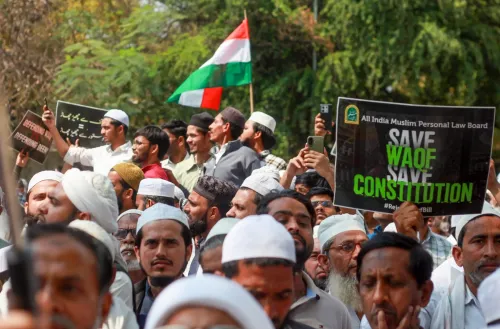
AIMPLB launches nationwide movement against mosque demolitions, Muslim marginalisation

Synopsis
The AIMPLB has moved beyond courtrooms into street-level mobilisation, constituting an Action Committee to build a nationwide movement against mosque demolitions, UCC expansion, and what it calls the systematic marginalisation of Muslims. With legal battles already filed in Nainital and more states adopting UCC frameworks, the Board is signalling this is a long campaign — not a one-off protest.
Key Takeaways
The AIMPLB Executive Committee on 22 June resolved to launch a nationwide movement against mosque demolitions and Muslim marginalisation.
An Action Committee has been constituted to coordinate with civil society and build a broad coalition.
The Board opposes UCC implementation in BJP-ruled states, citing Article 25 of the Constitution; it has already challenged Uttarakhand’s UCC in the Nainital High Court .
Assam , Madhya Pradesh , and Maharashtra are reportedly preparing to implement UCC, according to the Board.
The Board warned it will legally challenge any Central Government move to make Vande Mataram compulsory, and welcomed the Calcutta High Court stay on West Bengal’s school directive.
A comprehensive document on Muslim community conditions and rights violations is to be prepared and published.
The All India Muslim Personal Law Board (AIMPLB) on Monday, 22 June resolved to launch a nationwide movement against what it described as the “social and political marginalisation of Muslims and the demolition of mosques and madrasas.” The decision was taken at an Executive Committee meeting held in New Delhi, presided over by Board President Maulana Khalid Saifullah Rahmani.
Action Committee Constituted
The Executive Committee constituted a dedicated Action Committee to coordinate with what the Board called “democracy-loving and peace-loving sections of society.” According to a statement issued by the Board, the movement aims to highlight “the promotion of hatred and hostility, damage to communal harmony, and attacks on the life, property, honour and dignity of Muslims.” The Committee also resolved to prepare and publish a comprehensive document on the deteriorating condition of the Muslim community, communal tensions, and alleged violations of fundamental rights.
Opposition to Uniform Civil Code
The Board reiterated its opposition to the Uniform Civil Code (UCC), stating that its “forced implementation is contrary to the religious freedom guaranteed under Article 25 of the Constitution of India.” The Executive Committee expressed particular concern over ongoing legislative efforts in Bharatiya Janata Party (BJP)-ruled states. The meeting noted that after Uttarakhand and Gujarat, preparations are reportedly under way for UCC implementation in Assam, Madhya Pradesh, and Maharashtra. The Board said it has already challenged the Uttarakhand government’s UCC law in the Nainital High Court and will pursue similar legal action against comparable laws in other states.
Vande Mataram Row
The Board also took a firm position on the Vande Mataram debate, stating that attempts to make the song compulsory are contrary to Article 25 of the Constitution. The Board clarified that should the Central Government legislate to make Vande Mataram mandatory for all citizens or school students, it will challenge the move in court. Separately, the Executive Committee welcomed the interim order of the Calcutta High Court staying the West Bengal government’s directive requiring the singing of Vande Mataram in schools and madrasas. The Board stated that the song’s contents are contrary to the Islamic belief in Tawhid (the oneness of God) and therefore impermissible under Islamic law. It appealed to Muslims not to “compromise on their faith and beliefs in the name of tolerance or patriotism.”
Broader Context
The AIMPLB’s announcement comes amid a sustained period of legal and political contestation over minority rights, mosque demolitions linked to urban development projects, and the expanding scope of UCC legislation at the state level. This is among the Board’s most assertive public postures in recent years, signalling an intent to move beyond legal challenges into organised civil mobilisation. The forthcoming comprehensive document on Muslim community conditions is expected to serve as the movement’s foundational advocacy text.
Point of View
The Board’s primary tool was the courtroom; an organised nationwide movement represents a different kind of pressure — one aimed at shaping public narrative and building inter-community alliances. What is notable is the breadth of the grievances bundled together: mosque demolitions, UCC, and Vande Mataram are distinct legal and political issues, and packaging them into a single movement risks diluting the legal precision the Board has historically relied on. The real test will be whether the Action Committee can translate the resolution into sustained street presence, or whether this remains a statement of intent. Either way, with UCC expanding state by state, the Board cannot afford to fight these battles one high court at a time.
NationPress
21 Sept 2026
Frequently Asked Questions
What has the AIMPLB decided to do?
The All India Muslim Personal Law Board has resolved to launch a nationwide movement against mosque demolitions, madrasa demolitions, and the social and political marginalisation of Muslims. It has constituted an Action Committee to coordinate civil society outreach and will also pursue legal challenges against UCC laws in multiple states.
Which states are in the AIMPLB’s legal crosshairs over the UCC?
The Board has already filed a legal challenge against Uttarakhand’s UCC law in the Nainital High Court. It says it will take similar action against UCC legislation in Assam, Madhya Pradesh, and Maharashtra, where preparations are reportedly under way.
Why does the AIMPLB oppose Vande Mataram being made compulsory?
The Board holds that Vande Mataram’s contents conflict with the Islamic principle of Tawhid — the oneness of God — making it impermissible under Islamic law. It also argues that compelling citizens to sing it would violate Article 25 of the Constitution, which guarantees freedom of religion.
What did the Calcutta High Court rule on Vande Mataram?
The Calcutta High Court issued an interim order staying the West Bengal government’s directive that required schools and madrasas to have students sing Vande Mataram. The AIMPLB welcomed this order.
What is the Action Committee the AIMPLB has formed?
The Action Committee is a body constituted by the AIMPLB’s Executive Committee to coordinate the nationwide movement with what the Board describes as democracy-loving and peace-loving sections of society. It will also oversee the preparation of a comprehensive document on Muslim community conditions and rights violations.