Andaman and Nicobar Command Silver Jubilee: Conclave charts next 25 years
Synopsis
India's only Tri-Services Command marked 25 years with a strategic conclave that laid bare both its outsized importance — straddling the Strait of Malacca, through which 80 per cent of China's crude passes — and its persistent vulnerabilities, from logistical dependence on the mainland to an uninhabited archipelago that is nearly impossible to fully secure.
Key Takeaways
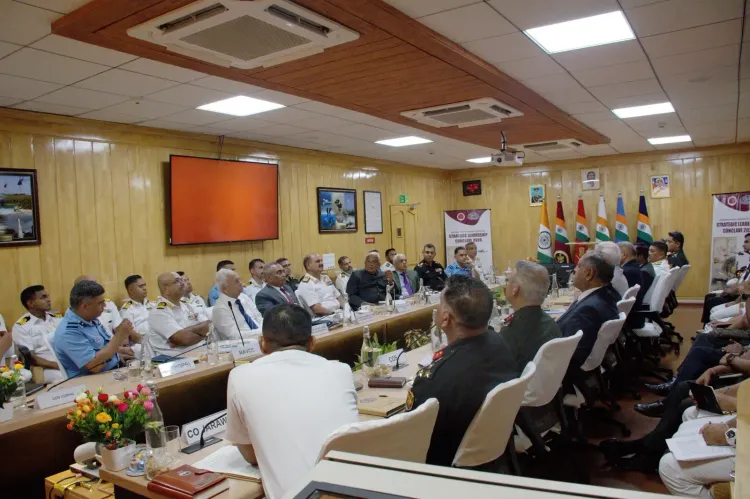
The Andaman and Nicobar Command (ANC) hosted a Strategic Leaders' Conclave on 11 October 2026 as part of its Silver Jubilee .
ANC is India's only Tri-Services Command , guarding 836 islands located 1,200 km from the mainland near the Strait of Malacca .
Roughly 35–40 per cent of global shipborne cargo and 80 per cent of China's crude oil imports transit the Strait of Malacca.
The conclave covered emerging maritime challenges, the future of India's Indo-Pacific strategy, and the Command's 25-year vision.
ANC's joint-service model is being studied as a template for India's planned theatre commands .
Persistent supply-chain vulnerabilities — including diesel-dependent electricity and mainland-reliant food supplies — continue to pose operational challenges.
The Andaman and Nicobar Command (ANC) hosted a Strategic Leaders' Conclave on Sunday, 11 October 2026, as part of its Silver Jubilee celebrations, bringing together former Commanders-in-Chief and senior military leaders to review two-and-a-half decades of progress and chart the Command's course for the future. The conclave underscored the growing strategic weight of the Andaman and Nicobar Islands in India's Indo-Pacific calculus.
What the Conclave Deliberated
Discussions ranged across the evolving strategic significance of the island chain, the importance of the Indian Ocean Region (IOR), and emerging maritime challenges. According to an ANC statement, deliberations also covered 'the future role of ANC in advancing India's maritime interests and strategic priorities in the Indo-Pacific.' The conclave additionally reviewed the Command's vision and priorities for the next 25 years, reaffirming ANC's identity as 'a strategic frontier and maritime arc of power.'
Why the Strait of Malacca Makes ANC Indispensable
India's only Tri-Services Command, the ANC was established to guard an archipelago of 836 islands — of which only 31 are inhabited — situated nearly 1,200 km from the mainland. The island chain sits astride the Strait of Malacca, the critical chokepoint that connects the Indian Ocean to the South China Sea and the Pacific. Roughly 35–40 per cent of global shipborne cargo, including oil and gas from the Middle East, transits this corridor. Notably, China routes nearly 80 per cent of its crude oil imports through the strait — a fact that allows Chinese military assets to patrol waters in close proximity to the Andamans.
The Jointmanship Imperative
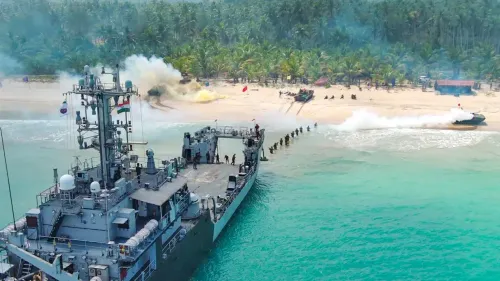
'Constant vigil has to be maintained. That is why the Navy, Air Force and Army has assets and work in coordination. The Indian Coast Guard also plays its role along the coast. There has to be completed synergy between all the components. This involves regular interactions and intelligence sharing. Jointmanship is crucial,' an official said. The ANC's model of inter-service coordination is being closely studied as India moves toward establishing theatre commands for the broader armed forces.
Beyond Defence: A Multi-Mission Command
The Command's mandate extends well beyond conventional defence. Officials noted that regular movement of poachers, smugglers, and traffickers from Bangladesh and Myanmar must be interdicted, while the 'rich but fragile marine ecosystem' around the islands requires active protection. Monitoring is also conducted to prevent insurgent groups from using the islands as a staging ground. The ANC regularly conducts marine search-and-rescue operations and evacuates injured or ill seafarers from passing merchant vessels, in addition to monitoring marine pollution.
Logistical Vulnerabilities Persist
The islands' near-total dependence on the mainland remains a structural challenge. Electricity is generated on the islands by diesel-powered generators, with the fuel shipped from the mainland. The precariousness of this supply chain was illustrated recently when a vessel carrying potatoes developed engine trouble and had to return to Kolkata, leaving the island chain temporarily short of the staple. These supply vulnerabilities add a logistical dimension to the Command's already complex operational profile.
As ANC enters its next quarter-century, the conclave's deliberations signal a Command that is rethinking its scope — from a regional maritime guardian to a pivotal node in India's broader Indo-Pacific strategy.
Point of View
The Command remains the only proof-of-concept for joint inter-service operations India has — and yet it still relies on mainland diesel to keep the lights on. If India cannot solve basic logistics for its most strategically sensitive archipelago, scaling that model to full theatre commands will be a formidable challenge. The Strait of Malacca dimension — with 80 per cent of China's crude passing through — gives the ANC genuine coercive leverage, but leverage only matters if the Command has the assets and sustainability to act on it.
NationPress
12 Oct 2026
Frequently Asked Questions
What is the Andaman and Nicobar Command (ANC)?
The Andaman and Nicobar Command is India's only Tri-Services Command, established to protect the Andaman and Nicobar archipelago of 836 islands located roughly 1,200 km from the mainland. It integrates the Navy, Army, Air Force, and Indian Coast Guard under a unified command structure, and is the sole Indian military model of its kind currently operational.
Why is the Andaman and Nicobar Command strategically important?
The island chain sits at the mouth of the Strait of Malacca, through which 35–40 per cent of global shipborne cargo and nearly 80 per cent of China's crude oil imports pass. This position gives India significant maritime surveillance capability and strategic leverage in the Indo-Pacific region.
What did the Silver Jubilee conclave focus on?
The conclave, held on 11 October 2026, reviewed 25 years of ANC operations and deliberated on emerging maritime challenges, the strategic importance of the Indian Ocean Region, and the Command's vision for the next 25 years. It reaffirmed ANC's role as a 'strategic frontier and maritime arc of power' in India's Indo-Pacific strategy.
What is the relevance of ANC to India's theatre command plans?
ANC is currently India's only functioning joint inter-service command, making it a critical reference point as the country plans to establish broader theatre commands. Its experience in integrating Navy, Army, and Air Force assets — along with intelligence sharing and jointmanship — is seen as a model for the planned restructuring of India's armed forces.
What are the key operational challenges facing the ANC?
The Command faces a combination of security and logistical challenges: interdicting poachers, smugglers, and traffickers from Bangladesh and Myanmar; protecting a fragile marine ecosystem; monitoring for insurgent activity; and conducting search-and-rescue operations. Logistically, the islands depend on the mainland for diesel and basic supplies, creating supply-chain vulnerabilities that periodically affect daily life and operations.