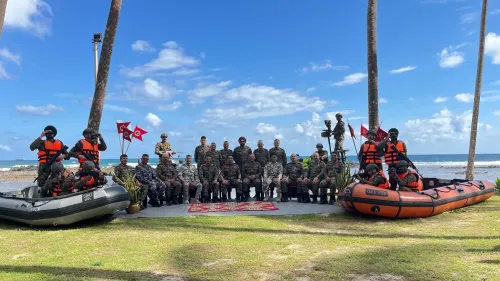
Andaman and Nicobar Command briefs War College officers on amphibious ops
Synopsis
India's only tri-service command, the Andaman and Nicobar Command, took its case to the Army's War College in Mhow — outlining how 805 uninhabited islands, a fleet of landing crafts, and LPD-equipped naval assets position the ANC as a potent amphibious force in the Indo-Pacific. The historical parallel drawn was the 75,000-troop Inchon Landing of 1950 — a deliberate signal of strategic ambition.
Key Takeaways
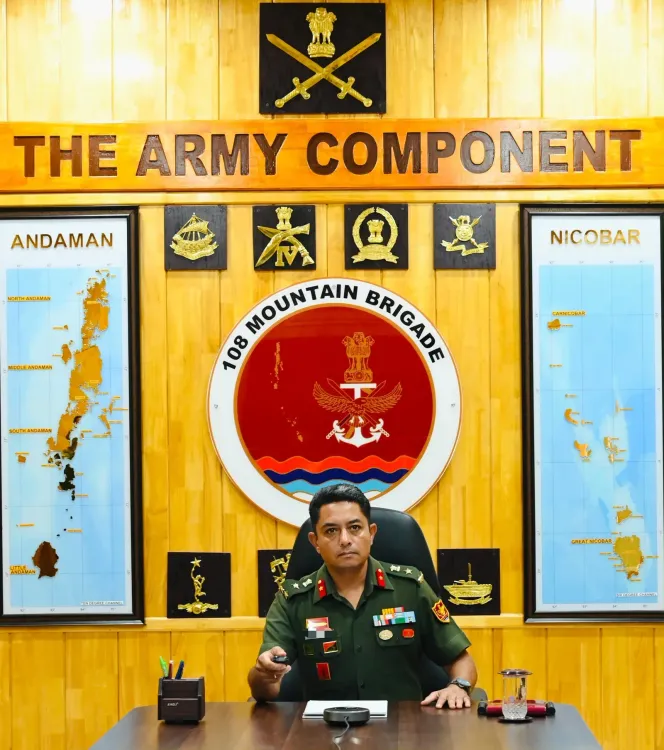
The Army Component Commander of ANC addressed student officers at the Indian Army War College, Mhow on Saturday .
The Andaman and Nicobar archipelago comprises 836 islands ; only 31 are inhabited , with the rest offering training and operational space for amphibious exercises.
The Indian Navy uses landing crafts to deploy Army troops on beaches, with IAF providing air cover — a tri-service model in practice.
The Inchon Landing (1950) , involving 75,000 troops and 260+ naval vessels , was cited as a historical benchmark for amphibious impact.
Landing Platform Docks (LPDs) — capable of carrying troops, tanks, armoured vehicles, and helicopters — were highlighted as a critical capability asset.
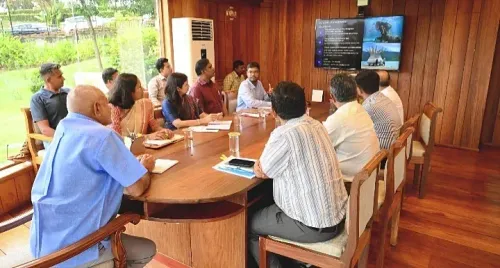
The Andaman and Nicobar Command (ANC), India's only tri-service military command, took centre stage at the Indian Army's War College in Mhow on Saturday, as the Army Component Commander of ANC delivered a detailed address on the conduct and strategic value of amphibious operations to student officers. The session underscored the growing operational relevance of the Andaman and Nicobar Islands in India's tri-service military doctrine.
Key Developments
The talk, titled 'Conduct of Amphibious Operations,' outlined the immense operational potential the ANC holds by virtue of its unique geography. The Andaman and Nicobar archipelago comprises 836 islands, of which only 31 are inhabited. The vast expanse of uninhabited islands, the officer noted, provides an ideal environment for practising and executing amphibious operations on a routine basis.
A significant number of landing crafts are permanently based on the islands to support these operations. The Indian Navy deploys these crafts to land Indian Army troops on beaches, while the Indian Air Force provides coordinated air support and cover — a classic demonstration of tri-service integration in action.
Historical Context: The Inchon Lesson
To illustrate the decisive strategic impact of amphibious assaults, the officer cited the Inchon Landing (Operation Chromite) of 1950 during the Korean War. The operation involved 75,000 troops and more than 260 naval vessels, ultimately leading to the recapture of Seoul and a significant strategic shift in favour of UN forces. The example reinforced how amphibious operations can reverse battlefield fortunes and reclaim lost ground.
Types of Operations and Training
The officer elaborated on the spectrum of amphibious operations — ranging from targeted assaults to full-scale raids followed by deliberate troop withdrawal. Detailed training requirements for the successful execution of each type were also discussed, highlighting the complexity and coordination demanded by such missions.
Stand-off beachings using Landing Platform Docks (LPDs) were a key focus. LPDs are large naval vessels capable of accommodating troops, tanks, and armoured vehicles, and are equipped with flight decks for helicopter operations — making them a versatile asset in any amphibious campaign.
Strategic Significance of ANC
The ANC, headquartered at Port Blair, is India's only integrated tri-service command and occupies a strategically vital position in the Indo-Pacific. Its location astride major sea lanes of communication gives it an outsized role in India's maritime security posture. Notably, the Command's potential for power projection through amphibious capability has gained renewed attention amid evolving regional security dynamics.
The War College session reflects a broader institutional push to ensure India's senior military leadership is fully conversant with joint and combined operations — a prerequisite for effective tri-service warfighting.
Frequently Asked Questions
What is the Andaman and Nicobar Command (ANC)?
The Andaman and Nicobar Command is India's only integrated tri-service military command, headquartered at Port Blair. It brings together elements of the Indian Army, Navy, and Air Force under a single command structure and is positioned along critical sea lanes in the Indo-Pacific.
What are amphibious operations and why do they matter?
Amphibious operations involve the coordinated use of naval, land, and air forces to project military power from sea onto shore. They are critical for recapturing territory, conducting raids, and establishing beachheads, as demonstrated by the 1950 Inchon Landing during the Korean War, which involved 75,000 troops and over 260 naval vessels.
Why are the Andaman and Nicobar Islands suited for amphibious training?
Of the archipelago's 836 islands, only 31 are inhabited, leaving a large number of uninhabited islands that provide an ideal, low-interference environment for routine amphibious exercises and operations. A significant fleet of landing crafts is permanently based there to support these activities.
What is a Landing Platform Dock (LPD) and what role does it play?
An LPD is a large naval vessel designed to transport and deploy troops, tanks, and armoured vehicles, and is equipped with a flight deck for helicopter operations. It enables stand-off beachings, allowing forces to be launched from a safe distance offshore — a key capability discussed at the War College session.
Why was the Inchon Landing cited during the briefing?
The 1950 Inchon Landing, or Operation Chromite, was cited as a historical example of how a well-executed amphibious assault can decisively alter a conflict's outcome. The operation led to the recapture of Seoul and a strategic reversal in favour of UN forces, illustrating the high-impact potential of amphibious operations.