Life Imprisonment for Kashmiri Separatist Asiya Andrabi; Associates Sentenced to 30 Years

Synopsis
In a landmark ruling, a Delhi court has sentenced Kashmiri separatist Asiya Andrabi to life imprisonment for terrorist activities against the Indian government. Alongside her associates, who received 30-year sentences, this case sheds light on serious threats to national security.
Key Takeaways
Asiya Andrabi sentenced to life imprisonment.
Associates receive 30-year sentences .
Convicts promoted secessionist ideology .
Case highlights national security issues.
Judicial action against terrorism is emphasized.
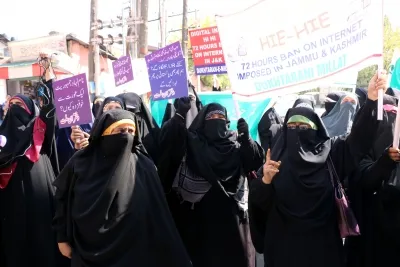
New Delhi, March 24 (NationPress) A Delhi court has sentenced the Kashmiri separatist leader Asiya Andrabi to life imprisonment for crimes including conspiracy to engage in terrorist activities and waging war against the Government of India. Her associates, Sofi Fehmeeda and Nahida Nasreen, each received 30-year prison sentences.
During the sentencing, Additional Sessions Judge Chander Jit Singh of the Karkardooma Courts stated that the actions of the convicts threatened the "very existence of India" and aimed to achieve the secession of Jammu and Kashmir, a vital region of the nation.
The judge noted that the evidence presented showed that the defendants had "not abhorred violence"; rather, they had indirectly encouraged it by glorifying deceased militants and advocating for a secessionist agenda.
“The activities of the convict, while not directly inciting violence, instill in people, especially the youth, the notion that Kashmir is not part of India, and that India has unlawfully occupied Kashmir. This can stir sentiments that may drive them towards adopting violent methods,” the court remarked.
This case stemmed from a 2018 investigation by the National Investigation Agency (NIA), which alleged that the banned group Dukhtaran-e-Millat (DeM), led by Andrabi, had been utilizing social media, public addresses, and other mediums to advocate for Jammu and Kashmir’s integration with Pakistan.
The prosecution presented various videos, online posts, and other evidence purportedly depicting the accused praising militants, inciting unlawful actions like stone-pelting, and promoting narratives based on the two-nation theory.
Andrabi was convicted under multiple sections of the Unlawful Activities (Prevention) Act (UAPA), including Section 18 (conspiracy for terrorist acts) and Section 20 (membership of a terrorist organization), along with Indian Penal Code (IPC) offenses like criminal conspiracy and waging war against the state.
Fehmeeda and Nasreen were also found guilty under several provisions of the anti-terror law and IPC. The court, emphasizing the seriousness of their crimes, asserted that actions aimed at destabilizing the nation and promoting secessionist ideology demanded severe punishment.
Andrabi, who established the all-female separatist organization in 1987, was taken into custody in April 2018. The court observed that the group had largely become inactive following her arrest.
Frequently Asked Questions
What were the charges against Asiya Andrabi?
Asiya Andrabi was charged with conspiracy to commit terrorist acts and waging war against the Government of India, among other offenses.
What sentences were given to Andrabi's associates?
Her associates, Sofi Fehmeeda and Nahida Nasreen, were sentenced to 30 years in prison.
What is the Unlawful Activities (Prevention) Act?
The UAPA is a law in India aimed at preventing unlawful activities associated with terrorism and secessionist movements.
How did the court view the actions of the convicts?
The court stated that the convicts' actions threatened the existence of India and promoted violence and secessionist ideology.
What organization did Asiya Andrabi lead?
Asiya Andrabi was the leader of the banned group Dukhtaran-e-Millat (DeM).