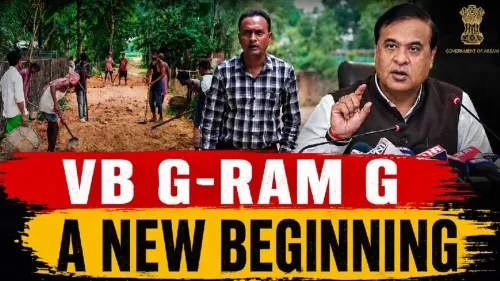
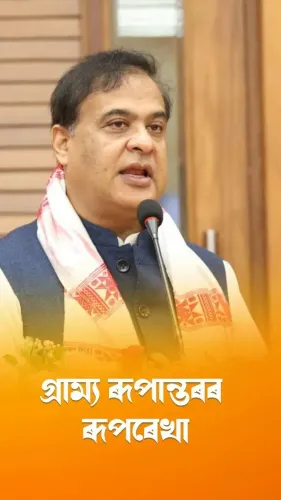
Assam's VB-G RAM G initiative puts villages first, says CM Sarma

Synopsis
Assam CM Himanta Biswa Sarma has reframed rural development as a community-driven mission under the VB-G RAM G initiative — positioning villagers as builders of 'Viksit Assam', not just beneficiaries. The real test will be whether grassroots participation translates into measurable gains in livelihoods and connectivity on the ground.
Key Takeaways
Assam CM Himanta Biswa Sarma announced a community-first approach under the VB-G RAM G initiative on 25 August .
The initiative targets better livelihoods, connectivity, and public infrastructure across Assam's villages.
Sarma envisions a 'Viksit Assam' built from the village level up, with local communities as active participants.
Improved connectivity is aimed at linking villages to markets, education, and healthcare in nearby towns.
The programme is designed to complement the state's broader rural economy strengthening efforts.
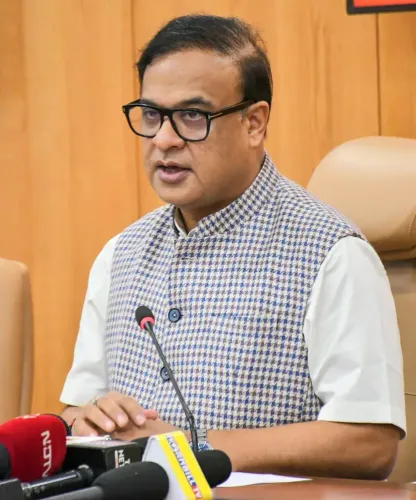
Assam Chief Minister Himanta Biswa Sarma on Tuesday, 25 August said the state government is anchoring its rural development agenda around a community-first approach under the VB-G RAM G initiative, targeting improved livelihoods, connectivity, and public infrastructure across Assam's villages. Sarma made the remarks via a post on social media platform X, reinforcing the government's push to make grassroots participation central to the state's growth vision.
What the VB-G RAM G Initiative Entails
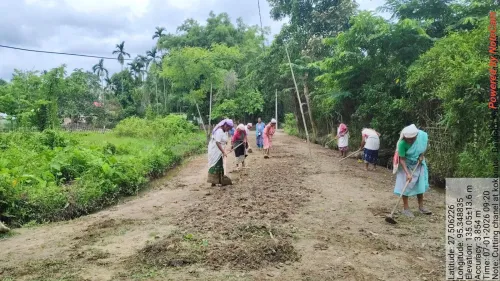
The VB-G RAM G initiative is designed to channel development directly to rural households, addressing local needs ranging from employment and connectivity to public spaces and essential facilities. According to Sarma, the programme positions villagers not as passive beneficiaries of welfare schemes but as active co-architects of Assam's development trajectory. 'Under VB–G RAM G, Assam is taking a community-first approach. Better livelihoods, better connectivity, better public spaces and facilities for every village,' he said in his post.
The Vision of a 'Viksit Assam'
Sarma emphasised that a 'Viksit Assam' — a developed Assam — would be built from the village upward, driven by local communities rather than top-down administration. He underlined that the state's broader development vision would be realised only through active participation at the grassroots level, with villages remaining central to that framework.
Connectivity and Rural Access as Key Pillars
A significant component of the initiative focuses on strengthening physical and economic connectivity between villages and nearby towns and growth centres. Improved links are expected to expand rural residents' access to markets, education, healthcare, and other essential services. Upgraded public spaces and community facilities are also expected to raise living standards and reinforce local infrastructure.
Broader Context and What Comes Next
The announcement comes as the Assam government has been consistently highlighting rural development and livelihood generation as cornerstones of its policy agenda. This initiative is expected to complement the state's wider efforts to strengthen rural economies and close the service-delivery gap between urban and rural areas. With community participation now formally embedded in the programme's design, the government's next challenge will be ensuring that implementation at the panchayat level matches the ambition of its stated vision.
Point of View
Which is harder to critique. But the initiative's credibility will depend on whether 'community participation' is operationalised through genuine local decision-making or remains a communication layer over conventional top-down delivery. Assam's rural development record has improved in recent years, yet gaps in last-mile connectivity and livelihood creation persist. Until the government publishes verifiable outcome metrics — villages connected, jobs created, facilities built — the vision of a 'Viksit Assam' built by its own people remains an aspiration rather than a programme.
NationPress
9 Oct 2026
Frequently Asked Questions
What is the VB-G RAM G initiative in Assam?
VB-G RAM G is an Assam government rural development initiative that adopts a community-first approach, focusing on improving livelihoods, connectivity, and public infrastructure in villages. It aims to make local communities active participants in the state's development rather than passive beneficiaries.
What did CM Himanta Biswa Sarma say about the initiative?
Sarma said that under VB-G RAM G, Assam is pursuing better livelihoods, better connectivity, and better public spaces for every village. He added that a 'Viksit Assam' would be built in villages and by the people themselves, emphasising grassroots participation.
How does the initiative plan to improve rural connectivity?
The initiative aims to strengthen links between villages and nearby towns and growth centres, improving rural residents' access to markets, education, healthcare, and essential services. Upgraded public spaces and community facilities are also part of the plan.
Who benefits from the VB-G RAM G initiative?
The initiative targets rural households across Assam, with a focus on communities that need better employment opportunities, connectivity, and public facilities. Villages are positioned as the primary unit of development under the programme.
How does VB-G RAM G fit into Assam's broader development agenda?
The initiative complements the Assam government's wider push to strengthen rural economies and close the urban-rural service gap. Rural development and livelihood generation have been highlighted as key pillars of the government's vision for a developed Assam.