UNGA President Baerbock: UNSC reform options tabled, but India wants more
Synopsis
For the first time in the 17-year IGN process, multiple UNSC reform options were formally placed on the table — but India and the G4 call it incremental at best. With P5 agreement deemed ‘not really realistic’ by the outgoing UNGA President herself, the gap between diplomatic progress and structural change has rarely been more visible.
Key Takeaways
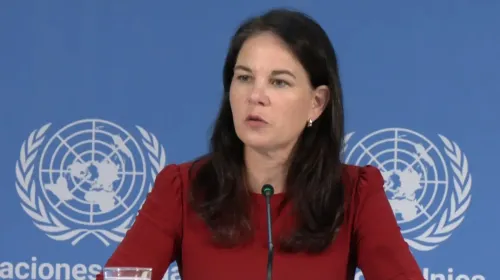
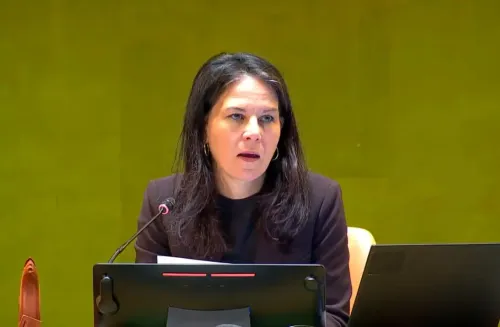
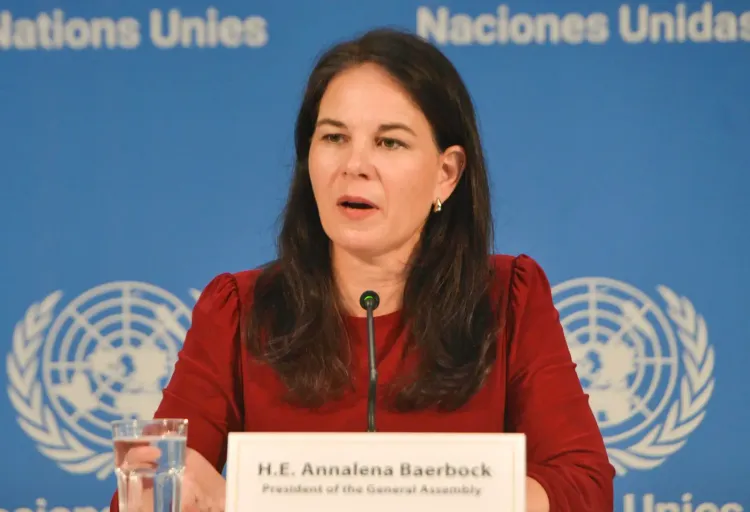
UNGA President Annalena Baerbock said multiple UNSC reform options were tabled for the first time during her tenure, at her final press conference on 4 September .
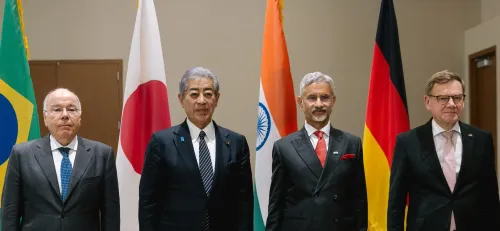
India and the G4 (Germany, Brazil, Japan) say the progress is insufficient, as no formal negotiating text has been adopted after 17 years of IGN talks.
The G4 proposal calls for expanding the Security Council to 25–26 seats , adding six permanent and four or five non-permanent members .
The Uniting for Consensus (UfC) bloc, led by Italy and including Pakistan , has blocked adoption of a negotiating text through procedural manoeuvres.
Baerbock conceded that P5 agreement on reform is ‘not really realistic’ , and criticised the secretive process for selecting the next UN Secretary-General .
Baerbock will join Columbia University as a professor after her term ends next week.
General Assembly President Annalena Baerbock said on Thursday, 4 September that the United Nations Security Council reform process had taken a step forward during her tenure, with multiple reform options formally placed on the table for the first time — though India and several other nations argue the progress falls far short of what is needed to unlock substantive negotiations.
What Baerbock Said at Her Final Press Conference
Speaking at her last press conference as UNGA President, Baerbock said, “We took a step forward.” She added that “for the first time, different options for the reform were put on the table” during the current session of the General Assembly. She also highlighted a “strong call for the representation of African states as also [for more] permanent members in the Security Council.”
However, Baerbock conceded that any meaningful reform would ultimately require the agreement of the five permanent members (P5) — the United States, Russia, China, France, and the United Kingdom — which she acknowledged was “not really realistic.”
India and G4 Nations: Not Enough Progress
India, along with Germany, Brazil, and Japan — collectively known as the G4 — has long campaigned for permanent seats on an expanded Security Council. The G4 and allied nations have been demanding a formal negotiating text to move the Inter-Governmental Negotiations (IGN) process beyond its current deadlock, which has persisted for 17 years within the IGN framework and nearly 35 years since the General Assembly first took up the issue of UNSC reform.
The tabling of options, while a procedural advance, does not constitute the binding negotiating text that India and its partners have sought. A bloc called Uniting for Consensus (UfC) — which includes Pakistan and is led by Italy — has repeatedly used procedural manoeuvres to block such a text, according to reports.
Key Reform Proposals on the Table
Three principal proposals are currently in contention. The G4 plan calls for expanding the Security Council from 15 to 25 or 26 seats, adding six new permanent members and four or five new non-permanent members. The African Union proposal demands two permanent seats for the African continent, in addition to non-permanent representation. The UfC, by contrast, advocates only for seats with longer, renewable terms — stopping short of new permanent membership.
Baerbock on Vetoes, the SG Election, and Gender
Baerbock was pointed in her criticism of the P5's use of veto powers, arguing that “we have seen more wars and conflicts, we have seen the blockage in the Security Council on questions on peace and security.” She cited two General Assembly meetings she convened — one on the US veto of a resolution on the Gaza crisis, and another on a China and Russia veto related to the Strait of Hormuz confrontation — as instances where permanent members were compelled to publicly justify their actions.
She also criticised the opaque process for selecting the successor to Secretary-General António Guterres, whose term ends this year. US Alternate Representative Jennifer Locetta had accused her of “overreach and irresponsible actions” for holding open hearings at which candidates addressed UN members and civil society. Baerbock defended the transparency drive, warning that the UN’s credibility was at stake “if we allow a process again, where behind closed doors some will be chosen who is not defending all the three principles of this organisation.”
On the question of gender, Baerbock said: “After 80 years you have to consider if this organisation is living up to their own principles, if again a woman would be not selected.”
What Comes Next
Baerbock’s term as UNGA President ends next week, after which she will join Columbia University’s School of International and Public Affairs as a professor and co-director of its master’s programme in Global Leadership. The IGN process will continue under her successor, though without a negotiating text, substantive progress remains uncertain. For India and the G4, the reform push enters another session with incremental gains but no structural breakthrough.
Point of View
Not merely delayed. Tabling options is not the same as negotiating them — a distinction India and the G4 have pressed for decades. The UfC’s procedural blocking, led by Italy with Pakistan as a key member, continues to serve as a proxy veto for countries opposed to new permanent seats. What mainstream coverage underplays is that nearly 35 years of General Assembly deliberation have produced no binding text — a failure of multilateral architecture that reflects P5 self-interest as much as procedural obstruction.
NationPress
19 Oct 2026
Frequently Asked Questions
What progress was made on UNSC reform during Baerbock’s UNGA presidency?
For the first time, multiple reform options were formally placed on the table during the current General Assembly session. However, no binding negotiating text was adopted, which India and G4 nations say is the minimum needed to advance the 17-year-old IGN process.
Why is India dissatisfied with the current state of UNSC reform?
India, along with Germany, Brazil, and Japan in the G4, has demanded a formal negotiating text that would serve as the basis for structured talks on expanding the Security Council. The tabling of options falls short of this threshold, and the IGN process has been stalled for 17 years without producing such a text.
What are the main proposals for reforming the UN Security Council?
Three proposals are in contention: the G4 plan to expand the Council to 25–26 seats with six new permanent members; the African Union’s demand for two permanent African seats; and the UfC’s preference for longer, renewable non-permanent terms only, without new permanent seats.
Who is blocking Security Council reform and how?
The Uniting for Consensus (UfC) bloc, led by Italy and including Pakistan, has used procedural manoeuvres to prevent the adoption of a negotiating text. The five permanent members’ veto power also means any structural reform requires their consent, which outgoing UNGA President Baerbock called ‘not really realistic.’
What did Baerbock say about the UN Secretary-General election process?
Baerbock criticised the secretive, P5-dominated process for selecting the successor to Secretary-General António Guterres, whose term ends this year. She held open hearings for candidates, which drew a rebuke from the US Alternate Representative, but defended the move as essential to the UN’s credibility.