Balochistan marks 'muted' Pakistan I-Day; BNM slams nation's creation
Synopsis
On Pakistan's Independence Day, Balochistan went quiet — not in celebration but in dissent. Shops stayed shut across Quetta, rockets and grenades struck a ceremony in Zarghoon Colony, and BNM chairman Naseem Baloch used the occasion to call Pakistan's very creation illegitimate, invoking Balochistan's brief independence of 1947 and its occupation in 1948.
Key Takeaways
Most shops and markets across Balochistan , including Quetta , remained closed on 14 August , Pakistan's Independence Day.
Multiple rockets and grenades were fired at an Independence Day ceremony in Zarghoon Colony, Quetta , causing approximately eight explosions ; CTD and Frontier Corps personnel were present.
Security was tightened around Pakistani forces' camps, government offices, and sensitive installations across the region.
BNM chairman Naseem Baloch issued a statement denouncing Pakistan's creation, linking 14 August to the loss of Balochistan's independence.
Baloch stated that Balochistan declared independence on 11 August 1947 and was occupied by Pakistan on 27 March 1948 .
Balochistan observed a largely subdued Pakistan Independence Day on 14 August, with most shops and commercial establishments across major markets — including those in Quetta — remaining closed, according to local media reports. Public movement was visibly reduced across several districts and towns, with residents in many areas reportedly choosing to stay indoors.
Security Tightened Across Key Sites
Authorities significantly heightened security around Pakistani forces' camps, government offices, and other sensitive installations. Additional personnel were reportedly deployed at multiple locations, with movement near key sites closely monitored. Government institutions and Pakistani forces held only very limited ceremonies at select venues in Quetta, according to local reports.
Rockets and Grenades Fired at Quetta Ceremony
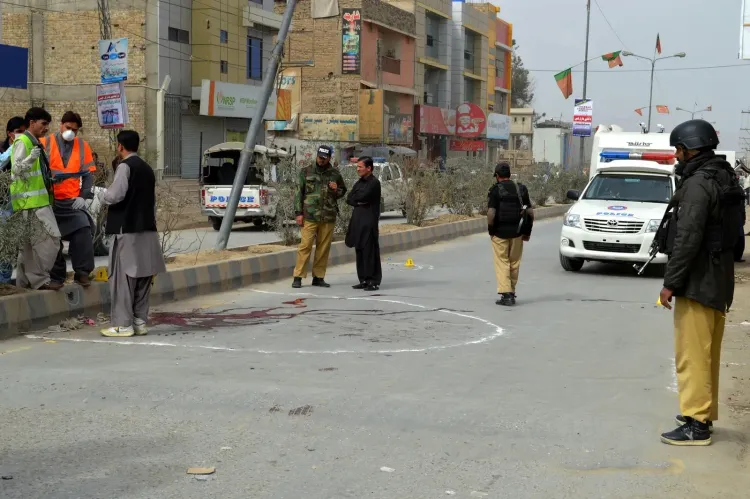
Several security-related incidents were reported across the region. According to local sources, multiple rockets and grenades were fired at an Independence Day ceremony held in Zarghoon Colony, Quetta, resulting in approximately eight explosions. The ceremony was reportedly attended by a large number of personnel from the Counter-Terrorism Department (CTD) and the Frontier Corps (FC). The full extent of casualties or damage was not immediately confirmed in available reports.
BNM Chairman Criticises Pakistan's Formation
Naseem Baloch, chairman of the Baloch National Movement (BNM), issued a statement on the occasion sharply criticising the creation of Pakistan, associating the date with what he described as the loss of Balochistan's independence. He argued that the regions now constituting Pakistan did not witness any significant political movement for the country's formation, and contended that Pakistan emerged from British colonial policy, religious-representation politics, and political compromises — rather than a popular indigenous demand.
Baloch claimed that the Baloch nation bore the heaviest cost of Partition. He stated that, following historical agreements between Britain and Balochistan and a prolonged period of Baloch political struggle, Balochistan declared independence on 11 August 1947. According to him, the Baloch leadership at the time sought relations with neighbouring states on the basis of equality and mutual agreement. That prospect, he argued, was extinguished when Pakistan occupied Balochistan on 27 March 1948.
A Pattern of Dissent on August 14
This is not the first time Balochistan has seen a muted or contested Independence Day. Separatist sentiment in the province has historically surfaced around 14 August, with nationalist groups using the occasion to highlight what they describe as Balochistan's forced integration into Pakistan. This comes amid longstanding tensions between Baloch nationalist movements and the Pakistani state, with the region having witnessed cycles of insurgency, enforced disappearances, and counter-insurgency operations over several decades. The BNM is among several groups that reject the legitimacy of Pakistan's sovereignty over Balochistan.
What Comes Next
The incidents in Zarghoon Colony are likely to prompt a security review by Pakistani authorities, while the BNM's statement is expected to draw a political response from Islamabad. The broader situation in Balochistan — marked by periodic unrest and a deep trust deficit between the state and sections of the population — shows little sign of near-term resolution.
Point of View
A rocket attack on a ceremony attended by counter-terrorism forces, and a formal BNM statement that goes beyond protest to question the legal and moral legitimacy of Pakistan's existence. Mainstream coverage often frames such events as law-and-order incidents; the deeper story is a decades-old political grievance that Pakistani state policy has consistently failed to address through dialogue. The attack in Zarghoon Colony, if confirmed, would represent a direct targeting of security apparatus on a symbolically charged date — an escalation worth watching closely.
NationPress
29 Sept 2026
Frequently Asked Questions
Why did Balochistan observe a muted Independence Day on 14 August?
Most shops and markets across Balochistan, including Quetta, remained closed on 14 August, reflecting subdued public participation in Pakistan's Independence Day celebrations. Residents in several areas reportedly stayed indoors, and public movement was visibly reduced across districts, according to local media reports.
What happened at the Zarghoon Colony ceremony in Quetta?
Multiple rockets and grenades were reportedly fired at an Independence Day ceremony in Zarghoon Colony, Quetta, resulting in approximately eight explosions. The ceremony was attended by a large number of Counter-Terrorism Department (CTD) and Frontier Corps (FC) personnel, according to local sources.
What did BNM chairman Naseem Baloch say about Pakistan's creation?
Naseem Baloch issued a statement arguing that Pakistan's creation was a product of British colonial policy, religious-representation politics, and political compromises — not a genuine popular movement. He claimed the Baloch nation paid the highest price for Partition and that Balochistan was occupied by Pakistan on 27 March 1948, ending its brief independence of 11 August 1947.
What is the Baloch National Movement (BNM)?
The Baloch National Movement (BNM) is a Baloch separatist organisation that rejects Pakistan's sovereignty over Balochistan. It is among several nationalist groups that use occasions such as Pakistan's Independence Day to highlight their political position on Balochistan's status and history.
How does this year's situation compare to past Independence Days in Balochistan?
Muted or contested Independence Day observances in Balochistan have been a recurring pattern, with nationalist groups historically using 14 August to express dissent. This year's incidents — including the reported rocket attack and the BNM's formal statement — follow a long-established cycle of unrest and political contestation in the province.