Bangladesh garment workers demand Tk 30,000 wage, 500+ factories shut in Dhaka
Synopsis
Over 500 garment factories have shut across Bangladesh as workers demand a near-tripling of the minimum monthly wage — from Tk 12,500 to Tk 30,000. With the sector generating 80% of the country's export earnings and $38.7 billion in annual shipments, this is not just a labour dispute: it is a stress test for Bangladesh's entire development model — and a potential opportunity for rivals like Vietnam and India.
Key Takeaways
More than 500 RMG factories in Mirpur, Savar, Gazipur, Ashulia and Mymensingh have reportedly shut following worker protests on 3 November 2026 .
Workers demand the monthly minimum wage rise from Tk 12,500 to Tk 30,000 — wages have been revised only six times since 1985 .
The government has formed a six-member wage board ; Information Adviser Zahed Ur Rahman says the administration is sympathetic but blames the opposition for violence.
Bangladesh's RMG sector employs around four million workers , accounts for over 80% of export earnings, and generated approximately $38.7 billion in exports in 2025-26 .
Bangladesh is the world's second-largest apparel exporter after China; a prolonged shutdown could redirect orders to rivals Vietnam and India .
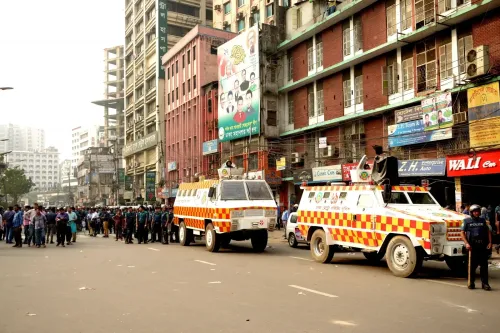
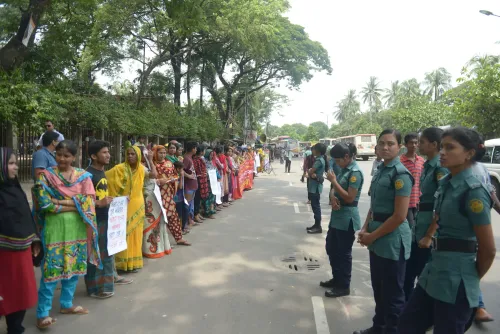
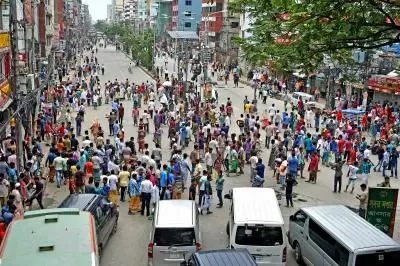
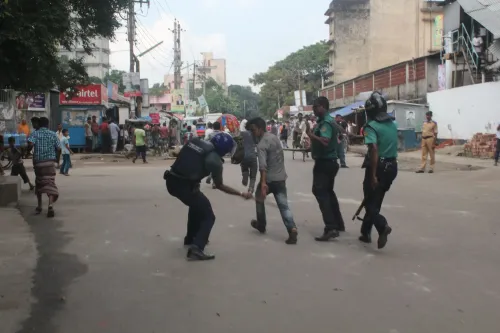
Bangladesh's ready-made garment (RMG) sector was rocked again on Tuesday, 3 November 2026, as thousands of factory workers clashed with police on the streets of Dhaka, prompting law enforcers to deploy tear gas shells and sound grenades to disperse crowds. More than 500 RMG factories across Mirpur, Savar, Gazipur, Ashulia, and Mymensingh have reportedly downed shutters, threatening output in a sector that underpins the country's entire export economy.
The Wage Demand at the Heart of the Unrest
Workers are demanding that the monthly minimum wage be raised from Tk 12,500 (less than Rs 9,500) to Tk 30,000 (approximately Rs 22,767), according to reports citing The Daily Star. Over the past three years, high inflation and surging food prices have sharply eroded workers' real incomes and purchasing power, making the demand less a push for incremental gains and more, as one analysis noted, 'an attempt to regain their ability to afford necessities.'
Notably, wages in the RMG sector have been revised only six times since 1985 — a span of more than four decades — rising from Tk 627 to the current Tk 12,500. Workers have also drawn comparison to recent government salary revisions for public-sector employees, demanding a corresponding adjustment in the private sector.
Government Response and the Wage Board
Facing mounting pressure, the government has established a six-member wage board tasked with reviewing the sector's wage structure. The board includes representatives of workers, employers, and the government, and has been asked to recommend a revised framework.
Prime Minister's Information Adviser Zahed Ur Rahman said the government is sympathetic to workers' concerns given rising living costs. However, Rahman also alleged that the violent conduct witnessed during some protests was not typical of garment workers, suggesting outside interference. He held the opposition responsible for instigating unrest, citing what he described as 'sufficient information and evidence.' Rahman separately dismissed the prospect of the banned Awami League leveraging the protests for political gain, saying such activities would not pave the way for deposed former Prime Minister Sheikh Hasina's return in December.
Why the RMG Sector Is Bangladesh's Economic Lifeline
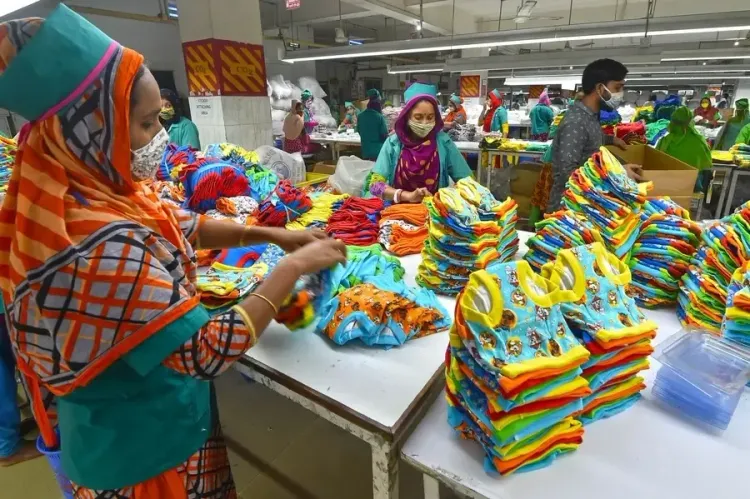
The scale of the disruption cannot be overstated. The RMG sector employs approximately four million workers, generates more than 80 per cent of Bangladesh's total export earnings, and contributes roughly 10 per cent of national GDP. Garment exports reached approximately $38.7 billion in the 2025-26 financial year, with products shipped to more than 150 countries. Bangladesh currently ranks as the world's second-largest apparel exporter after China.
Beyond the numbers, the sector has drawn millions of women into formal employment and served as a primary engine of poverty reduction — making sustained instability a threat not just to exporters but to broad-based social progress.
Factory Owners' Counter-Argument
Employers argue that a steep wage hike of this magnitude is difficult to absorb at a time of rising production costs, energy shortages, weaker global demand, and persistent pressure from international fashion brands to keep prices low. The simultaneous squeeze from cost inflation and buyer pricing power leaves little room for significant wage increases without restructuring, they contend.
Regional Competition and What Is at Stake
Vietnam has emerged as Bangladesh's most credible rival, benefiting from bilateral trade agreements with major consumer markets, superior logistics infrastructure, and higher productivity — offsetting its comparatively higher wages through efficiency and value-added production. India, with a far larger textile ecosystem spanning cotton cultivation to finished garments, has historically struggled to capitalise on orders shifting away from China due to fragmented manufacturing and regulatory complexity, though recent reforms are reportedly narrowing that gap.
A prolonged standoff in Bangladesh risks accelerating the diversification of global apparel sourcing, with buyers potentially fast-tracking orders to Vietnam, Cambodia, or India. How quickly the government and factory owners can resolve the wage dispute will determine whether this unrest becomes a turning point or a temporary disruption for the world's second-largest garment exporter.
Point of View
And Vietnam is actively positioning to absorb overflow orders. The government's wage board is a procedural safety valve, but it does not address the structural contradiction at the heart of Bangladesh's export model — a competitive advantage built on wages that have not kept pace with inflation for four decades. Factory owners are not wrong that margins are thin, but suppressing wages to stay competitive is a strategy with a finite lifespan, as this week's shutdowns demonstrate. The real question is whether Bangladesh can move up the value chain fast enough to afford better-paid workers — because the low-wage arbitrage alone will not hold.
NationPress
3 Nov 2026
Frequently Asked Questions
Why are Bangladesh garment workers protesting in November 2026?
Workers are demanding that the monthly minimum wage be raised from Tk 12,500 to Tk 30,000, arguing that three years of high inflation have severely eroded their real incomes. The unrest has led to factory shutdowns and clashes with police across major industrial zones including Dhaka, Savar, and Gazipur.
How many factories have been affected by the Bangladesh garment strike?
More than 500 ready-made garment factories have reportedly shut across Mirpur, Savar, Gazipur, Ashulia, and Mymensingh as of 3 November 2026. The closures are disrupting production in a sector that accounts for over 80% of Bangladesh's total export earnings.
What has the Bangladesh government done to resolve the wage dispute?
The government has formed a six-member wage board comprising representatives of workers, employers, and the government to review and recommend a revised wage structure. Information Adviser Zahed Ur Rahman has stated the administration is sympathetic to workers' demands, though he has also alleged that opposition groups are fuelling the violence.
How important is the RMG sector to Bangladesh's economy?
The ready-made garment sector is the backbone of Bangladesh's economy, employing approximately four million workers, generating more than 80% of export earnings, and contributing roughly 10% of national GDP. Garment exports totalled approximately $38.7 billion in the 2025-26 financial year, shipped to over 150 countries.
Could the unrest benefit rival exporters like Vietnam or India?
Potentially, yes. Vietnam is already Bangladesh's strongest competitor, with trade agreements, superior logistics, and high productivity. India, with its vast textile ecosystem, is also narrowing the gap through recent reforms. A prolonged shutdown in Bangladesh could prompt international buyers to accelerate order diversification toward these rivals.