Bangladesh Commemorates 'Genocide Day' as World Reflects on the Atrocities of Pakistani Forces
Synopsis
As Bangladesh observes 'Genocide Day' on March 25, the nation remembers the horrific events of 1971, when Pakistani forces brutally suppressed the civilian population. Eyewitness accounts and reports highlight the atrocities committed during Operation Searchlight, a prelude to the nine-month Liberation War.
Key Takeaways
March 25, 1971: Known as the 'Black Night,' when Pakistani forces launched a brutal assault.
Operation Searchlight: A military operation targeting unarmed civilians in East Pakistan.
Mass Casualties: Thousands of innocent lives were lost in a single night.
Bangabandhu's Arrest: The Awami League leader was detained, marking a significant moment in the liberation struggle.
Legacy: The events triggered the nine-month Liberation War, culminating in independence.
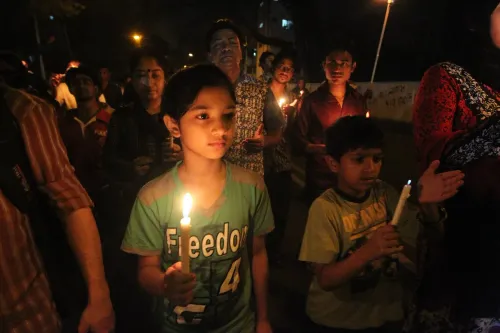
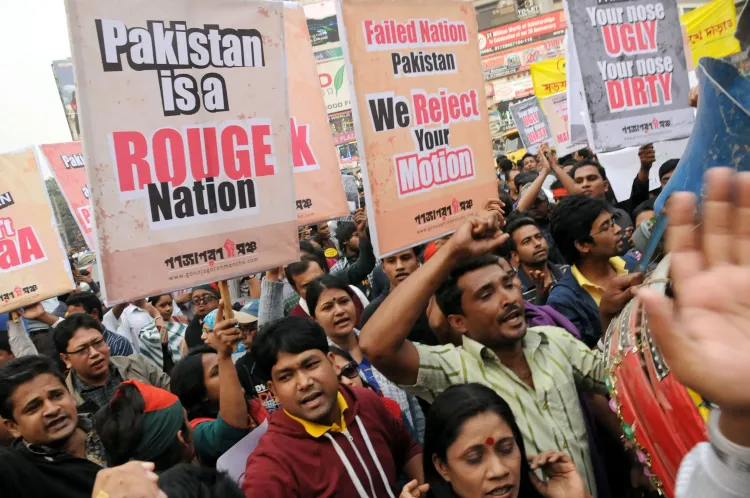
Dhaka, March 25 (NationPress) The evening of March 25, 1971, known as the 'Black Night,' serves as a stark reminder of the atrocious repression inflicted upon the Bangladeshi populace by Pakistani military forces, as Bangladesh commemorates 'Genocide Day' today.
The horrific events began with the initiation of 'Operation Searchlight' against defenseless Bangladeshis, marking the onset of one of the most tragic periods in the country's history.
“As night descended, armored tanks surged through the streets, and soldiers opened fire indiscriminately. Major sites like Dhaka University, Pilkhana, Rajarbagh Police Lines, and predominantly Hindu neighborhoods in Old Dhaka faced coordinated assaults. Numerous students and educators lost their lives, with university dormitories transforming into sites of mass slaughter,” a report from Bangladesh’s foremost newspaper 'The Daily Star' elaborated.
“This orchestrated campaign sought to dismantle the Bengalee nationalist movement after the Awami League's electoral triumph in 1970. The violence soon permeated throughout the then East Pakistan, targeting innocent civilians, students, intellectuals, and even members of the security forces,” it further stated.
According to eyewitness accounts and comprehensive historical analysis, the report revealed that thousands of unarmed civilians were murdered within just one night, homes were set ablaze, and entire communities laid in ruin.
The scale and savagery of the violence reverberated globally.
On that fateful night, Bangabandhu Sheikh Mujibur Rahman, the Awami League leader and symbol of the independence struggle, was apprehended by Pakistani forces. He was later transported to West Pakistan, enduring nine months of imprisonment.
Highlighting that these violent acts instigated the Bangladesh Liberation War, the report affirmed, “The occurrences of March 25 are largely considered the spark of the 1971 genocide, which ignited the nine-month Liberation War. Bangladesh ultimately achieved freedom on December 16, 1971, when Pakistani forces surrendered to the Bangladesh-India Allied Forces at Race Course Maidan, now known as Suhrawardy Udyan.
On this day, Bangladesh's Prime Minister Tarique Rahman characterized the events of March 25, 1971, as a “premeditated massacre” and one of the most savage episodes in the nation’s chronicles.
“March 25, 1971, is observed as Genocide Day. On this solemn occasion, I extend my deepest tributes to all the martyrs. This date remains one of the most shameful and brutal days in the history of freedom-loving Bangladesh,” stated Tarique Rahman.
The Prime Minister remarked that the Pakistani occupying forces perpetrated one of the most “atrocious” genocides in history against unarmed Bangladeshis that night under the guise of Operation Searchlight.
In addition, Bangladesh's President Mohammed Shahabuddin noted that March 25, 1971, marks the most brutal and agonizing chapter in the nation’s past, a day when the entire population was rendered speechless and horrified by this genocide.
Shahabuddin urged all citizens of Bangladesh, regardless of their religion, caste, political affiliation, or opinion, to unite in a spirit of patriotism to honor the ideals and aspirations of the 1971 Liberation War martyrs.
Point of View
It is crucial to recognize the historical significance of March 25, 1971, as Bangladesh marks 'Genocide Day.' The events of that night serve as a poignant reminder of the brutality faced by the nation, igniting a movement that eventually led to independence. The memories of the martyrs continue to resonate and shape the national identity.
NationPress
23 Sept 2026
Frequently Asked Questions
What does 'Genocide Day' commemorate?
'Genocide Day' commemorates the brutal crackdown by Pakistani forces on March 25, 1971, marking the onset of a violent campaign against unarmed Bangladeshis.
What was Operation Searchlight?
Operation Searchlight was a military operation launched by the Pakistan Army on March 25, 1971, targeting civilians in East Pakistan to suppress the independence movement.
Who was Bangabandhu Sheikh Mujibur Rahman?
Bangabandhu Sheikh Mujibur Rahman was the leader of the Awami League and a central figure in Bangladesh's struggle for independence, who was arrested on the night of the genocide.
What was the outcome of the events on March 25, 1971?
The events of March 25, 1971, sparked the Bangladesh Liberation War, ultimately leading to the country's independence from Pakistan on December 16, 1971.
Why is March 25 significant in Bangladesh?
March 25 is significant as it marks the day of a horrific massacre and the beginning of a movement that led to the establishment of Bangladesh as an independent nation.