Is Bangladesh Worried About the Increasing Role of Religion in Politics?
Synopsis
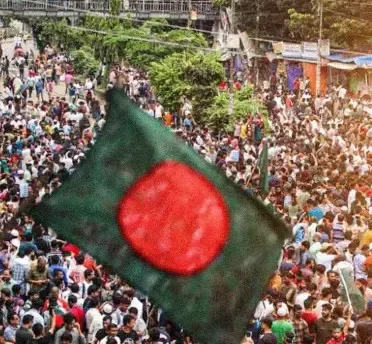
The rising trend of intertwining religion with politics in Bangladesh, especially during elections, raises significant concerns. An article on Banglanews24 highlights a TIB study that reveals the growing influence of religious parties in the political landscape, prompting debates about the implications for democracy and governance.
Key Takeaways
Increasing concern over the role of religion in politics in Bangladesh.
The rise of Islamist parties in upcoming elections.
Political leaders using religious sentiments for electoral advantage.
Impact on the democratic process and governance.
Need for awareness among the electorate to resist manipulation.
New Delhi, Jan 24 (NationPress) Growing worries in Bangladesh regarding the increasing trend of intertwining religion with politics, particularly during elections, were recently highlighted in an article published on a popular online Bengali news portal.
The piece on the Banglanews24 website referenced a study conducted by Transparency International Bangladesh (TIB), which underscored the escalation of religious politics.
The article stated, "The underlying cause of this situation is the prolonged absence of a democratic political atmosphere in the nation, the influence of religious extremism, and the emergence of radical political factions both domestically and globally, which has led to this troubling scenario in the country."
The report detailed political pledges of "gaining paradise" in exchange for endorsing specific electoral symbols, while others sought backing for the implementation of Islamic laws.
Even as civilization evolves to become "more modern each day, the prevalence of such 'political religions' is escalating," the article lamented.
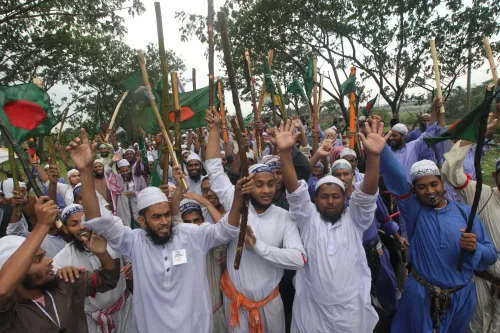
It criticized political parties and leaders across the spectrum in Bangladesh for exploiting religion for political gain, asserting, "Leaders of religion-oriented political parties have long been observed donning religious garb, increasingly utilizing religion in their public outreach efforts."
The article mentioned allegations against Bangladesh Jamaat-e-Islami for soliciting votes with promises of a "ticket to paradise".
A senior figure from the Bangladesh Nationalist Party (BNP) compared the Jamaat's tactics to similar religious strategies employed during historical "dark ages".
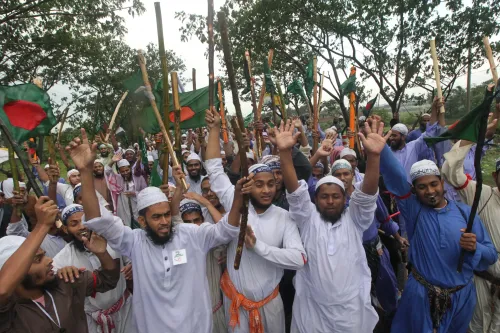
The report illustrated male leaders wearing religious caps and female leaders sporting scarves or head coverings at election events.
The article pointed out that the intertwining of religion with politics first became prominent during the 1991 elections when the BNP's campaign asserted that the Awami League’s rise to power would abolish the 'azan' prayer call and usher in Hindu practices in mosques.
However, it also placed the Awami League in a similar light, alleging that the party's President and former Prime Minister, Sheikh Hasina, participated in the 1996 election campaign while wearing a black headscarf and long-sleeved blouse, commencing her campaign from a shrine.
The report accused the Awami League, now barred from participating in elections, of exploiting religion in its last five election campaigns.
Additionally, the Islamic Movement Bangladesh, which previously formed an electoral alliance with Jamaat-e-Islami and nine other parties, withdrew from the coalition due to disagreements over 'Sharia law', as stated in the report.
The TIB study indicated that a total of 51 political parties are contesting in the upcoming February elections, with 1,981 candidates, of which approximately 13% are independents.
According to the report, Islamist parties constitute 36% of the total candidates, marking the highest figure in the last five elections.
In contrast, the 2024 elections saw only 9.5% of candidates from Islamic parties.
The report highlighted that their representation has grown since the 2018 Parliamentary elections when their participation was recorded at 29.66%.
It noted that this figure has now surged to 36% for the February 2026 elections.
The article concluded with the TIB report emphasizing the "escalation of Islamist activities within the internal politics and administration of the country."
Many analysts believe that these religious parties seek to capitalize on the faith of voters, a significant portion of whom lack education and awareness. However, it has been consistently observed that such strategies yield little success—as no Islamist party has ever managed to form a government independently.
Point of View
It is crucial to recognize the delicate balance between religion and politics in Bangladesh. While the concerns raised about the increasing intertwining of these two spheres are valid, it is essential to approach this matter with an unbiased lens, analyzing the implications for our democracy and the rights of citizens.
NationPress
22 Sept 2026
Frequently Asked Questions
What is the main concern regarding religion in Bangladesh's politics?
The primary concern is the increasing trend of political leaders using religion for electoral gains, potentially undermining the democratic political environment.
How has the participation of Islamist parties changed in recent elections?
The representation of Islamist parties has risen significantly, with 36% of candidates in the upcoming February elections being from these parties, the highest recorded in the last five elections.
What role does Transparency International Bangladesh play in this context?
Transparency International Bangladesh conducted a study highlighting the rise of religious politics, emphasizing the impact of religious extremism and the absence of a democratic political atmosphere.
What implications does this trend have for Bangladeshi democracy?
The trend of using religion in politics poses risks to the democratic process, as it may exploit voters' faith and diminish secular governance.
Have Islamist parties ever successfully formed a government in Bangladesh?
No, Islamist parties have not been able to form a government independently in the past.