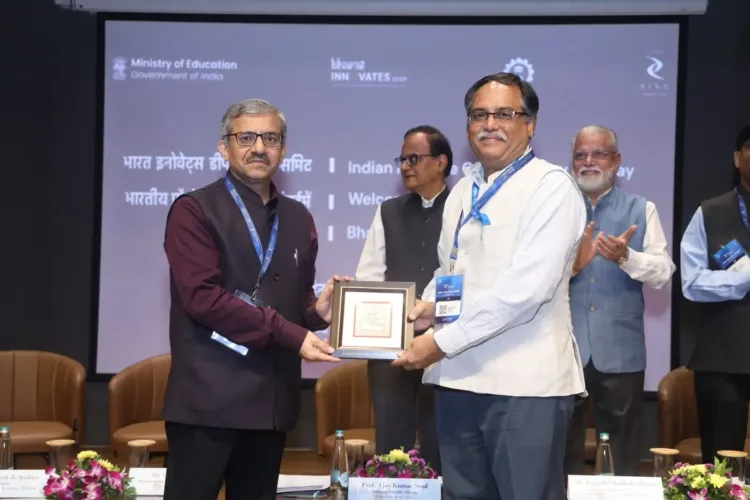
Inauguration of Bharat Innovates Deep-Tech Pre-Summit at IIT Bombay
Synopsis
Ajay Kumar Sood inaugurated the Bharat Innovates Deep-Tech Pre-Summit at IIT Bombay, emphasizing deep-tech innovation's role in enhancing India's global competitiveness. The event sets the stage for India's participation in the upcoming global innovation showcase in France.
Key Takeaways
Inauguration of Bharat Innovates Deep-Tech Pre-Summit by Ajay Kumar Sood.
Focus on enhancing India's global competitiveness through deep-tech innovation.
Collaboration of multiple government departments for a unified effort.
Showcasing of 137 selected deep-tech startups out of 3,000 applications.
Preparation for India's participation in global innovation showcase in Nice, France.
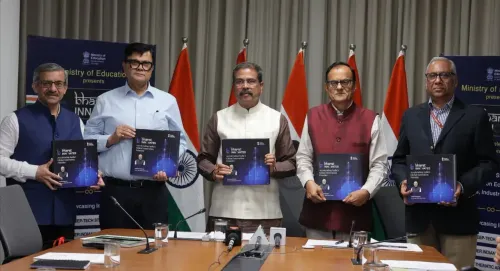
Mumbai, March 21 (NationPress) On Saturday, Ajay Kumar Sood, the Principal Scientific Adviser to the Indian government, officially inaugurated the two-day Bharat Innovates Deep-Tech Pre-Summit at IIT Bombay. This event emphasizes the significance of deep-tech innovation in bolstering India's technological leadership and enhancing its competitive edge on a global scale.
In his inaugural address, Sood, who also chairs the Prime Minister's Science, Technology and Innovation Advisory Council (PM-STIAC), underscored the vital contributions of academic institutions, research ecosystems, and startups in driving forward cutting-edge technologies.
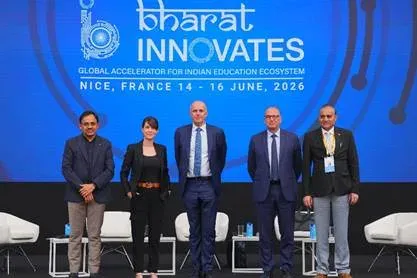
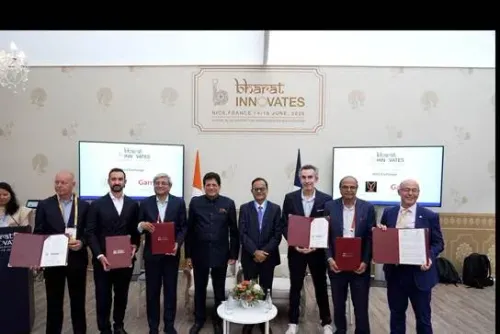
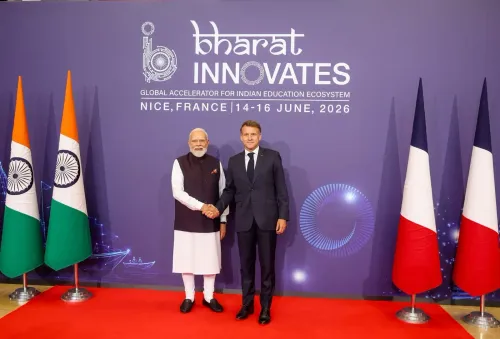
The Bharat Innovates Deep-Tech Pre-Summit is a significant initiative by the Ministry of Education, acting as a precursor to the broader Bharat Innovates 2026 initiative. This journey will culminate in India's first global innovation showcase at Nice, France in June 2026, as part of the India-France Year of Innovation 2026, which was announced by Prime Minister Narendra Modi.
The summit was inaugurated at the ASPIRE – IIT Bombay Research Park Foundation, located on the IIT Bombay campus in Mumbai, according to an official statement.
Vineet Joshi, Secretary of the Department of Higher Education in the Ministry of Education, mentioned that Bharat Innovates 2026 is a comprehensive government initiative that unifies multiple departments, including the Ministry of Education, the Department of Science and Technology, the Department of Biotechnology, the Space Department, and the Ministry of Defence. This collaboration aims to present India's advanced deep-tech capabilities to the world.
Joshi emphasized that this initiative is not just about showcasing innovations globally but also about transforming the educational landscape of India.
He pointed out that the National Education Policy, 2020, has initiated a critical transformation, shifting the focus from mere examination scores to recognizing the true essence of education as a meaningful contribution to society, in line with the vision of 'Viksit Bharat by 2047'.
He urged investors and corporate entities to scout for promising startups beyond metropolitan areas, reiterating that innovation knows no geographical boundaries.
Notable attendees included Abhay Karandikar, Secretary of the Department of Science and Technology; K. Radhakrishnan, Chairperson of IIT Bombay's Board of Governors; and Shireesh Kedare, the Director of IIT Bombay.
Radhakrishnan encouraged innovators and entrepreneurs to work with a sense of national purpose and to forge a new narrative for India.
He hailed innovators as ambassadors of India and urged them to strive for national pride.
Karandikar noted that India has emerged as the third-largest startup ecosystem globally, boasting nearly 200,000 startups and around 125 unicorns, a significant increase from just 24 unicorns in 2017-18.
He also mentioned that over 1,000 investors are currently active in India, with approximately Rs 70–80 billion in venture capital having been invested into Indian startups in recent years.
Kedare described Bharat as a deep-tech ecosystem built on three main pillars: the education system, strategic investors, and the corporate sector, which are essential for market access and translating technology into impact.
He revealed that over 3,000 startup applications were submitted nationwide, from which 137 of India's most promising deep-tech startups were meticulously selected through a stringent multi-stage evaluation process covering 13 thematic areas.
The Bharat Innovates 2026 program will highlight innovations across 13 crucial technology domains, including Advanced Computing, Healthcare and MedTech, Space and Defence, Energy and Sustainability, Semiconductors, Biotechnology, Smart Cities and Mobility, Blue Economy, Next-Gen Communications, Agri and Food Technologies, Advanced Materials, Manufacturing and Industry 4.0, and Disaster Management.
Point of View
It's clear that the Bharat Innovates Deep-Tech Pre-Summit is a pivotal step in showcasing India's innovative capabilities. The collaboration among various government departments illustrates a national commitment to advancing technology and education, aiming for a transformative impact by 2047.
NationPress
22 Sept 2026
Frequently Asked Questions
What is the Bharat Innovates Deep-Tech Pre-Summit?
The Bharat Innovates Deep-Tech Pre-Summit is a two-day event focused on promoting deep-tech innovation in India, inaugurated by Ajay Kumar Sood at IIT Bombay.
What is the goal of this summit?
The summit aims to highlight India's technological advancements and prepare for the global innovation showcase in Nice, France, in June 2026.
Who are the key figures involved in this initiative?
Key figures include Ajay Kumar Sood, Vineet Joshi, and K. Radhakrishnan, among others, who play pivotal roles in advancing India's deep-tech landscape.
How many startups were selected for Bharat Innovates 2026?
Out of over 3,000 applications, 137 promising deep-tech startups were selected through a rigorous evaluation process.
What are some of the technology domains showcased?
The summit showcases innovations across various domains, including Advanced Computing, Healthcare, Space and Defence, and more.