BJP panel submits cross-voting report on Karnataka Council polls to Vijayendra
Synopsis
A BJP panel has formally submitted its cross-voting inquiry report to Karnataka chief B.Y. Vijayendra, alleging 12 NDA votes were lost in the recent Legislative Council elections. With expelled MLA S.T. Somashekar blaming Union Minister Shobha Karandlaje and internal rivalries, the party faces a crisis that cuts in every direction — and the report is only interim.
Key Takeaways
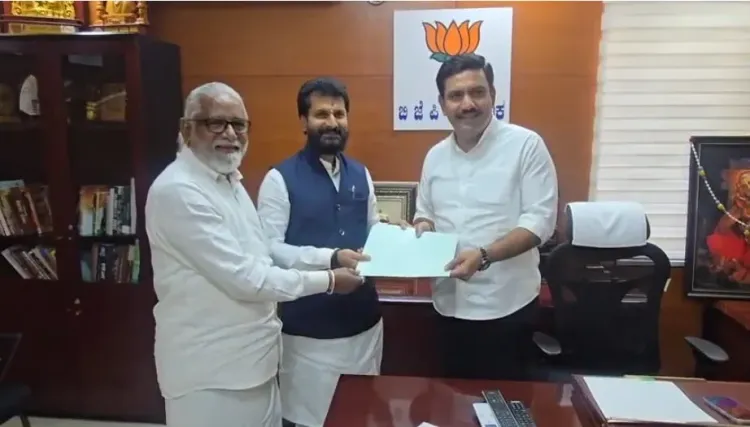
A three-member BJP inquiry panel submitted its cross-voting report to Karnataka State President B.Y.
Vijayendra on 27 June .
The panel, led by C.T.
Ravi , alleged 12 NDA votes were cross-voted — 8 from JD(S) and 4 from BJP .
Ravi blamed the Congress for engineering the cross-voting through 'unethical practices'.
Somashekar alleged Union Minister Shobha Karandlaje was directly responsible, citing internal party rivalry.
The report is interim ; the BJP Core Committee will decide if further investigation is needed.
Ashoka had briefed national BJP President Nitin Nabin in New Delhi earlier in the week.
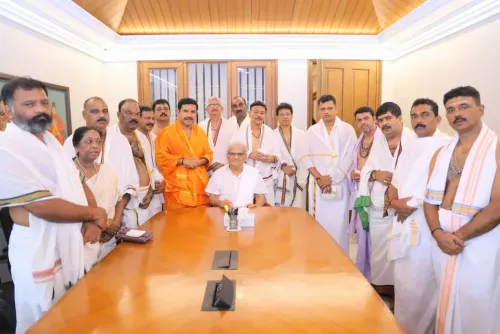
A three-member Bharatiya Janata Party (BJP) inquiry committee on Saturday, 27 June submitted its findings to Karnataka BJP State President B.Y. Vijayendra regarding alleged cross-voting by party legislators during the recently concluded Karnataka Legislative Council elections. The report, completed in four days, marks the party's formal internal reckoning with a controversy that has exposed deep fissures within its state unit.
What the Committee Found
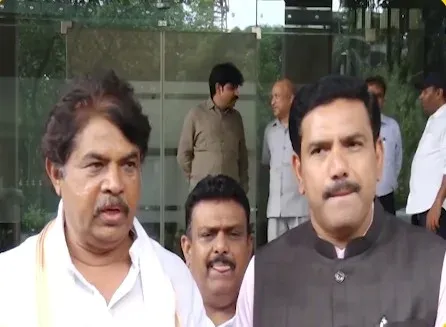
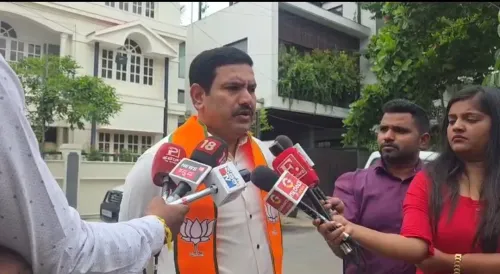
The panel — comprising former BJP national general secretary and MLC C.T. Ravi, State Vice-President N. Mahesh, and MLA Mahesh Tenginakayi — was constituted by Vijayendra to conduct an internal inquiry. Speaking to reporters outside the BJP state office in Bengaluru, Ravi said all three members reached unanimous findings.
'The committee was asked to investigate the matter and submit a report. As directed, we completed the enquiry within four days. All three members unanimously agreed on the findings, and the report has now been submitted to the State President,' Ravi said.
The committee held virtual meetings, conducted one-on-one discussions with party leaders, consulted Janata Dal (Secular) (JD(S)) leaders, engaged with the party's Chief Whip and Leader of the Opposition, and cross-referenced media sources to build its case.
The Cross-Voting Numbers
Ravi alleged that a total of 12 NDA votes were cross-voted during the Council elections. He said each of the two BJP candidates had been allocated 30 votes. One candidate secured 29 votes with one declared invalid, while the second received only 27 votes — a shortfall of three. The JD(S) candidate, expected to receive 22 votes, secured only 14, pointing to a loss of eight JD(S) votes and four BJP votes.
'This indicates that eight JD(S) votes and four BJP votes — a total of 12 NDA votes — were cross-voted,' he claimed, while declining to disclose the full contents of the report, citing its internal nature.
BJP Targets Congress Over 'Unethical Practices'
Ravi squarely blamed the ruling Indian National Congress (Congress) for engineering the cross-voting, alleging the use of unethical means. 'The Congress should not think these votes came because of affection for the party. The cross-voting was the result of unethical practices,' he alleged. He added that Congress leaders who have criticised similar incidents in other states now 'have no moral authority' to question such conduct.
The report also reportedly identified lapses in the BJP's own internal processes and areas where the party should have exercised greater caution. Ravi described it as an interim report, with the State President and the party's Core Committee to decide on further investigation.
The Wider Political Storm
The controversy has taken on a multi-layered character. On Friday, Vijayendra visited the Dharmasthala pilgrimage centre and publicly denied any connection with Chief Minister D.K. Shivakumar, dismissing allegations that he had encouraged the cross-voting.
Expelled BJP MLA S.T. Somashekar on Thursday alleged that Union Minister of State Shobha Karandlaje was directly responsible, attributing it to internal rivalry. He also claimed that tensions between Vijayendra and Leader of the Opposition R. Ashoka had contributed to the breakdown in party discipline, and that the cross-voting was part of a conspiracy to force both leaders out of their positions.
Earlier in the week, Vijayendra and Ashoka had travelled to New Delhi on Tuesday to brief national BJP President Nitin Nabin on the situation. Notably, the episode comes at a particularly sensitive moment for the BJP nationally, as several Opposition legislators across the country are reportedly gravitating toward the National Democratic Alliance (NDA) — making the reverse trend in Karnataka a source of considerable embarrassment for the party.
What Happens Next
The State BJP President and the Core Committee will now review the interim report and determine whether a deeper investigation is warranted. With allegations pointing in multiple directions — at the Congress, at a Union Minister, and at internal leadership rivalries — the BJP's response in the coming days will be closely watched as a test of the party's ability to manage dissent ahead of future electoral contests in Karnataka.
Point of View
The State President, and the Leader of the Opposition simultaneously suggests the problem is structural, not incidental. An interim report that declines to name names publicly does little to restore discipline; it merely defers the reckoning. The timing is doubly damaging: as the BJP nationally benefits from Opposition defections to the NDA, a reverse current in Karnataka hands the Congress a ready-made counter-narrative.
NationPress
26 Sept 2026
Frequently Asked Questions
What is the BJP cross-voting controversy in Karnataka?
The controversy centres on alleged cross-voting by BJP and JD(S) legislators during the Karnataka Legislative Council elections, in which 12 NDA votes are alleged to have been cast in favour of the Congress. The BJP constituted an internal inquiry panel to investigate, which submitted its report on 27 June.
What did the BJP inquiry panel find?
The three-member panel, led by C.T. Ravi, concluded that 12 NDA votes — 8 from JD(S) and 4 from BJP — were cross-voted. The full contents of the report have not been made public, as the panel described it as an internal document.
Who has been blamed for the cross-voting?
BJP's C.T. Ravi alleged the Congress engineered the cross-voting through unethical means. Separately, expelled BJP MLA S.T. Somashekar alleged that Union Minister of State Shobha Karandlaje was directly responsible, citing internal rivalry with State President Vijayendra and Leader of the Opposition R. Ashoka.
What happens next in the BJP's internal inquiry?
The report submitted on 27 June is described as interim. The Karnataka BJP State President and the party's Core Committee will now decide whether a further, deeper investigation is required.
Why is this controversy significant for the BJP nationally?
The episode is particularly damaging because it comes at a time when Opposition legislators in other states are reportedly joining the NDA. Cross-voting in the opposite direction in Karnataka gives the Congress a political counter-narrative and raises questions about BJP's internal discipline in the state.