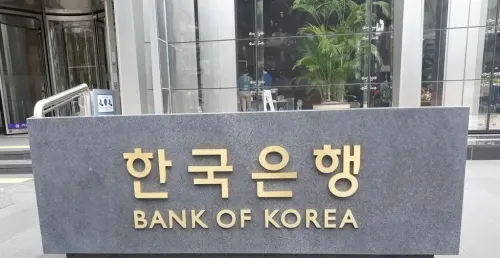
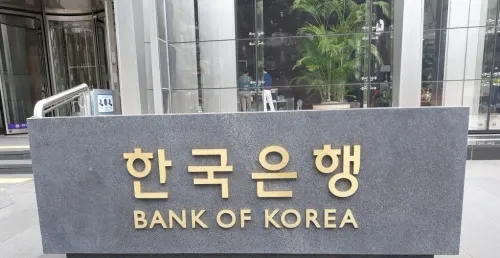
Bank of Korea Holds Interest Rate Steady, Upgrades 2026 Growth Outlook
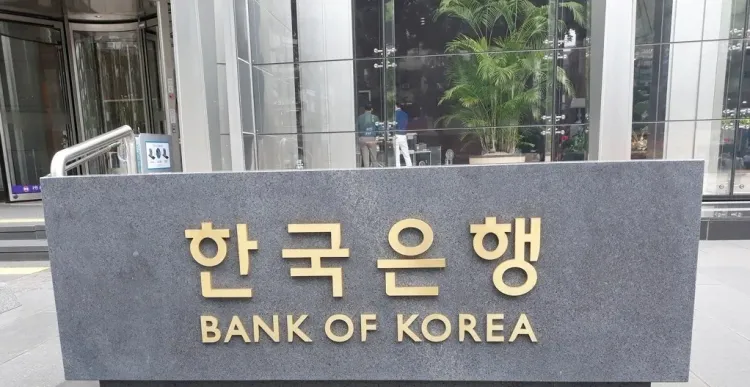
Synopsis
In a significant move for the South Korean economy, the Bank of Korea has decided to keep its interest rate steady at 2.5%. This decision reflects a stronger-than-expected growth momentum and comes amid concerns over household debt and real estate instability. Discover what this means for the future of South Korea's economy.
Key Takeaways
Interest Rate: The Bank of Korea maintains the benchmark interest rate at 2.5%.
Growth Forecast: The 2026 growth forecast has been upgraded to 2%.
Property Market: Apartment prices in Seoul increased by 8.98% year-on-year.
Household Debt: Rising household debt remains a key concern.
Inflation: The inflation forecast has been adjusted to 2.2% for this year.
Seoul, Feb 26 (NationPress) The central bank of South Korea has decided to maintain its benchmark interest rate on Thursday, attributing this choice to stronger-than-anticipated growth dynamics. The move aims to ensure financial stability in the face of a weakening local currency and a volatile housing sector. In a decision widely anticipated, the Monetary Policy Board of the Bank of Korea (BOK) opted to keep the key rate at 2.5 percent during its recent meeting in Seoul, as reported by the Yonhap news agency.
This marks the sixth consecutive time the bank has opted not to change rates, despite being in a cycle of easing.
Since October 2024, the BOK has lowered the benchmark interest rate by a total of 100 basis points from 3.5 percent to stimulate economic growth, maintaining this rate since May 2025.
The BOK appears to be taking a cautious approach as the economy continues to recover, fueled by strong exports linked to a semiconductor boom.
On this day, the central bank also expressed a positive outlook for the local economy, revising its growth forecast for 2026 upward by 0.2 percentage points to 2 percent.
A significant factor in Thursday's decision was the instability in the property market and the growing household debt levels.
According to recent data from the Korea Real Estate Board, apartment prices in Seoul saw an 8.98 percent year-on-year increase in 2025, the highest growth rate since 2013, when records began.
Despite the government's intensified measures to temper the overheated housing market, the average selling price of apartments in Seoul has continued to rise, with a 0.15 percent increase in the second week of February compared to the previous week.
President Lee Jae Myung has reiterated his strong commitment to stabilizing the real estate market, issuing warnings against property owners with multiple homes, stating, "the root of all problems in this country lies in real estate."
Additionally, the Bank of Korea has raised its growth forecast for this year to 2 percent, citing robust exports and a rebound in private consumption.
This revision represents a 0.2 percentage-point increase from the earlier forecast of 1.8 percent made in November.
The updated forecast aligns with the government's growth predictions and is slightly more optimistic than the 1.9 percent projections by the International Monetary Fund (IMF) and the Korea Development Institute (KDI).
Moreover, the BOK has revised its consumer price inflation forecast for the year, increasing it to 2.2 percent from 2.1 percent due to rising global oil prices influenced by geopolitical tensions.
Point of View
I view the Bank of Korea's decision to maintain interest rates as a strategic move aimed at balancing growth with financial stability. The bank's cautious approach reflects current economic dynamics and significant concerns regarding the property market and household debt. Such measures are pivotal for ensuring sustainable growth in the South Korean economy.
NationPress
2 Oct 2026
Frequently Asked Questions
Why did the Bank of Korea decide to keep interest rates unchanged?
The Bank of Korea decided to keep interest rates unchanged to support financial stability amid stronger-than-expected economic growth and concerns about the local currency and housing market.
What is the new growth forecast for South Korea in 2026?
The Bank of Korea raised its growth forecast for South Korea in 2026 to 2 percent, up by 0.2 percentage points from the previous estimate.
How has the real estate market in Seoul performed recently?
Recent data indicates that apartment prices in Seoul rose by 8.98 percent year-on-year in 2025, marking the highest growth since 2013.
What inflation forecast has the Bank of Korea revised?
The Bank of Korea revised its inflation forecast for this year to 2.2 percent, up from 2.1 percent, due to rising global oil prices.
What are the implications of rising household debt in South Korea?
Rising household debt poses risks to financial stability and is a concern for the Bank of Korea, particularly in the context of the volatile real estate market.