Mumbai-Ahmedabad Bullet Train electrification: India's first 320 kmph rail power system takes shape
Synopsis
India's bullet train corridor is quietly crossing a major engineering threshold — the country's first-ever high-speed railway electrification system, built to push trains at 320 kmph, is now taking shape across 1,125 track kilometres with 22,000 steel masts, 28 earthquake-detection seismometers, and a growing list of components now made in India.
Key Takeaways
Electrification is underway on the 508-km Mumbai–Ahmedabad Bullet Train corridor , deploying India's first 2×25 kV Overhead Traction System for speeds up to 320 kmph .
14 Traction Substations are being built — 5 in Maharashtra and 9 in Gujarat — fed by the National Power Grid through Grid Substations.
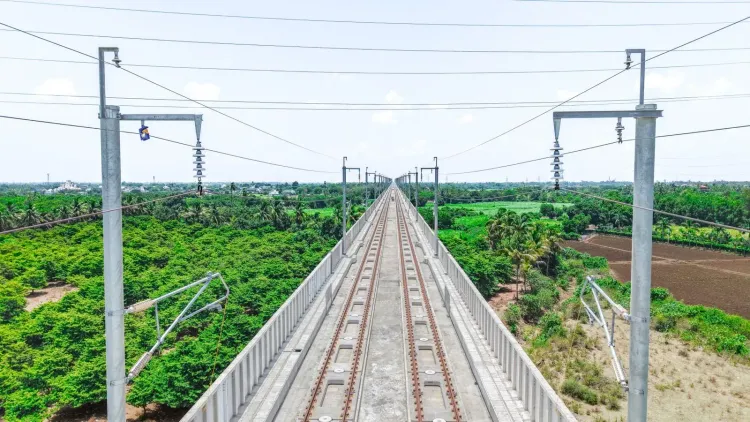
The overhead network spans 1,125 track kilometres , supported by nearly 22,000 steel masts and over 25,700 cantilever assemblies .
28 seismometers will be deployed along the corridor and inland, capable of detecting earthquakes and stopping trains within seconds.
Key components including major transformers and overhead wire systems are now being manufactured domestically under the project's localisation drive.
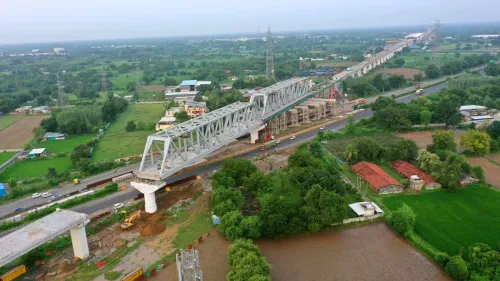
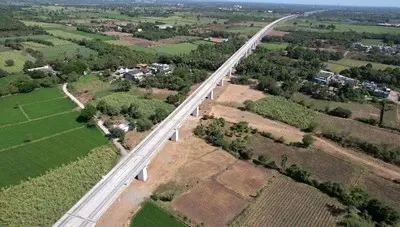
Electrification works on the 508-km Mumbai–Ahmedabad High Speed Rail corridor are advancing in parallel with civil construction and track laying, with officials confirming on 22 July that the project is deploying India's first high-speed railway electrification system — engineered to sustain train operations at speeds of up to 320 kmph. The scale and technical complexity of the infrastructure mark a significant departure from anything previously built on Indian rail.
The Power Architecture: How Electricity Will Move the Bullet Train
The corridor is being fitted with a 2×25 kV Overhead Traction System — a technology standard on high-speed rail networks globally but being deployed in India for the first time. Power drawn from the National Power Grid will be routed through specially designed Grid Substations into 14 Traction Substations distributed along the route.
Of these, five are located in Maharashtra — at Mumbai, Thane, Virar, Boisar, and the Thane Depot — while the remaining nine are in Gujarat, at Vapi, Bilimora, Surat, Bharuch, Vadodara, Anand, Mahemdabad, Ahmedabad, and the Sabarmati Depot. The substations are designed to ensure seamless power transitions as trains cross between sections without any operational disruption.
Supporting this backbone are 31 Switching Posts to maintain uninterrupted supply and enable rapid fault isolation, alongside 16 Distribution Substations that will power stations, signalling systems, maintenance facilities, and other operational infrastructure.
The Overhead Network: Scale and Engineering Firsts
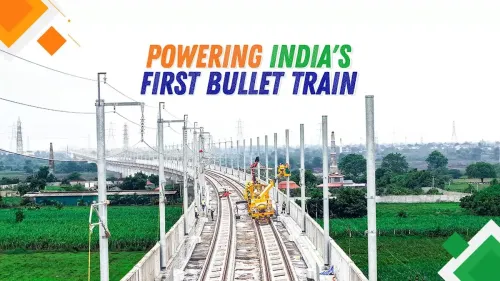
The overhead electrification network will span 1,125 track kilometres, including depots, supported by nearly 22,000 steel masts and more than 25,700 cantilever assemblies. The masts stand between 10.5 and 14.5 metres high and carry a compound catenary system — another technology making its Indian debut on this project.
Every wire in the system will be installed under precisely calculated mechanical tension, ensuring the train's pantograph can draw power smoothly and continuously at speeds of up to 320 kmph without interruption or voltage fluctuation. This level of engineering precision has no precedent in India's existing rail infrastructure.
Domestic Manufacturing: The Make-in-India Dimension
Officials highlighted a growing localisation push within the electrification programme. Major transformers, cross arms mounted on overhead equipment masts, and the ground, protection, and feeder wires forming the upper electrical network are now being manufactured in India. Several components across the traction power supply system, distribution power system, and electro-mechanical works are also being sourced domestically.
This localisation drive is intended to strengthen India's industrial base, generate specialised employment, reduce import dependence, and build a domestic manufacturing ecosystem capable of supporting future high-speed rail projects. Notably, this mirrors the broader indigenisation trajectory seen in India's defence and semiconductor sectors in recent years.
Earthquake Safety: Seismometers Along the Entire Route
Safety infrastructure forms a critical layer of the electrification plan. Each of the 14 Traction Substations will be equipped with Early Earthquake Detection Seismometers capable of detecting seismic activity and triggering protective measures — including stopping trains — within seconds of an event.
A total of 28 seismometers are planned across the project: 22 installed along the high-speed corridor at Traction Substations and Switching Posts, and 6 additional inland units positioned in earthquake-prone areas of Maharashtra and Gujarat. In Maharashtra, seismometers will be placed near Mumbai, Thane, Virar, Boisar, Kheda, Ratnagiri, Latur, and Pangri; in Gujarat, near Vapi, Bilimora, Surat, Bharuch, Vadodara, Anand, Mahemdabad, Ahmedabad, Adesar, and Old Bhuj.
Centralised Monitoring and What Comes Next
The entire electrical network will be monitored in real time from a centralised control centre, where automated protection systems are designed to respond within fractions of a second to any anomaly. As civil construction and track-laying continue alongside electrification, the convergence of these workstreams will be a key indicator of the project's overall timeline.
Point of View
And the domestic manufacturing push is being watched as a proof-of-concept for whether India can build, not just buy, high-speed rail. The seismometer network across Maharashtra and Gujarat also signals a serious safety architecture — a necessary credibility signal for a country where rail disasters still shape public trust. The real question is whether the localisation momentum holds across the full project lifecycle, or whether procurement pressures eventually push critical components back to imports.
NationPress
21 Oct 2026
Frequently Asked Questions
What electrification system is being used on the Mumbai–Ahmedabad Bullet Train corridor?
The corridor is being equipped with a 2×25 kV Overhead Traction System, a technology widely used on high-speed rail networks internationally but being deployed in India for the first time. It is designed to deliver stable, uninterrupted power for train operations at speeds up to 320 kmph.
How many traction substations are being built along the bullet train route?
A total of 14 Traction Substations are being constructed — 5 in Maharashtra at Mumbai, Thane, Virar, Boisar, and Thane Depot, and 9 in Gujarat at Vapi, Bilimora, Surat, Bharuch, Vadodara, Anand, Mahemdabad, Ahmedabad, and Sabarmati Depot. They will supply power to different sections of the corridor for seamless train movement.
What is the scale of the overhead electrification network on the bullet train corridor?
The overhead network will extend across 1,125 track kilometres, including depots, supported by nearly 22,000 steel masts standing between 10.5 and 14.5 metres high, and more than 25,700 cantilever assemblies carrying a compound catenary system — another technology being introduced in India for the first time.
How will the bullet train corridor handle earthquake safety?
A total of 28 Early Earthquake Detection Seismometers are planned across the project — 22 along the corridor at Traction Substations and Switching Posts, and 6 additional inland units in earthquake-prone zones of Maharashtra and Gujarat. These are capable of detecting seismic activity and triggering measures to stop trains within seconds.
Are any bullet train components being made in India?
Yes. Major transformers, cross arms for overhead masts, and ground, protection, and feeder wires are now being manufactured domestically. Several components across the traction power supply, distribution power, and electro-mechanical systems are also being sourced within India, with the aim of building a domestic ecosystem for future high-speed rail projects.