Chinese Statistics Are Misleading, Warns CEPA Report

Synopsis
A bombshell CEPA report warns that China's official statistics — from GDP to military tech claims — are systematically manipulated. Author James Lewis reveals how Beijing arrests researchers, inflates growth figures, and conceals debt, urging the world to stop taking Chinese data at face value.
Key Takeaways
James Lewis , Distinguished Fellow at CEPA (Washington, DC) , warns that accepting Chinese official statistics at face value is a strategic mistake.
China classifies more data as state secrets than most nations and has arrested journalists for publishing figures other countries consider public.
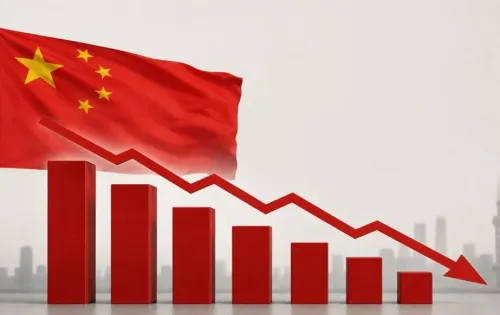
China's GDP figures are routinely inflated while national debt levels are deliberately obscured, distorting global economic comparisons.
China's J-20 fighter jet being equivalent to the US F-35 is described as bogus in the report, with recent military deployments in Venezuela and Iran cited as evidence.
Despite leading in 5G tower deployment , China trails the United States in actual consumer access to 5G services , per the CEPA findings.
The report urges global policymakers to apply rigorous independent scrutiny to all data originating from Chinese government sources .
A new report by the Center for European Policy Analysis (CEPA), headquartered in Washington, DC, has issued a stark warning that accepting official Chinese statistics at face value is a critical error — one that distorts global understanding of China's actual technological, economic, and military capabilities. The report, authored by James Lewis, a Distinguished Fellow at CEPA's Tech Policy Programme, was flagged in New Delhi on April 25.
China's Data Opacity: A Deliberate Strategy
Lewis argues that China is engaged in a long-running influence campaign designed to project an image of inevitable dominance across sectors. The report makes clear that while China is genuinely advancing in several areas, the scale of that progress is frequently exaggerated through carefully curated data.
China's government classifies far more information as state secrets than most other nations do. Economic statistics, in particular, are routinely massaged, suppressed, or selectively published to support a preferred national narrative. In extreme cases, China has even arrested journalists and researchers for disclosing data that would be considered freely available public information in most democracies.
Lewis writes that there are places where China is ahead, but fewer than a casual reading might suggest, urging analysts and policymakers to apply rigorous scrutiny before drawing conclusions from Chinese-sourced figures.
GDP Inflation and Debt Concealment
One of the most consequential areas of data manipulation, according to the report, involves GDP metrics and national debt levels. There is a persistent institutional pressure within China to inflate growth figures while simultaneously obscuring liabilities that would contradict the narrative of uninterrupted economic success.
Lewis points out that while published data may appear to show the United States carrying more public debt than China, this comparison is fundamentally flawed. He writes that this is the result of Chinese obfuscation, meaning China's true debt burden is deliberately hidden from international scrutiny, making direct comparisons unreliable.
Military Claims Under the Microscope
The report also scrutinises China's military technology claims, finding several to be significantly overstated. China's assertion that its radar systems could detect stealth aircraft, and that its J-20 fighter jet was a direct equivalent to the US F-35, is described as bogus by Lewis.
The report points to recent events in Venezuela and Iran — where Chinese-supplied military technology reportedly underperformed — as evidence that such claims were exaggerated. Additionally, the mysterious disappearance of the J-20's chief designer has raised further questions about the programme's actual status and credibility.
5G and Scientific Publications: Metrics That Mislead
The CEPA report also challenges how widely used benchmarks are interpreted. The volume of scientific citations and research publications from China is often cited as proof of academic dominance — but the report cautions that the metric of what is being counted must be examined against what it actually measures in real-world impact.
On 5G infrastructure, China has undoubtedly built more towers and coverage networks. However, when the metric shifts to actual consumer access to 5G services, the United States leads, according to the report. Similarly, China operates more high-speed rail lines, but the US maintains a significantly larger fleet of passenger aircraft — illustrating how raw numbers can paint an incomplete picture depending on what is being measured.
Why This Matters for India and the World
For India, which shares a contested border with China and competes with it across diplomatic, economic, and technological domains, the implications of this report are particularly significant. Policymakers who rely on inflated Chinese economic data or overestimated military capability assessments risk making strategic miscalculations.
This comes amid growing global calls for greater transparency in how nations report economic and technological benchmarks — a conversation in which China's opacity stands in sharp contrast to the disclosure standards of G7 nations. As geopolitical competition intensifies, the reliability of data from rival states will increasingly shape defence budgets, trade policy, and diplomatic alignments worldwide.
Analysts expect this report to fuel further debate within Western policy circles and multilateral institutions about establishing independent verification mechanisms for data published by non-transparent governments — a development that could reshape how international rankings and indices are constructed in the years ahead.
Point of View
Data itself is a weapon. China's systematic manipulation of economic and technological metrics is not just a transparency issue — it is a strategic tool designed to demoralise rivals and attract investment under false pretences. For India, which is locked in a multi-front competition with Beijing, accepting Chinese statistics uncritically is not naivety — it is a strategic liability. The world needs independent verification frameworks, and this report should accelerate that conversation at the UN and G20 levels.
NationPress
19 Sept 2026
Frequently Asked Questions
Why are Chinese government statistics considered unreliable?
Chinese government statistics are considered unreliable because Beijing classifies extensive data as state secrets, routinely adjusts economic figures to support political narratives, and has arrested journalists for publishing data that most countries treat as public. A 2025 CEPA report by James Lewis highlights systematic manipulation of GDP, debt, and technology metrics.
What does the CEPA report say about China's military technology claims?
The CEPA report states that China's claims — including that its radar can detect stealth aircraft and that the J-20 fighter jet equals the US F-35 — are bogus. Events in Venezuela and Iran, where Chinese military tech reportedly underperformed, and the disappearance of the J-20's designer, support this assessment.
Is China ahead of the US in 5G technology?
China leads in 5G infrastructure deployment, including the number of towers built, but the United States leads when measured by actual consumer access to 5G services, according to the CEPA report. This distinction illustrates how raw metrics can be misleading without proper context.
Who authored the CEPA report on Chinese statistics?
The report was authored by James Lewis, a Distinguished Fellow at the Tech Policy Programme of the Center for European Policy Analysis (CEPA), based in Washington, DC. It was highlighted in New Delhi on April 25, 2025.
How does China manipulate its GDP and debt data?
According to the CEPA report, China inflates GDP figures to project economic strength while concealing its true national debt levels through deliberate obfuscation. This makes direct comparisons with countries like the US misleading, as China's actual debt burden is far higher than officially reported figures suggest.