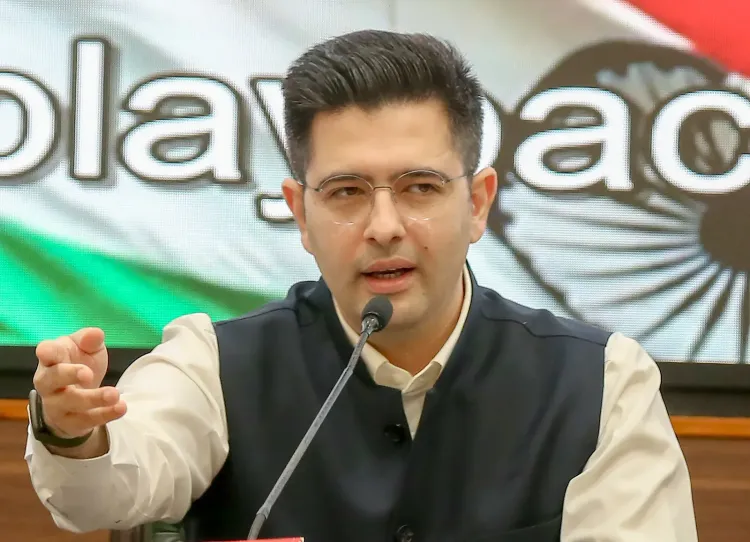
Raghav Chadha's voter record marked 'shifted' in Punjab SIR rolls; BJP MP cries political vendetta
Synopsis
A sitting Rajya Sabha MP’s voter record quietly marked ‘shifted’ in Punjab’s draft electoral rolls — and the MP in question is a defector who left AAP for the BJP. Raghav Chadha’s allegation cuts to a structural vulnerability: every official in Punjab’s SIR process chain reports to the same state government he is accusing of targeting him.
Key Takeaways
BJP Rajya Sabha MP Raghav Chadha alleges his voter record in Mohali was marked ‘permanently shifted’ in Punjab’s SIR draft electoral rolls .
Chadha left AAP and joined the BJP in April 2026 along with six other AAP MPs under the anti-defection merger provision.
He invoked Paragraph 4(d) of ECI’s SIR guidelines, which mandates inclusion of sitting public representatives’ names in draft rolls.
The Claims and Objections process is ongoing; final electoral rolls are due in October 2026 .
Chadha alleged the entire SIR process chain — from BLO to Chief Electoral Officer — comprises Punjab government officials, enabling political pressure.
The AAP government in Punjab had not publicly responded to the allegations at the time of reporting.
Bharatiya Janata Party (BJP) Rajya Sabha member Raghav Chadha on Thursday, 3 September accused the Aam Aadmi Party (AAP)-led Punjab government of deliberately classifying his voter identification record in Mohali as ‘permanently shifted’ in the draft electoral rolls prepared under the Election Commission of India’s Special Intensive Revision (SIR), alleging that the move violated ECI guidelines designed to protect the names of sitting public representatives.
What the Draft Rolls Show
Chadha, who was elected to the Rajya Sabha from Punjab in 2022 on an AAP ticket before joining the BJP in April 2026 along with six other AAP MPs under the anti-defection merger provision, said his voter ID is registered in Mohali, Punjab. Despite holding a sitting MP’s status, his name was classified as ‘shifted’ in the SIR draft rolls, he alleged.
“The AAP government in Punjab has now taken its politics of revenge to the Draft Electoral Rolls. I am a sitting Rajya Sabha MP from Punjab, with my voter ID registered in Mohali, Punjab. Yet my name has been classified as ‘shifted’ in the draft electoral rolls,” Chadha said in a post on X.
Why Chadha Calls It Political Vendetta
The BJP leader argued that the classification was not a clerical oversight but a “clear case of political vendetta.” He pointed out that every official in the SIR process chain — from the Booth Level Officer (BLO) to the Assistant Electoral Registration Officers (AEROs), Electoral Registration Officers (EROs), District Election Officers (DEOs), and the Chief Electoral Officer of Punjab — is a Punjab government official.
“Who marked me as ‘shifted’? An official of AAP’s Punjab Government. Who verified that classification? Again, an officer of AAP’s Punjab Government. Who processed it at higher level? Once again, the same AAP’s Punjab Government official,” Chadha alleged.
He further claimed that these officers are aware that the AAP government controls their transfers, postings, and career trajectories once their electoral duty ends, which he said creates structural conditions for political pressure to be applied through the state machinery.
The ECI Guideline He Invoked
Chadha cited Paragraph 4(d) of the Election Commission of India’s Detailed Guidelines for SIR, which mandates a ‘protected list’ ensuring that names of members of the judiciary, public representatives, holders of declared offices, and public personalities — once flagged in the electoral database — must be included in the draft electoral rolls so that necessary documents can be collected during the Claims and Objections period.
“I am a sitting Member of Parliament from Punjab. If at all my name was flagged, Paragraph 4(d) required my inclusion in the draft electoral rolls. The instruction was not overlooked. It was wilfully violated in my case,” he said.
The Remedies Available and What Comes Next
Chadha acknowledged that the rolls in question are still at the draft stage, and that the Claims and Objections process — the formal window for corrections — remains open. Final electoral rolls for Punjab are expected to be published in October 2026.
“Thankfully, these are only the Draft Electoral Rolls, not the Final Electoral Rolls. Names are corrected during the ‘Claims and Objections’ process, which is ongoing. I am already in the process of availing the remedies provided under SIR guidelines,” he said.
Chadha also alleged that his case is not isolated, claiming that other MPs who left AAP and joined the BJP have similarly been targeted by the Punjab government’s administrative machinery. “AAP may run the Punjab Government, but Punjab’s Draft Electoral Rolls are not its private property,” he added. The AAP government in Punjab had not issued a public response to the allegations at the time of reporting.
Point of View
The same state government machinery that runs daily administration also staffs the electoral revision chain at every level. That overlap creates a latent conflict of interest regardless of which party is in power. What makes this case politically loaded is the timing — a high-profile defector’s name flagged in a revision exercise conducted by the government he defected from. Whether or not intent is proven, the ECI’s Paragraph 4(d) protection exists precisely to prevent such optics. The more important question mainstream coverage is missing: how many other names of public representatives across India have been similarly classified in this SIR cycle, and is Punjab an outlier or a pattern?
NationPress
18 Oct 2026
Frequently Asked Questions
What happened to Raghav Chadha’s voter record in Punjab’s SIR draft electoral rolls?
BJP Rajya Sabha MP Raghav Chadha’s voter ID, registered in Mohali, Punjab, was classified as ‘permanently shifted’ in the draft electoral rolls prepared under the Election Commission’s Special Intensive Revision (SIR). Chadha alleged this was a deliberate act of political vendetta by the AAP-led Punjab government, not a clerical error.
What is the Election Commission’s SIR Paragraph 4(d) that Chadha cited?
Paragraph 4(d) of the ECI’s Detailed Guidelines for SIR mandates that names of sitting public representatives, judiciary members, and other flagged personalities must be included in the draft electoral rolls so documents can be verified during the Claims and Objections period. Chadha argued this provision was wilfully violated in his case.
Can Chadha’s voter record still be corrected?
Yes. The rolls in question are draft electoral rolls, not the final version. The Claims and Objections process — the formal correction window — is currently ongoing. Chadha confirmed he is pursuing remedies under SIR guidelines. Final electoral rolls for Punjab are expected to be published in October 2026.
Why did Raghav Chadha leave AAP and join BJP?
Chadha, elected to the Rajya Sabha from Punjab in 2022 on an AAP ticket, joined the BJP in April 2026 along with six other AAP MPs, invoking the anti-defection merger provision. He has since alleged that AAP’s leadership has used state machinery to retaliate against those who left the party.
Has the AAP government in Punjab responded to Chadha’s allegations?
The AAP government in Punjab had not issued a public response to Chadha’s allegations at the time of reporting. Chadha also claimed that other MPs who left AAP and joined the BJP have faced similar targeting by Punjab’s administrative machinery.