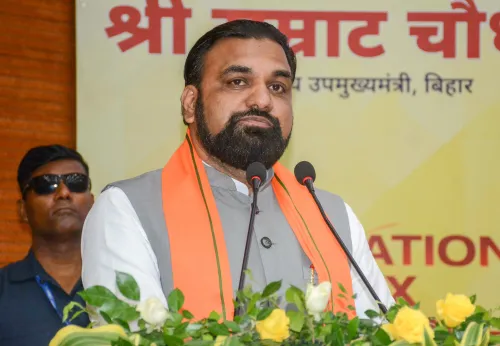
What Did Samrat Choudhary Say About RJD and Law-and-Order Measures in Bihar Assembly?
Synopsis
In a fiery debate at the Bihar Assembly, Deputy Chief Minister Samrat Choudhary criticized RJD leaders for their inactivity while outlining significant law-and-order enhancements in Bihar, from new housing for police to advanced forensic capabilities.
Key Takeaways
Strengthened Special Task Force and police infrastructure.
Introduction of centralized monitoring systems for police accountability.
Regular public hearings to enhance citizen-police relations.
Continuous training for police in forensic and cybercrime techniques.
Commitment to maintaining law and order as a foundation for economic growth.
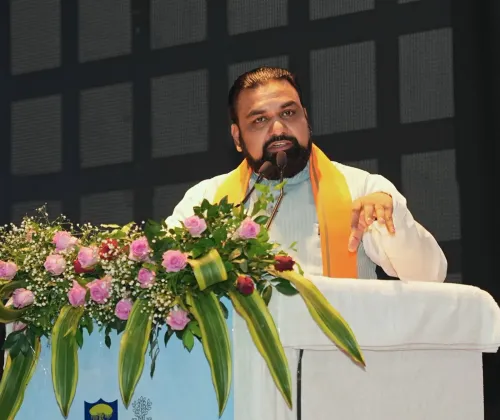
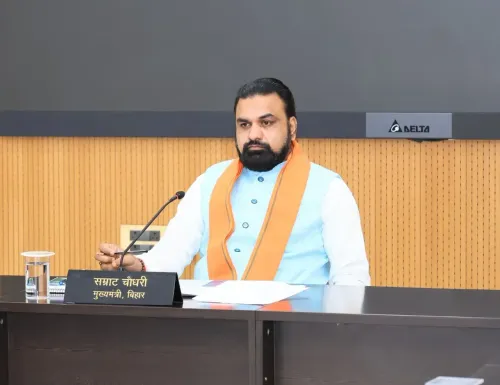
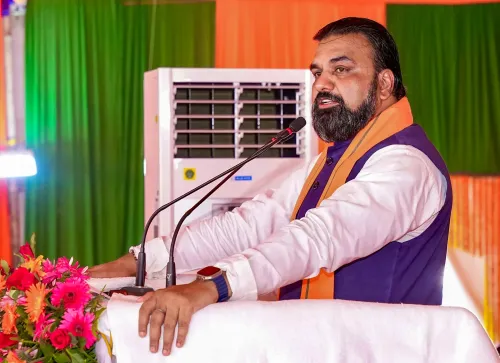
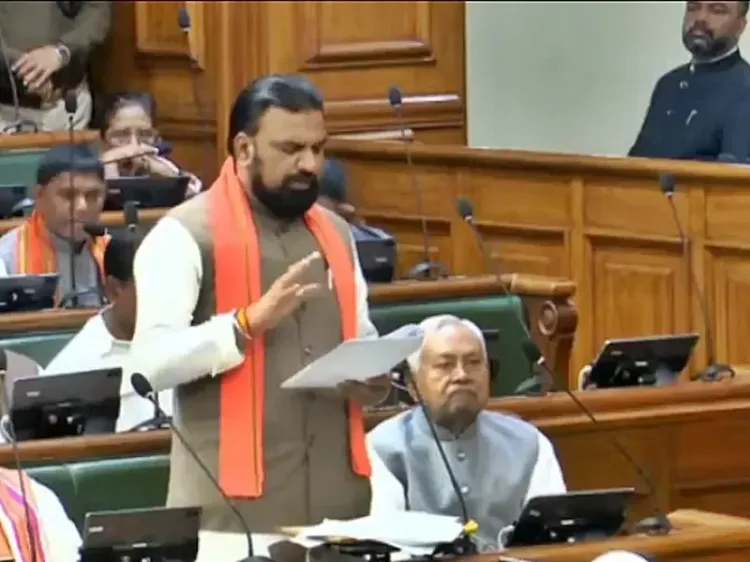
Patna, Feb 20 (NationPress) In a pointed critique during the Bihar Legislative Assembly's discussion on the Home Department's budget, Deputy Chief Minister Samrat Choudhary took aim at the Rashtriya Janata Dal (RJD). He asserted that while RJD leaders are active on social media, they neglect to present even budget cut motions in the House.
Choudhary emphasized that all significant policy decisions of the state government are made under the guidance of Chief Minister Nitish Kumar.
Addressing the law-and-order scenario in Bihar, Choudhary highlighted that the state government has notably enhanced the Special Task Force (STF) and the comprehensive policing framework to bolster crime management and public security.
He reported to the Assembly that criminals are consistently apprehended and that a centralized monitoring system is now in place to oversee the operations of every police station, ensuring accountability and efficiency throughout the state.
The Deputy Chief Minister also mentioned that 618 residential structures are underway to house around 27,000 constables, along with 1,279 housing units designated for female constables, as part of police welfare and infrastructure enhancement.
Moreover, he stated that a centralized system has been set up to monitor the function of the STF and police stations across Bihar.
As part of this initiative, 968 police stations are now connected to an online CCTV surveillance network, with infrastructure upgrades and connectivity work ongoing in an additional 343 police stations.
Choudhary urged police officers statewide to hold regular public hearings to ensure timely resolutions of citizens' issues and to foster better police-public relations.
A comprehensive mechanism for monitoring reporting, performance, and actions taken by government officials and police staff has also been established to promote transparency and accountability.
He underscored initiatives in cyber security, stating that continuous monitoring of cybercrime is being conducted in all districts through the National Cyber Crime Reporting Portal (NCRP), which has reinforced crime detection, prevention, and law-and-order management.
Choudhary claimed that Bihar is now devoid of Maoist activities, asserting that no extremist criminal networks are operational within the state.
He also mentioned advancements in forensic capabilities, with forensic laboratories established in every district, allowing teams to quickly arrive at crime scenes and gather scientific evidence to support criminal investigations.
Additionally, he informed the House that security forces recently confiscated 2,722 cartridges, 174 detonators, and 135 bombs from extremist factions, commending both Chief Minister Nitish Kumar and the Prime Minister for their efforts in enhancing security operations within the state.
The Deputy Chief Minister stated that the Bihar Police force is being consistently strengthened to address emerging security threats and ensure effective law enforcement.
He added that two new battalions are being formed to safeguard industrial units and strategic facilities across the state.
Of the 15,000 Home Guard personnel selected, 11,438 have already been inducted, with recruitment currently in progress for an additional 31,000 police personnel.
More Home Guard personnel and Rakshak Jawans will also be recruited during 2026–27 to further bolster the state's security framework.
In concluding his address, Choudhary stated that ongoing training is being provided to police and security personnel in areas such as forensic science, cybercrime investigation, and skill development.
He reaffirmed that Bihar's economic and social advancement hinges on a robust law-and-order structure, assuring the Assembly of the government's commitment to creating a modern, proficient, and well-equipped policing and security system in the state.
Point of View
It is imperative to recognize the ongoing efforts by the Bihar government to enhance law and order. The Deputy Chief Minister's assertions reflect a strategic approach to tackling crime and improving public safety, which is vital for the region's stability and growth. The active role of political leaders in such discussions is essential for accountability and transparency.
NationPress
30 Sept 2026
Frequently Asked Questions
What measures are being taken to improve law and order in Bihar?
The Bihar government is enhancing the police force through increased housing for constables, centralized monitoring systems for police stations, and regular public hearings to address citizen complaints.
Is cybercrime being effectively monitored in Bihar?
Yes, continuous cybercrime monitoring is conducted across all districts using the National Cyber Crime Reporting Portal, which has significantly improved crime detection and prevention.
How is the Bihar government addressing the issue of extremism?
The government claims that Bihar is now free from Maoist activities and has established mechanisms to ensure the security of the state.