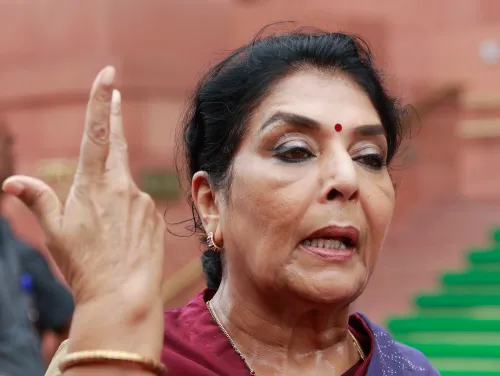
Congress MP Renuka Chowdhury Condemns Transgender Amendment Bill as Discriminatory
Synopsis
In a fierce critique of the Union government's Transgender Persons (Protection of Rights) Amendment Bill, Congress MP Renuka Chowdhury argues that it promotes discrimination over protection. Her remarks in the Rajya Sabha highlight significant concerns regarding the rights of transgender individuals in India.
Key Takeaways
Renuka Chowdhury criticized the Transgender Amendment Bill in the Rajya Sabha.
The Bill alters the legal recognition process for gender identity.
Chowdhury argues that the Bill undermines the rights of transgender individuals.
The government claims the amendments clarify welfare measures for transgender persons.
Opposition concerns highlight potential rollbacks of rights for marginalized communities.
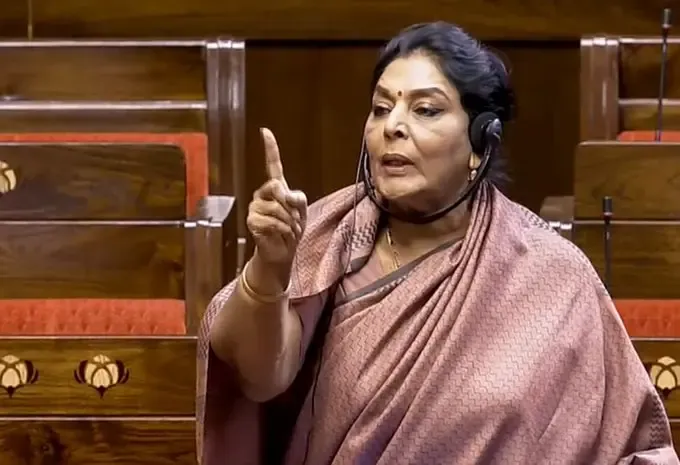
New Delhi, March 25 (NationPress) Congress Member of Parliament Renuka Chowdhury fiercely criticized the Union government in the Rajya Sabha while discussing the Transgender Persons (Protection of Rights) Amendment Bill, 2026. She likened the legislation to a "Special Intensive Revision (SIR) on transgender individuals" and asserted it constitutes an act of discrimination rather than a protective measure.
The Bill, which received approval from the Lok Sabha on Tuesday through a voice vote amidst a walkout by the Opposition, is now under consideration in the Upper House of Parliament.
Chowdhury initiated her remarks by directing a challenging inquiry towards her fellow Rajya Sabha members.
She questioned the validity of the self-identification of gender that all Members of Parliament acknowledge while completing official forms prior to entering Parliament.
"The Constitution stands with those who identify as transgender today. The Prime Minister (Narendra Modi) himself has identified as non-biological," she stated, igniting a stir within the House.
She quickly clarified that her comment was not intended as a critique of Prime Minister Narendra Modi but rather as a recognition of his progressive stance on the matter.
"Transgender individuals are represented in the Supreme Court, in law enforcement, and on sports fields winning medals for the nation. What is there to be ashamed of? Why impose new laws upon them?" the Congress Rajya Sabha MP questioned.
Chowdhury expressed that the Amendment Bill undermines the hard-fought rights of the transgender community by shifting from self-identification to increased bureaucratic and medical scrutiny.
She further remarked that the legislation appears more focused on exerting control than on authentic welfare or inclusivity.
The Transgender Persons (Protection of Rights) Amendment Bill, 2026, aims to amend the 2019 Act, including modifications to the process of legally recognizing gender identity.
Critics, including several MPs from the Opposition, argue that it weakens the principle of self-identified gender upheld by the Supreme Court in its landmark 2014 NALSA judgment.
As the debate progressed, members from various opposition parties voiced concerns that the Bill could reverse constitutional protections and create unnecessary barriers for one of the most marginalized groups in society.
In contrast, the Union government maintains that the amendments are intended to provide clarity and enhance the effectiveness of welfare initiatives for transgender individuals.
The discussion is anticipated to escalate into more intense political exchanges as the House moves forward with a clause-by-clause examination of the Bill.
Point of View
It is clear that this legislation has sparked a critical debate about the rights and recognition of transgender individuals in India. The concerns raised about bureaucratic overreach and the potential rollback of rights highlight the need for careful consideration of how such laws affect marginalized communities.
NationPress
23 Sept 2026
Frequently Asked Questions
What is the Transgender Persons (Protection of Rights) Amendment Bill?
The Transgender Persons (Protection of Rights) Amendment Bill, 2026, seeks to amend the 2019 Act, altering the legal recognition process for gender identity.
Who criticized the Amendment Bill in the Rajya Sabha?
Congress MP Renuka Chowdhury criticized the Amendment Bill, calling it discriminatory and an exercise in bureaucratic control.
What concerns did Chowdhury raise about the Bill?
Chowdhury expressed that the Bill undermines the rights achieved by the transgender community and shifts focus from self-identification to increased scrutiny.
What was the government's stance on the Amendment Bill?
The Union government claims that the amendments aim to clarify and enhance the implementation of welfare measures for transgender persons.
How did the Lok Sabha respond to the Bill?
The Bill was passed by the Lok Sabha on a voice vote, despite a walkout by the Opposition.