Did DRDO Successfully Test a High-Speed Rocket-Sled for Fighter Aircraft Escape Systems?
Synopsis
Discover how DRDO's latest high-speed rocket-sled test marks a pivotal moment in India's journey towards self-reliant defense technology. This breakthrough not only enhances pilot safety but also showcases India's growing capabilities in aerospace innovation.
Key Takeaways
DRDO conducted a successful high-speed rocket-sled test.
Test validated critical components of the fighter aircraft escape system.
Collaboration with ADA and HAL was key to the success.
Positioning India among elite nations with advanced testing capabilities.
Strengthened safety protocols for aircrew in indigenous combat aircraft.
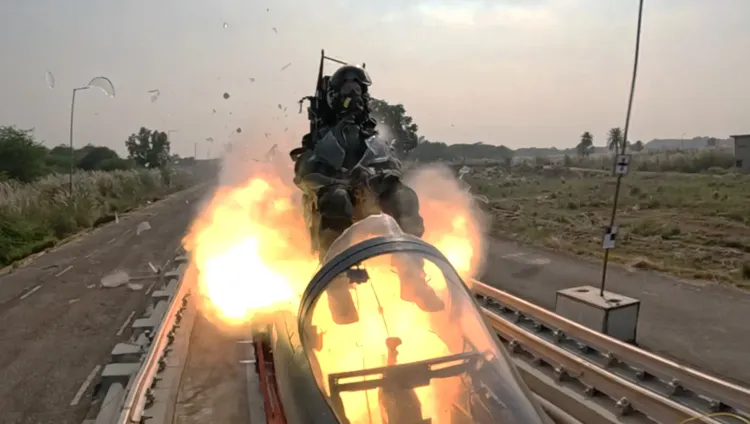
New Delhi, Dec 2 (NationPress) In a significant advancement towards self-reliance in defense technology, the Defence Research and Development Organisation (DRDO) announced on Tuesday the successful execution of a high-speed rocket-sled test for a fighter aircraft escape system at the Rail Track Rocket Sled (RTRS) facility of Terminal Ballistics Research Laboratory (TBRL) in Chandigarh.
This intricate dynamic test confirmed essential components of the aircrew escape system, encompassing canopy severance, ejection sequencing, and thorough aircrew recovery at meticulously controlled speeds, as stated in a press release.
In partnership with the Aeronautical Development Agency (ADA) and Hindustan Aeronautics Limited (HAL), the trial utilized a dual-sled setup featuring the forebody section of the Light Combat Aircraft (LCA).
A sophisticated dual-sled mechanism propelled the test item through phased ignition of multiple solid-propellant rocket motors, achieving the precise velocity profile necessary for a realistic simulation, according to the statement.
An instrumented Anthropomorphic Test Dummy collected vital data regarding loads, moments, and accelerations experienced during ejection, while the complete process—from “canopy fragilisation” to secure recovery—was recorded using high-speed onboard and ground-based imaging systems.
Unlike static trials, this dynamic ejection assessment represents the most stringent method for testing ejection seat functionality and canopy severance effectiveness under real-world conditions, positioning India as one of the few nations equipped with a fully indigenous capability to perform such sophisticated evaluations, the press release noted.
The test was overseen by senior officials from the Indian Air Force (IAF), the Institute of Aerospace Medicine, and certifying authorities.
Defence Minister Rajnath Singh praised DRDO, IAF, ADA, HAL, and industrial allies for the accomplishment, labeling it “a notable milestone for India’s indigenous defense capabilities and our path towards self-reliance.”
The Secretary of the Department of Defence R&D and Chairman of DRDO, Dr. Samir V Kamat, also expressed heartfelt congratulations to the entire DRDO team and associated organizations for the flawless execution of this highly intricate demonstration.
With this achievement, India boosts its capacity to design, develop, and certify world-class pilot escape systems entirely in-house, thereby enhancing the safety of aircrew operating indigenous combat aircraft and strengthening the nation’s rising reputation in cutting-edge aerospace innovation.
Point of View
I find this development to be a pivotal moment for India, highlighting our commitment to achieving self-reliance in defense technology. The successful testing of the fighter aircraft escape system not only enhances the safety of our aircrew but also reinforces India's position in the global aerospace arena. This achievement is a testament to the hard work and collaboration among various agencies and sets a precedent for future innovations in the defense sector.
NationPress
29 Sept 2026
Frequently Asked Questions
What is the significance of the high-speed rocket-sled test?
The high-speed rocket-sled test is crucial for validating the performance of fighter aircraft escape systems, enhancing pilot safety and showcasing India's advancements in defense technology.
Who conducted the test?
The test was conducted by DRDO in collaboration with the Aeronautical Development Agency (ADA) and Hindustan Aeronautics Limited (HAL).
Where did the test take place?
The test was performed at the Rail Track Rocket Sled (RTRS) facility of the Terminal Ballistics Research Laboratory (TBRL) located in Chandigarh.
What technology was used in the test?
A dual-sled configuration was utilized, propelled by phased firing of multiple solid-propellant rocket motors to achieve the required velocity for realistic simulation.
What does this achievement mean for India?
This accomplishment strengthens India's capability to develop indigenous defense technologies and enhances the safety of aircrew operating combat aircraft.