Is the Electromagnetic Spectrum the Key to Battlefield Dominance?

Synopsis
With the rise of the electromagnetic spectrum as a vital warfare domain, experts emphasize the importance of the 'Sense, Secure and Strike' mantra for military dominance. The future of conflicts demands a reevaluation of electronic warfare capabilities, showcasing the need for indigenization and advanced technology in India’s defense systems.
Key Takeaways
Electromagnetic spectrum is now a critical warfare domain.
SSS mantra: 'Sense, Secure and Strike' is essential for dominance.
Modern conflicts require reassessment of electronic warfare capabilities.
Indigenization is crucial for defense technological advancements.
Collaboration with industry can bolster India's defense strategy.
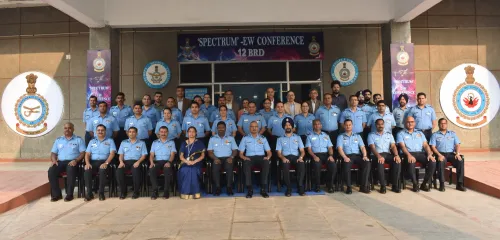
New Delhi, Jan 18 (NationPress) The electromagnetic spectrum has become a pivotal area of warfare, complementing traditional battlefields. Experts assert that the SSS mantra of 'Sense, Secure and Strike' is essential for achieving supremacy in this domain. During the ‘DESCOM 2026’ event, Chief Guest Vice Admiral Vineet McCarty, AVSM, Deputy Chief of Integrated Defence Staff (Policy Planning and Force Development) HQ IDS, emphasized that the landscape of modern warfare is rapidly evolving.
“At the core of this evolution is the electromagnetic spectrum, which has emerged as a crucial battlefield alongside conventional domains such as land, air, sea, cyber, and space,” he stated. The electromagnetic spectrum is not merely an enabler; it is a decisive factor in achieving battlefield superiority as future conflicts become increasingly rapid and complex.
Military forces must reevaluate their spectrum needs to maintain operational excellence. Electronic Warfare played a significant role during ‘Operation Sindoor’ through jamming and GPS spoofing. Experts suggest that enhanced electronic warfare capabilities are vital for future success.
Lt Gen Vivek Dogra, SM, Signal Officer-in-Chief and Colonel Commandant, Corps of Signals Indian Army, noted that ‘Operation Sindoor’ demonstrated that there are no hinterlands. “The electromagnetic spectrum has obliterated borders. Using commercial technology with dual-use capabilities has blurred the lines between civilian and military spectrums,” he remarked.
Discussing indigenization, he stated that achieving dominance is non-negotiable. “We must bridge the gap between laboratories, production, and the battlefield. Collaboration with industry is essential to keep our nation's reputation high,” he added.
Ashok Atluri, Chair of the PHDCCI Defence and HLS Committee, emphasized the abundance of talent, competence, and funding available. “What we lack is the determination to advance, design, and manufacture advanced warfare systems within India. The government’s new Research, Development and Innovation Fund has already initiated substantial deep-tech funding,” he said.
Point of View
The increasing significance of the electromagnetic spectrum highlights the urgency for India to innovate and adapt its defense strategies. Ensuring operational superiority through advanced technology is crucial, aligning with the nation’s goal of self-reliance in defense.
NationPress
28 Sept 2026
Frequently Asked Questions
What is the significance of the electromagnetic spectrum in warfare?
The electromagnetic spectrum is crucial for achieving dominance in modern warfare, serving as both a battlefield and a strategic resource.
What does the SSS mantra stand for?
The SSS mantra stands for 'Sense, Secure and Strike', emphasizing the essential steps for military forces to dominate the electromagnetic spectrum .
How does Operation Sindoor exemplify the use of electronic warfare?
During ‘Operation Sindoor’, electronic warfare techniques such as jamming and GPS spoofing showcased the need for superior capabilities in the electromagnetic spectrum .
What role does indigenization play in India’s defense strategy?
Indigenization is vital for reducing dependency on foreign technology, ensuring that India can develop and produce advanced warfare systems domestically.
Why is the Research, Development and Innovation Fund important?
The Research, Development and Innovation Fund promotes deep-tech funding and innovation, supporting India's goal to create advanced defense technologies.