Is the EU-India FTA Historic and a Gateway to New Opportunities?
Synopsis
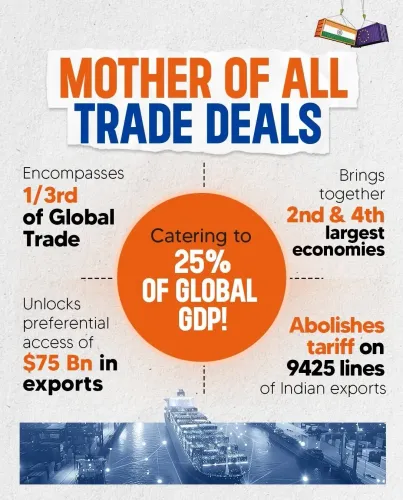
The EU-India Free Trade Agreement is poised to revolutionize trade relations, as Sweden's Ambassador underscores its historic significance and potential for Swedish businesses, especially SMEs. This agreement not only strengthens economic ties but also emphasizes scientific collaboration and talent mobility between the nations.
Key Takeaways
The EU-India FTA is a historic agreement .
Significant opportunities for SMEs .
Enhances bilateral trade and investment .
Promotes scientific and technological cooperation .
Facilitates talent mobility between nations .
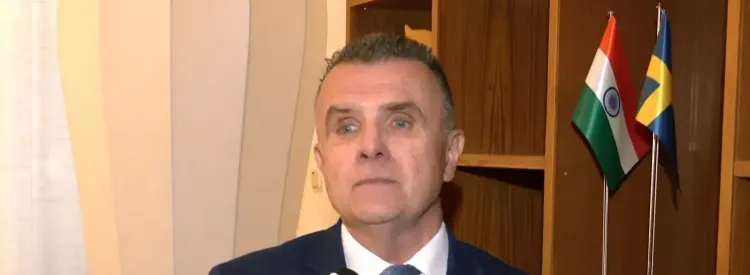
New Delhi, Jan 29 (NationPress) Describing the EU–India Free Trade Agreement (FTA) as "historic", Sweden’s Ambassador to India, Jan Thesleff, stated that this pact embodies the strong mutual trust between India and the European Union, paving the way for substantial new avenues for Swedish enterprises, especially small and medium-sized enterprises (SMEs), in India and beyond.
In an exclusive conversation with IANS, Thesleff remarked: "This agreement is a testament to the confidence India has in the European Union and vice versa."
He emphasized that while Sweden already enjoys a robust business presence in India, the FTA will reduce entry barriers and motivate numerous new Swedish companies to venture into the Indian market.
Thesleff added, "For Sweden, this agreement will unlock new opportunities for entities not yet established in India. It will foster a more innovative and engaging partnership between Sweden and India, as well as between the EU and India."
Stressing the significance of SMEs, the Ambassador pointed out that job creation, creativity, and innovation predominantly stem from small and medium enterprises. "This agreement will greatly benefit all involved, particularly SMEs and MSMEs on both ends," he stated.
Thesleff noted that approximately 400 Swedish companies currently operate in India, representing about seven percent of all EU businesses in the nation. "The agreement sends a powerful message to those yet to enter India that it is a market worth investing in, manufacturing within, and developing new products for," he explained.
Beyond trade and investment, the Ambassador highlighted the agreement’s broader implications for scientific and technological collaboration. "This is also an invitation to our research and innovation partners to collaborate, create centers of excellence, and work together in India, with India, and in Europe," he pointed out.
Regarding sectors poised to gain, Thesleff indicated that Sweden has extensive engagements with India in areas such as manufacturing, pharmaceuticals, IT, automobiles, and clean energy. "All these sectors will benefit from the agreement. Numerous Swedish brands are already well-known in India," he remarked.
He also emphasized that the partnership is reciprocal. "It is not solely European companies coming to India; Indian firms are also investing in Europe," he noted, adding that around 75–80 Indian companies have invested in Sweden. "Just a few months ago, an Indian investment in Gothenburg resulted in 1,500 jobs," he highlighted.
The Ambassador underscored that the EU–India FTA extends beyond trade. "It is about job creation and generating value for both parties," he stated.
On the prospects for skilled professionals, Thesleff shared that the agreement would facilitate greater mobility of talent. "As investments flow in, jobs are created. Skilled Indians coming to Sweden and Swedes coming to India not only bring salaries but also skills and expertise. I term this ‘intellectual remittances’," he explained.
He mentioned that Indians currently represent the largest group of foreign professionals in Sweden. "By 2030, we anticipate that one percent of Sweden’s population will be Indian. Despite the geographical distance, Sweden and India are drawing closer by the minute," he added.
Commending Prime Minister Narendra Modi’s leadership, Thesleff noted India’s consistent demonstration of its capabilities on the global stage. "During India’s G20 presidency, we clearly observed the nation’s leadership role. I am confident we will witness this again soon," he expressed.
At a time when the United States is imposing tariffs and global trade is facing escalating uncertainty, the proposed EU–India trade agreement delivers a strong message that rule-based cooperation remains viable, Thesleff stated.
"The message being conveyed by India and the EU to the world is that we can unite, reach agreements, and establish a rules-based global order," Thesleff remarked, adding that both sides are committed to agreed tariffs and enduring reliability as partners.
In light of global volatility and unpredictability, he mentioned that the current climate itself illustrates that "the opposites can also work", emphasizing the necessity for stable and predictable partnerships in an increasingly fragmented global economy.
On India’s aspiration for permanent membership in the UN Security Council, Sweden expressed its unequivocal support for reforming the global organization. "We advocate for reforming the UN system, and we believe that India deserves a rightful place at the table within a reformed United Nations, specifically at the Security Council," Thesleff stated.
Highlighting India’s role in the diversification of global supply chains, Thesleff noted that globalization has revealed how interconnected countries are while also highlighting the risks of over-dependence. "We must maintain flexibility and openness in sourcing," he emphasized, adding that free trade agreements are essential in securing supply routes and enhancing resilience.
Discussing cooperation in skill development and talent mobility, Thesleff shared that Sweden has been engaging with India for several years. "Every year, 15 to 17 Swedish universities visit India to attract talent," he noted.
Praising India’s demographic advantage, the envoy remarked that India possesses a "wealth of talent", with its youth showcasing creativity and innovation. "Swedish universities aim to tap into that talent pool," Thesleff stated, underscoring education and talent exchange as a fundamental aspect of India–Sweden collaboration.
Point of View
It's evident that the EU-India FTA is a pivotal agreement that not only enhances trade relations but also fosters a spirit of collaboration in various sectors. Such partnerships are crucial for economic growth and talent mobility, reflecting a promising future for both nations.
NationPress
20 Sept 2026
Frequently Asked Questions
What is the significance of the EU-India FTA?
The EU-India FTA signifies a historic milestone that enhances mutual trust between India and the EU, unlocking opportunities for businesses, particularly SMEs, to thrive in both markets.
How will the FTA benefit Swedish companies?
The FTA will reduce entry barriers, encouraging many Swedish companies to explore the Indian market, thus fostering innovation and expanding their presence.
What sectors will benefit from this agreement?
Key sectors such as manufacturing, pharmaceuticals, IT, automobiles, and clean energy are expected to gain significantly from the EU-India FTA.
What role do SMEs play in this agreement?
SMEs are crucial for job creation, creativity, and innovation, and the FTA is designed to provide substantial benefits to these enterprises on both sides.
How does the FTA impact talent mobility?
The agreement facilitates greater mobility of skilled professionals, creating opportunities for knowledge exchange and enhancing workforce capabilities between the two nations.