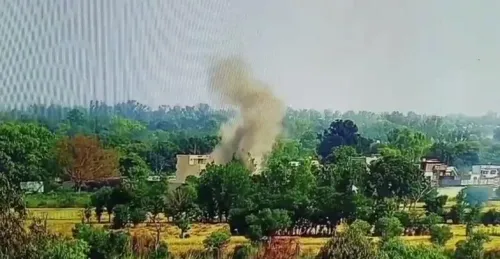
Kirana Hills hit by stray Harop drone during Op Sindoor, says ex-CDS Chauhan

Synopsis
India's former CDS General Anil Chauhan has offered the most candid explanation yet for what happened at Pakistan's Kirana Hills during Operation Sindoor — a Harop drone running out of fuel while hunting radars near Sargodha, not a deliberate strike on a nuclear site. He also revealed that a planned IAF strike on Skardu was cleared but scrapped due to bad weather, redirecting the mission to Bholari instead.
Key Takeaways
Former CDS General Anil Chauhan said a loitering munition, reportedly a Harop drone , may have struck Kirana Hills after failing to find a radar target near Sargodha during Operation Sindoor .
Kirana Hills is located approximately 10 km north of Sargodha and is considered a nuclear hub of the Pakistani Armed Forces.
The drone was not directed at Kirana Hills — it crashed after exhausting its approximately two-hour loiter time without locating a target.
The IAF received clearance to strike Skardu in PoK , but the mission was aborted due to adverse weather and redirected to Bholari .
The Bholari hangar strike on 10 May , carried out by the South Western Air Command , became the defining visual of the Operation Sindoor air campaign.
Bharti had previously denied any deliberate targeting of Kirana Hills during Operation Sindoor.
Former Chief of Defence Staff General Anil Chauhan has said that an Indian loitering munition — reportedly an Israeli-designed Harop drone — may have struck Pakistan's Kirana Hills, a site considered a nuclear hub of the Pakistani Armed Forces, during Operation Sindoor. Speaking at the 'VIMARSH' event on Operation Sindoor at the Vivekananda International Foundation in New Delhi on Tuesday, 26 August, General Chauhan was clear that Kirana Hills was not a deliberate target.
How the Drone Ended Up at Kirana Hills
According to General Chauhan, the loitering munition had been deployed to hunt for radar installations in and around Sargodha. Kirana Hills lies approximately 10 kilometres north of Sargodha. After failing to locate a radar target and exhausting its fuel while operating in the vicinity, the munition appears to have crashed into one of the hills.
'Before those strikes, we had sent a lot of loiter ammunition at Sargodha and Kirana Hills, which is 10 km north of Sargodha. So the loiter ammunition was looking for radars which were in and around Sargodha, and it has got a lifetime,' General Chauhan said. He added: 'It will loiter for about two hours, and if it doesn't find a target, it will come and hit somewhere. It must have come and hit one of those hills.'
India's Official Position on Kirana Hills
The remarks align with the Indian Air Force's earlier public clarification. During Operation Sindoor in May last year, then Director General of Air Operations Air Marshal A.K. Bharti had addressed the media and categorically denied that India targeted the nuclear facility at Kirana Hills. 'Thank you for telling us that Kirana Hills houses some nuclear installation. We did not know about it. And we have not hit Kirana Hills, whatever is there,' Air Marshal Bharti had said.
General Chauhan, referring to Bharti's statement, reiterated: 'Bharti had rightly clarified that we did not target Kirana Hills.'
Skardu Strike Cleared but Called Off Due to Weather
General Chauhan also disclosed that the Indian Air Force (IAF) had received clearance to strike Skardu in Pakistan-occupied Kashmir (PoK) during the operation, but the mission was aborted due to adverse weather conditions. The IAF subsequently redirected the strike to Bholari.
'The Chief had asked me whether he should strike Sargodha. I said, go ahead and added, please identify two more targets. One of the targets he had identified was Skardu. We gave a yes, but after some time, the weather was bad in Skardu, and they had to change over to Bholari,' General Chauhan said.
Bholari Strike: The Defining Visual of the Air Campaign
The IAF's strike on the Bholari hangar on 10 May subsequently became one of the most prominent symbols of the air campaign during Operation Sindoor. The mission was carried out by the IAF's Gandhinagar-based South Western Air Command. General Chauhan's disclosures provide the most detailed official-adjacent account yet of the decision-making chain behind some of the operation's most consequential moments.
Point of View
But for what it signals about India's willingness to speak more openly about Operation Sindoor's operational details. The 'accidental strike on a nuclear-adjacent site' framing, if accurate, is a double-edged narrative — it defuses escalation concerns but also raises questions about precision management of autonomous munitions near sensitive installations. The Skardu revelation is equally notable: a cleared strike never publicly reported, aborted by weather, and quietly redirected. These disclosures suggest the operation had a wider target set than officially acknowledged at the time, and that the full account is still being filled in incrementally.
NationPress
10 Oct 2026
Frequently Asked Questions
Did India deliberately strike Kirana Hills during Operation Sindoor?
No. Former CDS General Anil Chauhan clarified that Kirana Hills was not a deliberate target. A Harop loitering munition deployed to hunt radars near Sargodha reportedly crashed into the hills after exhausting its fuel without finding a target.
What is Kirana Hills and why does it matter?
Kirana Hills is a site in Pakistan located approximately 10 km north of Sargodha, widely considered a nuclear hub of the Pakistani Armed Forces. Any strike — even an accidental one — on or near the site carries significant strategic and escalatory implications.
What is a Harop loitering munition?
The Harop is an Israeli-designed loitering munition that autonomously searches for radar targets and destroys them on contact. It can loiter in the air for approximately two hours before striking a target or crashing if none is found.
Was a strike on Skardu planned during Operation Sindoor?
Yes. General Chauhan revealed that the IAF received clearance to strike Skardu in Pakistan-occupied Kashmir, but the mission was called off due to adverse weather conditions and subsequently redirected to Bholari.
What was the significance of the Bholari hangar strike?
The IAF's strike on the Bholari hangar on 10 May became one of the most prominent visual symbols of the Operation Sindoor air campaign, carried out by the Gandhinagar-based South Western Air Command after the Skardu mission was aborted.