Kerala's FCRA Amendments Ignite Heated Political Dispute
Synopsis
The proposed changes to the FCRA have led to intense political discourse in Kerala, with Congress MP Tewari criticizing them as rights violations, while Minister Kurien champions their legality. This ongoing debate could influence the upcoming Assembly polls.
Key Takeaways
FCRA amendments spark political division Concerns of rights infringement voiced by Congress Government defends changes as legally sound Potential electoral impact in Kerala Religious leaders raise alarms over implications
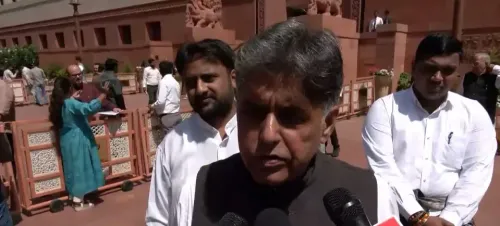
Thiruvananthapuram, March 31 (NationPress) The anticipated changes to the Foreign Contribution (Regulation) Act (FCRA) have sparked a significant political divide. Congress MP Manish Tewari has labeled these amendments as an infringement on fundamental rights, while Union Minister George Kurien has asserted that the alterations are both progressive and legally sound.
During a press conference in Thiruvananthapuram, Tewari, who is campaigning in Kerala, expressed that the amendments extend beyond considerations of minority and majority and fundamentally challenge the rights enshrined in the Constitution of India.
He criticized the provisions as “severe and authoritarian,” claiming they breach essential constitutional rights, including equality before the law and personal liberty.
Tewari argued that the Bill, as it stands, is deeply flawed and should either be withdrawn or sent to a Joint Parliamentary Committee or a Select Committee for more extensive consultation and examination.
In response, Kurien defended the amendments, stating they introduce beneficial changes and ensure adequate legal protections.
Kurien emphasized that there is significant opportunity to contest decisions in court and pursue appeals, which enhances procedural fairness within the FCRA framework.
“Those opposing these amendments should recognize that such an opportunity may not present itself again,” he stated.
Kurien dismissed fears that the law would facilitate a government takeover of religious institutions, describing such concerns as misleading.
He clarified that provisions permitting government intervention for non-functioning entities already exist in the current legislation.
“This represents a policy shift with a constructive outlook,” he remarked.
Moreover, he pointed out that organizations whose FCRA registrations have been suspended or revoked can seek legal recourse.
He cited examples where FCRA restrictions have been enforced across various cases regardless of affiliations, including those involving religious leaders and organizations.
Kurien mentioned that concerns voiced from Kerala have been communicated to the BJP central leadership, and discussions regarding the issue are expected in Parliament.
With both factions standing firm, the FCRA amendments are poised to remain a contentious subject in both political and legal spheres. This controversy could potentially disrupt the aspirations of the Kerala BJP in the upcoming April 9 Assembly polls, as it has escalated into a significant political flashpoint in the state, with Church leaders and the Congress expressing strong opposition, even as the Central government firmly denies allegations of targeting minorities.
The Supreme head of the Orthodox Church, Baselios Marthoma Mathews III Catholicos, spearheaded the criticism from the Christian community, cautioning that the amendments could “stifle” church operations, disrupt long-standing social services, and impose significant restrictions on institutions involved in education, healthcare, and charity.
He revealed that three Church accounts have already been frozen without a clear rationale, and despite bringing this to the attention of Prime Minister Narendra Modi, no resolution has been achieved.
Reiterating similar concerns, leaders from other Christian denominations, including the Syro-Malabar Church, warned that the proposed provisions, particularly those allowing the Centre to assume control of assets if licenses are not renewed, could severely undermine charitable institutions that have developed over decades.
Point of View
The ongoing debate surrounding the FCRA amendments highlights a critical intersection of legal reform and political strategy. Both the Congress and the BJP are leveraging this issue to galvanize support, revealing the complex dynamics at play in Kerala's electoral landscape.
NationPress
29 Jul 2026
Frequently Asked Questions
What are the key concerns regarding the FCRA amendments?
Critics, including Congress MP Manish Tewari, argue that the amendments infringe on fundamental rights and could lead to government overreach into religious institutions.
How does Union Minister George Kurien defend the amendments?
Kurien claims the amendments introduce positive changes, ensuring legal protections and procedural fairness, while dismissing fears of government takeover as misleading.
What impact could the FCRA debate have on the upcoming Assembly polls?
The contentious nature of the FCRA amendments could potentially affect the Kerala BJP's performance in the April 9 elections, as public sentiment is divided.
What has the Orthodox Church expressed about the proposed changes?
The Orthodox Church's head, Baselios Marthoma Mathews III, warned that the amendments could stifle church operations and disrupt social services.
Have there been any legal repercussions from the FCRA amendments?
Yes, churches have reported blocked accounts, raising concerns about the legal implications of the amendments on charitable institutions.