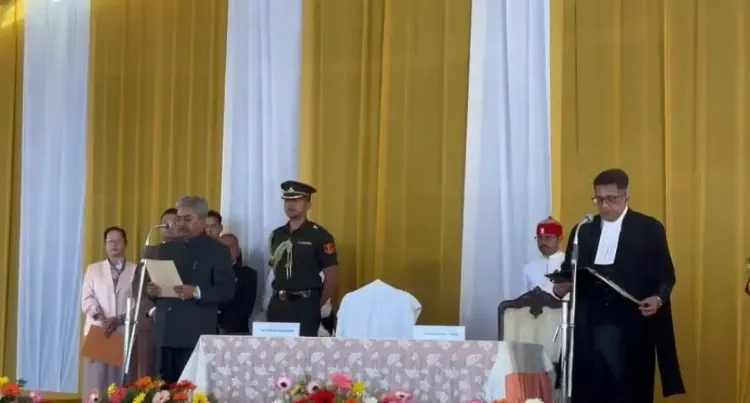
Dushyant Kumar Gautam sworn in as 21st Governor of Sikkim in Gangtok
Synopsis
Dushyant Kumar Gautam, a senior BJP veteran and former national general secretary, was sworn in as Sikkim's 21st Governor on 19 October in Gangtok — stepping into one of India's most strategically sensitive Himalayan posts, bordering China, Nepal, and Bhutan, at a time of continued focus on border connectivity and security.
Key Takeaways
Dushyant Kumar Gautam took oath as the 21st Governor of Sikkim on 19 October 2026 in Gangtok .
The oath was administered by Chief Justice A.
Muhamed Mustaque of the High Court of Sikkim.
Gautam was appointed by President Droupadi Murmu on 12 October , succeeding Om Prakash Mathur .
He is a senior BJP leader and former national general secretary of the party.
Sikkim shares international borders with Nepal , Bhutan , and China , giving it strategic importance in India's security and connectivity planning.
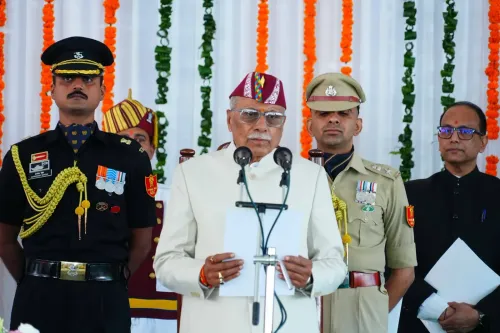
Dushyant Kumar Gautam on Monday, 19 October 2026, took oath as the 21st Governor of Sikkim at a swearing-in ceremony in Gangtok, formally assuming office as the constitutional head of the Himalayan state. The oath was administered by A. Muhamed Mustaque, Chief Justice of the High Court of Sikkim.
Key Developments at the Ceremony
The swearing-in was held in the presence of Chief Minister Prem Singh Tamang, cabinet ministers, Sikkim Lok Sabha member Indra Hang Subba, Darjeeling Lok Sabha member Raju Bista, and legislators of the state. Senior state government officials and other dignitaries also attended.
Gautam was appointed Governor of Sikkim by President Droupadi Murmu on 12 October. He succeeds Om Prakash Mathur, who has been appointed Governor of Kerala as part of a broader series of gubernatorial appointments announced by the Rashtrapati Bhavan.
Who Is Dushyant Kumar Gautam
A senior Bharatiya Janata Party (BJP) leader and former national general secretary of the party, Gautam assumes the constitutional role at a time when Sikkim remains focused on development, connectivity, tourism, and the preservation of its distinctive cultural identity. As Governor, his responsibilities are defined by the Constitution of India, with the role serving as the apex constitutional authority in the state.
Sikkim's Strategic and Historical Significance
Sikkim became the 22nd state of the Indian Union on 16 May 1975, following a constitutional process that ended the monarchy under the Chogyal and integrated the state into India. It had previously functioned as an Indian protectorate following the 1950 Indo-Sikkim Treaty.
Situated in the eastern Himalayas, Sikkim shares international borders with Nepal, Bhutan, and China, in addition to its domestic boundary with West Bengal. Its proximity to the India-China border and the sensitive Siliguri Corridor gives the state considerable importance in India's national security and regional connectivity planning.
Sikkim's Profile as a State
Beyond its strategic position, Sikkim is recognised for its Himalayan landscapes, Buddhist monasteries, and Kanchenjunga — the world's third-highest mountain. Over the decades, the state has built a distinct profile as a tourism destination and a significant centre for biodiversity conservation, even as it has navigated political and administrative transitions.
Gautam's appointment signals continuity in the Centre's approach to managing gubernatorial roles in sensitive northeastern and Himalayan states, and his tenure will be closely watched given Sikkim's geopolitical centrality.
Point of View
Nepal, and Bhutan — and its proximity to the Siliguri Corridor — make the gubernatorial post more consequential than its small size suggests. What merits scrutiny is whether the Governor's role will remain constitutionally circumscribed or whether, as has been seen in other states, it will become a vector for Centre-state friction. Chief Minister Prem Singh Tamang's presence at the ceremony signals a cooperative start, but the real test will come when development priorities and Centre directives diverge.
NationPress
19 Oct 2026
Frequently Asked Questions
Who is Dushyant Kumar Gautam, the new Governor of Sikkim?
Dushyant Kumar Gautam is a senior Bharatiya Janata Party (BJP) leader and former national general secretary of the party. He was appointed the 21st Governor of Sikkim by President Droupadi Murmu on 12 October and was sworn in on 19 October 2026 in Gangtok.
Who administered the oath to the new Sikkim Governor?
The oath of office was administered by A. Muhamed Mustaque, Chief Justice of the High Court of Sikkim, at the swearing-in ceremony held in Gangtok on 19 October 2026.
Who did Dushyant Kumar Gautam succeed as Governor of Sikkim?
Gautam succeeds Om Prakash Mathur, who has been appointed Governor of Kerala as part of a series of gubernatorial appointments announced by the Rashtrapati Bhavan.
Why is Sikkim considered strategically significant for India?
Sikkim shares international borders with Nepal, Bhutan, and China, and lies adjacent to the sensitive Siliguri Corridor — a narrow land passage connecting Northeast India to the rest of the country. This gives it considerable weight in India's national security and regional connectivity planning.
When did Sikkim become a state of India?
Sikkim became the 22nd state of the Indian Union on 16 May 1975, following a constitutional process that ended the Chogyal monarchy. It had previously functioned as an Indian protectorate under the 1950 Indo-Sikkim Treaty.