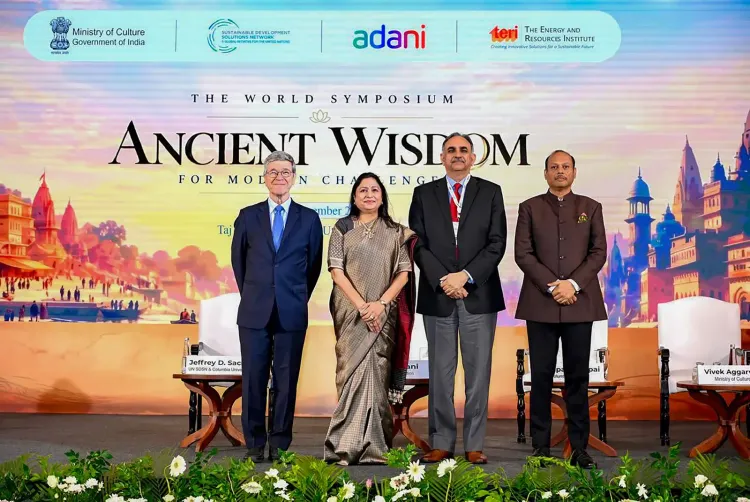
Ancient Wisdom for Modern Challenges symposium draws global scholars to Varanasi
Synopsis
For the first time, a global symposium on ancient wisdom landed in India — and Varanasi was no accident. With philosophers from Utrecht and Pretoria, an UN economist praising Adani's infrastructure role, and Columbia's Nirupam Bajpai explaining why Hinduism, Buddhism, and Jainism make Varanasi the only logical host, the event frames civilisational knowledge not as nostalgia but as a live toolkit for inequality and conflict.
Key Takeaways
The 'Ancient Wisdom for Modern Challenges' world symposium opened in Varanasi on 2 November 2026 — its first edition in India, following earlier events in Greece and China .
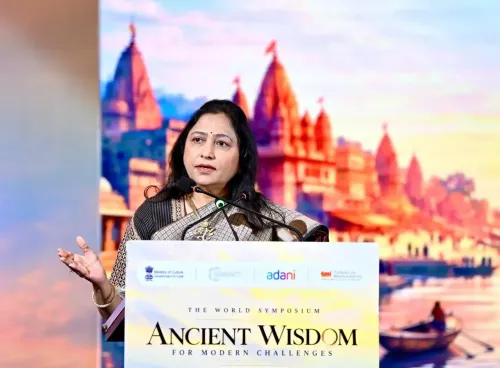
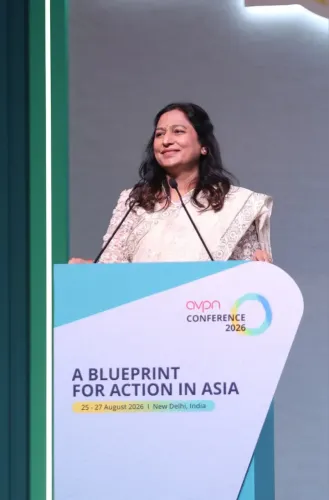
Dr Priti Adani , Chairperson of the Adani Foundation , delivered the keynote, calling for civilisational knowledge to be applied to suffering, inequality, and conflict.
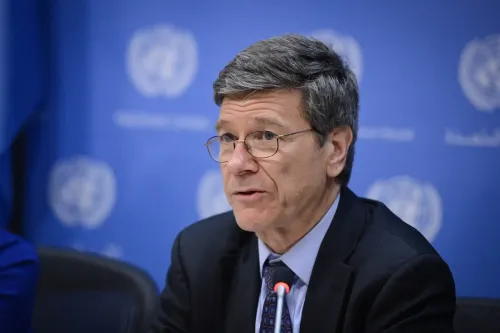
Jeffrey Sachs of the UN SDSN highlighted India as the fastest-growing large economy and credited the Adani Group with a major infrastructure role.
Varanasi was chosen for its unique convergence of Hinduism , Buddhism , and Jainism , according to Nirupam Bajpai of Columbia University .
Scholars from the University of Pretoria , Utrecht University , and the Chinmaya International Foundation called for integrating traditional wisdom into modern education and policy.
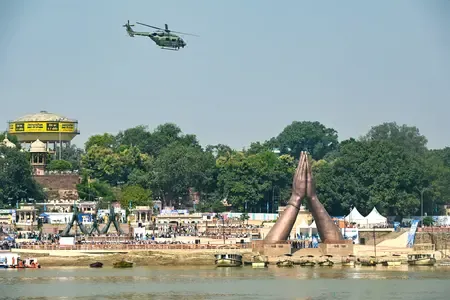
A three-day world symposium titled 'Ancient Wisdom for Modern Challenges' drew a distinguished gathering of global academicians, philosophers, and economists to Varanasi on 2 November 2026, with participants unanimously backing the application of civilisational knowledge to address contemporary problems ranging from inequality to conflict. The event, held in one of India's oldest spiritual cities, is being hosted in India for the first time.
Keynote Address and Core Theme
Dr Priti Adani, Chairperson of the Adani Foundation, delivered the keynote at the inaugural session, articulating the symposium's central premise. 'Ancient wisdom does not become valuable simply because it is ancient. It becomes valuable when we discover its relevance to contemporary problems,' she said, calling for civilisational knowledge to be preserved and actively applied to reduce suffering, inequality, and conflict.
Global Voices on Dialogue and Education
Chiara Robbiano, Associate Professor of Philosophy at Utrecht University in the Netherlands, underscored the transformative power of dialogue. 'We need to be able to spend time with one another and realise that who we are at any given moment is shaped by what happens between us. Through dialogue, we emerge as new people,' she said, stressing the importance of remaining receptive to the wisdom of others.
Zahraa McDonald, Professor at the University of Pretoria, argued for integrating indigenous and traditional knowledge systems into mainstream education. 'It is about bringing these cultures into modern education. We have been focusing on teaching mathematics and reading, and that is important. We cannot neglect these subjects,' she noted, pointing to the need for balance rather than replacement.
American philosopher Thaddeus Metz offered a philosophical justification for drawing on ancient traditions. 'If a body of thought has remained relevant for many centuries, there must be valuable insights in it about the human condition and how to make things better,' he said.
Adani Group's Role Highlighted
Jeffrey Sachs, President of the UN Sustainable Development Solutions Network (SDSN), spoke to India's economic trajectory and the Adani Group's contribution to it. 'The Adani Group is an enormous business, and it's one of the great progenitors of change in India. So, when we look at India's very rapid economic growth — the fastest-growing large economy in the world — it is fuelled in significant part by the advance of infrastructure, and the Adani Group is playing a huge role in that,' he stated.
Why Varanasi, and What Comes Next
Nirupam Bajpai, Economist and Professor at Columbia University, explained the significance of the venue. 'This is the third edition of the symposium. We have previously held two symposiums, one in Greece and the other in China. This is the first time it is being held in India. Varanasi was chosen because of its focus on Hinduism, Buddhism, and Jainism,' he said. He added that Varanasi had been under consideration from the outset given the city's unique convergence of these three religious and philosophical traditions.
Gauri Mahulikar, Academic Director of the Chinmaya International Foundation (CIF), offered a social lens, drawing on the idea of extended family relationships as a model for reducing inter-community conflict. With speakers representing institutions across four continents, the symposium signals a growing international appetite for re-examining ancient knowledge systems as practical tools — not cultural relics. The remaining sessions are expected to produce a set of recommendations for incorporating traditional wisdom into policy and educational frameworks.
Point of View
Delivered at an Adani Foundation event, is the kind of endorsement that money cannot easily buy — and its framing within an 'ancient wisdom' setting is unlikely to be accidental. The harder question, which the symposium did not appear to address, is how to operationalise these traditions without cherry-picking them selectively to suit modern power structures.
NationPress
2 Nov 2026
Frequently Asked Questions
What is the 'Ancient Wisdom for Modern Challenges' symposium in Varanasi?
It is a three-day world symposium bringing together global scholars, philosophers, and economists to explore how ancient civilisational knowledge can address contemporary issues such as inequality, conflict, and education. The 2026 Varanasi edition is the third in the series, following previous events in Greece and China.
Why was Varanasi chosen to host the symposium?
Varanasi was selected for its unique historical and spiritual convergence of Hinduism, Buddhism, and Jainism, making it a natural setting for a symposium on ancient wisdom. According to Columbia University economist Nirupam Bajpai, the city had been under consideration from the very beginning of the planning process.
Who organised the symposium and who are the key participants?
The Adani Foundation is among the key organisers, with its Chairperson Dr Priti Adani delivering the keynote address. Prominent participants include Jeffrey Sachs of the UN Sustainable Development Solutions Network, philosophers Chiara Robbiano and Thaddeus Metz, and educators from the University of Pretoria and the Chinmaya International Foundation.
What did Jeffrey Sachs say at the Varanasi symposium?
Jeffrey Sachs, President of the UN SDSN, described the Adani Group as 'one of the great progenitors of change in India' and attributed a significant part of India's rapid economic growth — which he called the fastest among large economies — to infrastructure advances driven by the group.
What is the broader significance of the symposium for education and policy?
Participants argued that ancient wisdom traditions should be integrated into modern education and policymaking rather than treated as purely cultural artefacts. Speakers called for structured dialogue, especially with younger generations, and for building frameworks that connect long-standing philosophical insights to practical challenges in governance and social equity.