Gujarat Environment Minister Modhwadia: Sustainability and development must go hand in hand
Synopsis
At a two-day GPCB workshop in Gandhinagar, Gujarat's Environment Minister Arjun Modhwadia positioned the pollution control board as the decisive force in making the state pollution-free — while calling for a shift from punitive enforcement to voluntary compliance and industry-friendly facilitation. The Vatva model and mandatory CETP zones are among the concrete proposals on the table.
Key Takeaways
Gujarat Forest and Environment Minister Arjun Modhwadia addressed the closing session of a two-day GPCB workshop in Gandhinagar on 7 June 2025 .
Modhwadia declared GPCB the most decisive force in making Gujarat pollution-free , emphasising sustainability alongside development.
Additional Chief Secretary Vinod Rao backed voluntary environmental compliance over court-mandated action and cited the Vatva model as a successful pollution-reduction example.
New industrial development plans should mandate approvals only in areas with Common Effluent Treatment Plant (CETP) facilities, Rao recommended.
Barad said environmental conditions in Gujarat had improved significantly and that growth and sustainability could coexist.
Workshop recommendations will feed into action plans across departments including Urban Development , Industries , Transport , and Water Resources .
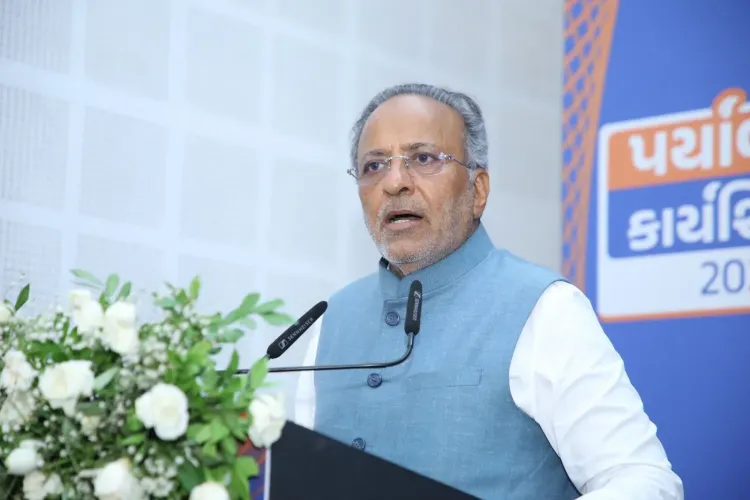
Gujarat Forest and Environment Minister Arjun Modhwadia on Sunday, 7 June declared that balancing sustainability with development and reducing dependence on natural resources remained a core state priority, as he addressed the closing session of a two-day environmental workshop in Gandhinagar. The event was jointly organised by the Forest and Environment Department and the Gujarat Pollution Control Board (GPCB).
Key Statements from the Minister
Chairing the closing session alongside Minister of State for Forest and Environment Pravin Mali, Modhwadia placed the GPCB at the centre of Gujarat's pollution-reduction ambitions. 'GPCB's role is going to be the most decisive in making Gujarat pollution-free. Ensuring sustainability alongside development and minimising the use of resources is our priority,' he said.
He noted that the Board and the Department had consistently led corrective action, with coordinated efforts ensuring industries could continue to operate while keeping pollution levels as low as possible. Modhwadia also highlighted the GPCB's future role in expanding compliance incentives, adding that the workshop's deliberations would prove instrumental in shaping the state's long-term environmental vision.
Calling for a shift in approach, the Minister urged Department and GPCB officials to function as 'friends and guides' to industries — maintaining continuous stakeholder dialogue rather than defaulting to punitive enforcement.
What the Workshop Produced
The two-day Chintan Shibir covered environmental challenges, regulatory reforms, institutional capacity building, and future-oriented planning. Modhwadia said the Vision Plan emerging from the workshop would enable departments such as Urban Development, Industries, Transport, and Water Resources to draft their own action plans.
Additional Chief Secretary Vinod Rao said the concluding report from the intensive deliberations would help chart the future direction of both environmental protection and development in Gujarat. He stressed that compliance should be voluntary rather than court-driven. 'It is more important that we comply with environmental regulations voluntarily than because of court orders,' Rao said.
The Vatva Model and Industrial Planning
Rao pointed to the 'Vatva model' as a proven example of pollution reduction in Ahmedabad and beyond, and advocated embedding environmental infrastructure into future industrial planning. He recommended that new industrial development plans mandate approvals only in areas where Common Effluent Treatment Plant (CETP) facilities are already in place, making pollution monitoring more tractable.
Rao also cited backing at the highest levels of government, noting that both Prime Minister Narendra Modi and Gujarat Chief Minister Bhupendra Patel are proponents of sustainable development. He called for policies that minimise punitive action and instead recognise compliant industries through non-financial incentives such as certificates and public honours.
GPCB Chairman's Assessment
GPCB Chairman R.B. Barad presented the workshop's findings and described the exercise as far more than a routine administrative programme. 'This was not merely a programme but a journey of ideas for the future of Gujarat,' he said, adding that environmental conditions in the state had improved markedly compared with earlier years.
Barad argued that Gujarat had demonstrated economic growth and environmental sustainability are not mutually exclusive — a claim officials said the workshop's recommendations would now translate into concrete cross-departmental action plans. The aim, officials said, is to position Gujarat as both an industrially advanced and environmentally responsible state.
Point of View
Yet it covers one industrial cluster; scaling it statewide requires enforcement muscle, not just encouragement. The push for voluntary compliance over judicial intervention also raises a question: without credible penalties, what stops non-compliant industries from free-riding on the goodwill framework? The CETP mandate for new industrial approvals is the most structurally sound proposal to emerge from the workshop — if implemented, it would bake environmental infrastructure into industrial expansion rather than retrofitting it. That detail deserves more scrutiny than the headline sustainability rhetoric.
NationPress
14 Sept 2026
Frequently Asked Questions
What was the GPCB Chintan Shibir workshop in Gandhinagar about?
The two-day Chintan Shibir was a joint workshop organised by Gujarat's Forest and Environment Department and the Gujarat Pollution Control Board (GPCB) in Gandhinagar, concluding on 7 June 2025. It covered environmental challenges, regulatory reforms, institutional capacity building, and future policy planning for the state.
What did Gujarat Environment Minister Arjun Modhwadia say at the workshop?
Modhwadia said the GPCB would be the most decisive force in making Gujarat pollution-free, and that ensuring sustainability alongside development while minimising resource use remained the state's priority. He also called on officials to act as 'friends and guides' to industries rather than adopting a purely punitive approach.
What is the Vatva model mentioned at the workshop?
The Vatva model is a pollution-reduction initiative in Ahmedabad that Additional Chief Secretary Vinod Rao cited as an effective example of controlling industrial pollution. Rao held it up as proof that economic activity and environmental responsibility can be managed together, and suggested scaling similar approaches statewide.
What is the proposed CETP mandate for new industries in Gujarat?
Rao recommended that future industrial development plans require industries to receive approvals only in areas where Common Effluent Treatment Plant (CETP) facilities are already available. The aim is to make pollution monitoring easier and ensure environmental infrastructure is built into industrial expansion from the outset.
Who will act on the workshop's recommendations?
GPCB Chairman R.B. Barad presented the workshop findings, and officials said the recommendations would shape policy decisions and action plans across multiple departments, including Urban Development, Industries, Transport, and Water Resources. The Vision Plan emerging from the workshop is intended to guide Gujarat's environmental and development strategy going forward.