CM Bhupendra Patel Leads Gujarat's Push for Pollution-Free Future

Synopsis
On World Environment Day 2026, Gujarat's Chief Minister's Office highlighted CM Bhupendra Patel's commitment to environmental conservation and a pollution-free Gujarat, reinforcing the state's green governance agenda under the hashtag 'Gujarat Always Ahead.'
Key Takeaways
The Chief Minister's Office of Gujarat posted on World Environment Day, June 5, 2026 , reaffirming the state's environmental commitments.
CM Bhupendra Patel is cited as the driving force behind Gujarat's resolve to protect the environment and eliminate pollution.
The post was shared under the hashtag #અગ્રેસર_ગુજરાત ('Gujarat Always Ahead'), a recurring branding theme of the current administration.
Gujarat has maintained environmental policy frameworks since at least 2009 , when it launched one of India's earliest state solar power policies.
Key watchpoints include new notifications from the Gujarat Pollution Control Board and updated state air quality data.
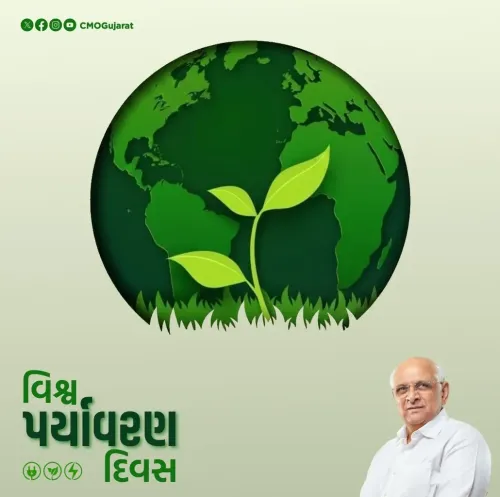
The Chief Minister's Office of Gujarat on Friday, June 5, 2026 — coinciding with World Environment Day — highlighted the state's commitment to environmental conservation and building a pollution-free atmosphere under the leadership of Chief Minister Bhupendra Patel. The post, shared under the hashtag #અગ્રેસર_ગુજરાત ('Gujarat Always Ahead'), signals the state government's continued emphasis on green governance as a pillar of its development agenda.
Context
The CMO's post, written in Gujarati, translates as: 'Gujarat, always ahead! Come, let us know the news of Gujarat — committed to protecting the environment and creating a pollution-free atmosphere under the leadership of Chief Minister Shri Bhupendra Patel.' The message was released on World Environment Day, a globally observed occasion that provides a natural platform for governments to articulate environmental priorities and communicate policy direction to citizens.
Gujarat has long positioned itself at the intersection of industrial growth and environmental stewardship, making such communications significant for both domestic audiences and investors watching the state's sustainability credentials.
Policy Backdrop
Gujarat has a documented history of integrating environmental measures into its economic model. The state introduced the Gujarat Solar Power Policy in 2009, one of the earliest state-level renewable energy frameworks in India, aimed at expanding clean energy capacity and reducing emissions from conventional sources. These efforts have broadly aligned with national frameworks such as the State Action Plans on Climate Change, which mandate state governments to outline sector-specific climate responses.
The Gujarat Pollution Control Board (GPCB) functions as the primary regulatory body overseeing industrial emissions, effluent treatment, and ambient air quality across the state. Gujarat's industrial belt — spanning Surat, Ahmedabad, Vadodara, and the Gulf of Khambhat coastline — makes pollution control a persistent governance challenge alongside economic expansion.
Stakeholders and Impact
Industrial units across Gujarat are primary stakeholders in any tightening or evolution of the state's environmental regulations. Stricter pollution norms directly affect compliance costs for small and medium enterprises (SMEs) concentrated in textile, chemical, and ceramic manufacturing clusters. At the same time, urban residents in cities like Ahmedabad and Surat — both of which have featured in national air quality monitoring data — stand to benefit most directly from sustained pollution abatement efforts.
The state's renewable energy push also has implications for farmers and rural communities, particularly through solar energy schemes that have enabled agricultural consumers to reduce electricity costs while contributing to grid decarbonisation.
What's Next
Observers will watch for the release of updated state air quality data or fresh pollution control notifications from the Gujarat Pollution Control Board in the weeks following this communication. The World Environment Day messaging typically precedes concrete policy announcements or scheme launches, and the CMO's framing of Gujarat as 'always ahead' suggests the administration may be preparing to showcase specific milestones or targets in the environmental space.
As India accelerates its commitments under international climate agreements, Gujarat's ability to balance its role as one of the country's most industrialised states with credible environmental governance will remain a closely watched test case for the broader national model.
Point of View
Timed to align Gujarat's brand with global green sentiment on one of the year's most visible environmental occasions. By invoking CM Bhupendra Patel's leadership explicitly, the administration reinforces a governance narrative that positions the Chief Minister as a proactive steward of both growth and sustainability — a balance that has defined Gujarat's political identity for over two decades. The 'Gujarat Always Ahead' framing is part of a broader pattern of competitive federalism, where state governments use national and global platforms to differentiate themselves in the eyes of investors, voters, and the Centre. Whether this messaging translates into verifiable policy outcomes will be the sharper test.
NationPress
19 Oct 2026
Frequently Asked Questions
What did Gujarat's CMO post on World Environment Day 2026?
The Chief Minister's Office of Gujarat shared a post on June 5, 2026, highlighting the state's commitment to environmental conservation and creating a pollution-free atmosphere under CM Bhupendra Patel's leadership.
Who is Bhupendra Patel and what is his role in Gujarat's environment policy?
Bhupendra Patel has been the Chief Minister of Gujarat since September 2021. The CMO credits his leadership with driving the state's resolve to protect the environment and reduce pollution.
What is the Gujarat Pollution Control Board?
The Gujarat Pollution Control Board (GPCB) is the state regulatory authority responsible for monitoring and controlling industrial and environmental pollution across Gujarat, including air and water quality standards.
What does 'Agresar Gujarat' or #અગ્રેસર_ગુજરાત mean?
'Agresar Gujarat' translates from Gujarati as 'Gujarat Always Ahead.' It is a recurring hashtag and branding theme used by the Gujarat government to highlight the state's progress across various sectors.
How has Gujarat historically approached environmental and renewable energy policy?
Gujarat introduced the Gujarat Solar Power Policy in 2009, one of India's earliest state-level clean energy frameworks. The state has since integrated renewable energy expansion and pollution control into its broader industrialisation model.