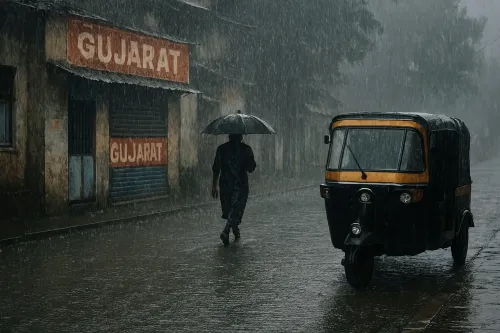
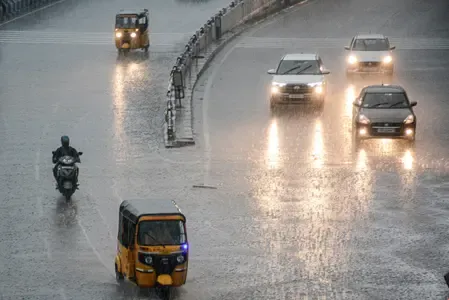
Gujarat monsoon 2025: Saurashtra leads rainfall, Ahmedabad reports zero complaints

Synopsis
Gujarat's monsoon is gaining ground — but unevenly. While Saurashtra has crossed 10% of its seasonal average and Sardar Sarovar sits at nearly 64% capacity, Kutch has received a mere 0.40% of its normal rainfall. Ahmedabad's zero-complaint scorecard and fully functional underpasses mark a contrast to past monsoon chaos, but 119 dams remain below 25% capacity, keeping the state's water-security calculus precarious.
Key Takeaways
Gujarat's cumulative monsoon rainfall stood at 76.92 mm — 8.46 per cent of the seasonal average — as of 6 a.m., 4 July 2025 .
Saurashtra led all regions at 10.45 per cent of normal rainfall; Kutch trailed at just 0.40 per cent .
Sardar Sarovar Dam held 63.94 per cent of capacity; the remaining 206 dams collectively at 36 per cent .
Dholidhaja (Surendranagar) and Wanakbori (Mahisagar) dams placed on High Alert ; seven others on warning .
Ahmedabad reported zero monsoon complaints and all roads fully functional as of 10 a.m.
9 NDRF teams and 24 SDRF platoons deployed across Gujarat as a precautionary measure.
Gujarat recorded a fresh surge in monsoon activity on Friday, 4 July 2025, with cumulative rainfall reaching 76.92 mm — equivalent to 8.46 per cent of the state's average seasonal total — as of 6 a.m., according to the State Emergency Operation Centre. Reservoir levels across the state have begun improving, while Ahmedabad remained fully operational with zero rain-related complaints logged at the city's Monsoon Main Control Room during the 18-hour window from 4 p.m. Thursday to 10 a.m. Friday.
Regional Rainfall Distribution
Saurashtra led all regions with 10.45 per cent of its normal seasonal rainfall received so far, closely followed by South Gujarat at 10.39 per cent. East-Central Gujarat has recorded 7.58 per cent, while North Gujarat stands at 4.10 per cent. Kutch remains the most rain-deficient zone, having received just 0.40 per cent of its seasonal average — a significant lag that authorities are monitoring closely.
Taluka-level data shows one taluka has already received between 500 mm and 1,000 mm this season, 16 talukas have recorded 250–500 mm, 37 talukas have received 126–250 mm, and 68 talukas have logged 51–125 mm.
Ahmedabad: City Holds Steady
The Ahmedabad Municipal Corporation (AMC) reported an average cumulative seasonal rainfall of 15.81 mm (0.62 inches) as of 10 a.m. Friday. Overnight showers between 4 p.m. Thursday and 10 a.m. Friday contributed an additional 12.54 mm on average across the city.
The North West Zone recorded the highest cumulative seasonal total at 37.92 mm, followed by the South West Zone at 21.72 mm and the West Zone at 19.27 mm. The Central Zone logged the lowest figure at 4.27 mm. During a two-hour burst between 8 p.m. and 10 p.m. on Thursday, Thaltej Ward in the North West Zone received 15.50 mm, while the Science City area recorded 15.00 mm and Bodakdev received 11.00 mm.
All roads, streets, and underpasses across Ahmedabad were reported fully functional as of 10 a.m. Friday. The water level at Vasna Barrage stood at 133.00 feet, with an inflow of 600 cusecs into the canal; all barrage gates remained closed.
Reservoir Status Across Gujarat
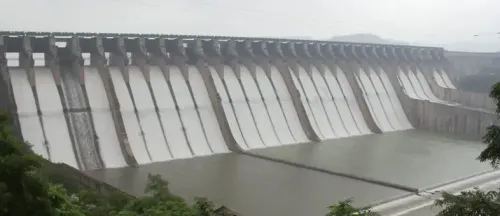
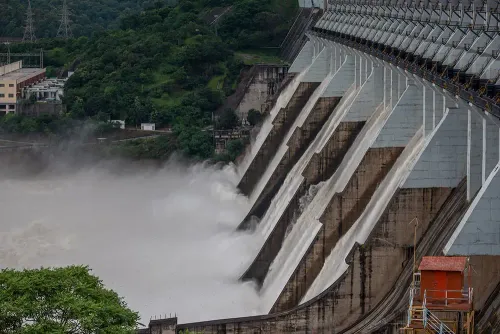
The Sardar Sarovar Dam on the Narmada River held 2,13,605 mcft of water — 63.94 per cent of its total storage capacity — with an inflow of 16,853 cusecs and an outflow of 616 cusecs recorded at 8 a.m. Friday. The remaining 206 dams across the state collectively held 2,00,846 mcft, or 36 per cent of their combined capacity.
Of these, nine dams were between 70 and 100 per cent full, 20 dams between 50 and 70 per cent, 58 dams between 25 and 50 per cent, and 119 dams remained below 25 per cent capacity. Two dams — Dholidhaja in Surendranagar and Wanakbori in Mahisagar district — were placed on High Alert, while seven others, including Venu-II in Rajkot, Vansal in Surendranagar, Ranghola in Bhavnagar, Saran in Porbandar, Sukhi in Chhota Udepur, Kalaghogha in Kutch, and Bantva-Kharo in Junagadh, were placed on warning.
AMC's Monsoon Preparedness
The AMC has identified 1,416 potholes across Ahmedabad, of which 1,310 have been repaired and work on the remaining 106 is ongoing using cold emulsion injection patching, jet patcher machines, cold mix, wet mix, hot mix, and infrared technology. The West Zone recorded the highest pothole count at 477, followed by the North Zone with 377 and the East Zone with 216.
To manage monsoon-related incidents, the civic body has deployed 76 desilting teams, 314 workers, 69 tractors and small utility vehicles, 2 JCB machines, 2 tractor trolley pumps, 25 fighter pumps, and 30 Varun pumps. Emergency Response Teams are active in every ward, with heavy-capacity pumps installed at underpasses and storm water pumping stations monitored in real time through the SCADA system. The city is additionally under surveillance via 1,139 CCTV cameras, including 44 at underpasses.
At the state level, 9 National Disaster Response Force (NDRF) teams and 24 State Disaster Response Force (SDRF) platoons had been deployed in rain-affected areas as of 9 a.m. Friday, as a precautionary measure. With Kutch still severely rain-deficient and over 100 dams below quarter capacity, the coming weeks of the monsoon will be critical for Gujarat's water security.
Point of View
But the regional skew tells a sharper story: Kutch at 0.40 per cent is effectively waiting for the monsoon to arrive, while Saurashtra is already running ahead. The 119 dams below 25 per cent capacity are the number that matters most for Gujarat's agricultural and drinking-water outlook. Ahmedabad's zero-complaint record is operationally creditable, but it also reflects low rainfall intensity so far — the real test of the AMC's SCADA and pump infrastructure will come when the monsoon hits peak intensity in late July and August.
NationPress
1 Oct 2026
Frequently Asked Questions
How much rainfall has Gujarat received so far this monsoon season?
Gujarat had received 76.92 mm of cumulative rainfall as of 6 a.m. on 4 July 2025 , equivalent to 8.46 per cent of the state's average seasonal total, according to the State Emergency Operation Centre. Saurashtra led all regions at 10.45 per cent of its normal monsoon rainfall.
What is the current water level at Sardar Sarovar Dam?
The Sardar Sarovar Dam on the Narmada River held 2,13,605 mcft of water — 63.94 per cent of its total storage capacity — as of 8 a.m. on 4 July 2025 , with an inflow of 16,853 cusecs and an outflow of 616 cusecs .
Which Gujarat dams are on High Alert?
Dholidhaja in Surendranagar and Wanakbori in Mahisagar district were placed on High Alert . Seven additional dams — including Venu-II in Rajkot, Vansal in Surendranagar, and Kalaghogha in Kutch — were placed on warning as of 4 July 2025.
Did Ahmedabad face any waterlogging or road closures due to overnight rain?
No. The Ahmedabad Municipal Corporation confirmed that all roads, streets, and underpasses were fully functional as of 10 a.m. on 4 July 2025 , and zero complaints were registered at the Monsoon Main Control Room during the 18-hour window from 4 p.m. Thursday to 10 a.m. Friday.
What disaster response forces are deployed in Gujarat for the monsoon?
As of 9 a.m. on 4 July 2025 , 9 NDRF teams and 24 SDRF platoons had been deployed across rain-affected areas of Gujarat as a precautionary measure against any unforeseen monsoon-related incidents.