How Did Gujarat’s Tableau Showcase the Evolution of the Indian Flag at the 77th R-Day?
Synopsis
Explore Gujarat's stunning tableau at the 77th Republic Day parade that illustrated the rich history and evolution of the Indian Flag. With the theme 'Swatantrata Ka Mantra: Vande Mataram,' it highlighted the contributions of revolutionaries like Madam Bhikaiji Cama and showcased India's journey towards freedom.
Key Takeaways
Gujarat's tableau highlighted the evolution of the Indian Flag.
It was themed 'Swatantrata Ka Mantra: Vande Mataram.' Madam Bhikaiji Cama played a pivotal role in the flag's history.
The tableau illustrated major events leading to India's independence.
2,500 artists participated in the Republic Day parade.
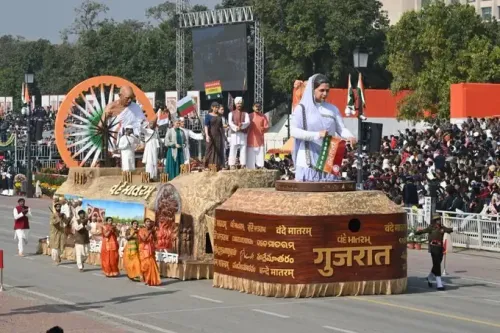
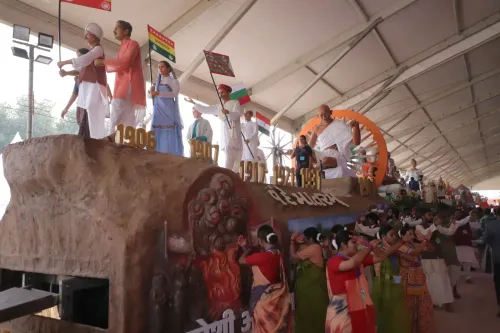
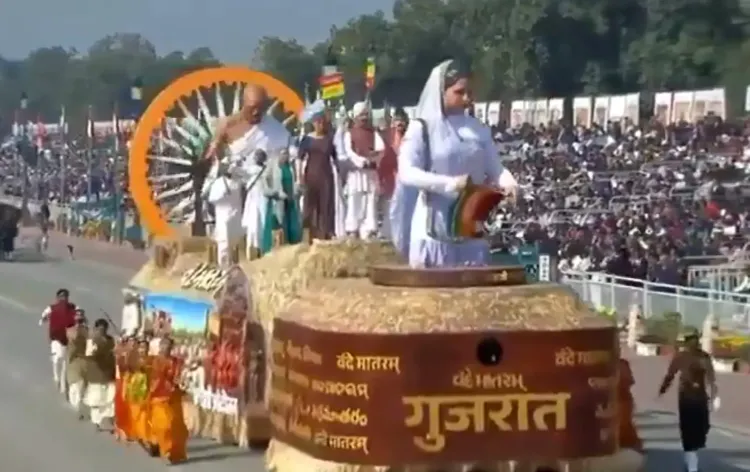
New Delhi, Jan 26 (NationPress) During the 77th Republic Day parade on Kartavya Path, Gujarat's tableau, reflecting the theme “Swatantrata Ka Mantra: Vande Mataram”, highlighted the evolution of the Indian Flag on Monday.
Gujarat's tableau emerged as a prominent highlight at the Republic Day parade, illustrating the journey and rich history of the Tricolour.
This tableau narrated the inspiring tale of the flag inscribed with ‘Vande Mataram’, crafted by Madam Bhikaiji Cama, who hailed from Navsari, Gujarat. She was a key figure in igniting the revolutionary spirit alongside fellow Gujarati patriots like Shyamji Krishna Varma and Sardarsinhji Rana, carrying forward Mahatma Gandhi's swadeshi message through the charkha and embodying the essence of the contemporary ‘Atmanirbhar Bharat’ initiative.
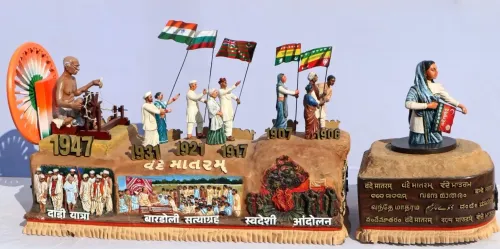
At the forefront of the tableau, the courageous Madam Bhikaiji Cama was depicted holding the self-crafted ‘Vande Mataram’-inscribed flag, which she famously unfurled on foreign soil in Paris in 1907. This flag was later showcased at the ‘Indian Socialist Conference’ in Stuttgart, Berlin, Germany.
Underneath the half-statue of Madam Cama waving the flag, the words ‘Vande Mataram’ were artistically inscribed in numerous Indian languages recognized by the Constitution.
The core section of the tableau illustrated the evolution and history of the National Flag, tracing its journey back to 1906.
Initially, revolutionaries hoisted the flag adorned with 'Vande Mataram' in celebration of the boycott of foreign goods and the acceptance of Swadeshi at the Parsi Bagan in Kolkata.
In 1907, Madam Bhikaiji Cama unfurled her flag in Paris. Then in 1917, during the Home Rule Movement, a new flag was introduced by Annie Besant and Bal Gangadhar Tilak. In 1921 at Vijayawada, the young revolutionary Pingali Venkayya designed a new flag and presented it to Gandhiji. By 1931, a modified flag created by Pingali, featuring the charkha and three colors, was on the verge of acceptance.
Finally, on July 22, 1947, the Constituent Assembly of India endorsed the tricolor with the Dharma Chakra at its center. Alongside this narrative of the National Flag, the tableau also depicted significant movements from India’s freedom struggle.
In the closing segment of the tableau, a sculpture of Mahatma Gandhi, who advocated for freedom through the Swadeshi movement using the charkha, was portrayed alongside a grand Dharma Chakra.
As a tribute to the valiant souls who sacrificed their lives for the freedom struggle, artists performed to the rhythm of ‘Kasumbi No Rang’, composed by the renowned Gujarati poet Jhaverchand Meghani, affectionately known as the ‘National Poet’, infusing the tableau with spirit and patriotic fervor.
This year, a total of 30 tableaux were featured at the Republic Day parade, representing 17 states and Union Territories, along with 13 tableaux from various departments of the Central Government. Approximately 2,500 artists participated in the cultural events on Kartavya Path. About 10,000 special guests from across the nation were in attendance.
Point of View
I believe this tableau represents a profound homage to our nation's history and the sacrifices made for our freedom. It serves as a reminder of our rich legacy and inspires future generations to uphold the values of independence and patriotism.
NationPress
5 Oct 2026
Frequently Asked Questions
What was the theme of Gujarat's tableau?
The theme of Gujarat's tableau was 'Swatantrata Ka Mantra: Vande Mataram'.
Who created the flag inscribed with 'Vande Mataram'?
The flag was created by Madam Bhikaiji Cama, a prominent revolutionary from Gujarat.
What significant event did the tableau depict?
The tableau depicted the evolution of the Indian Flag and significant movements in India's freedom struggle.
How many tableaux were displayed at the Republic Day parade?
There were a total of 30 tableaux displayed at the Republic Day parade.
Who performed during the tableau?
Artists performed to the rhythm of ‘Kasumbi No Rang’, composed by Jhaverchand Meghani.