Gurjar standoff: Bainsla's son unveils statues at Ranthambore CTH zone
Synopsis
The Gurjar community unveiled statues of Colonel Kirori Singh Bainsla and reservation martyrs inside Ranthambore's protected tiger habitat zone — defying the administration head-on. With 1,000 police deployed and no compromise in sight, Bainsla's son has drawn a direct parallel to the Ayodhya Ram Temple, framing the site as non-negotiable on grounds of faith. The standoff is now as much about identity as it is about wildlife law.
Key Takeaways
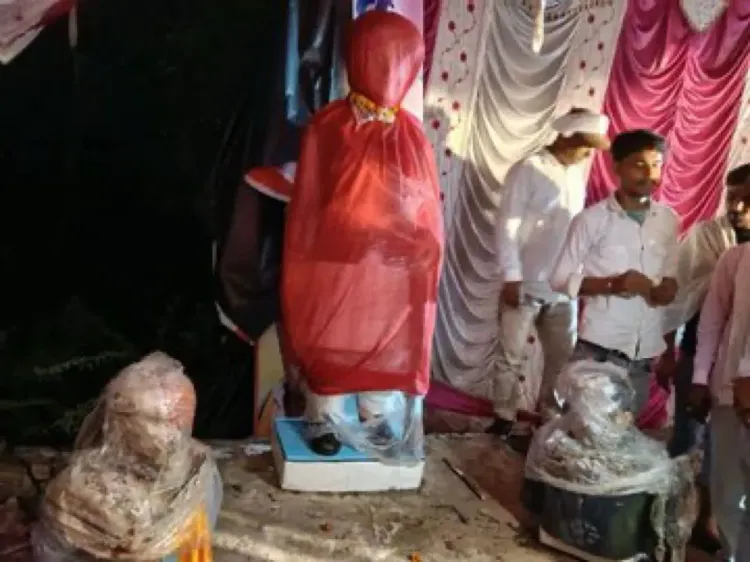
Statues of Colonel Kirori Singh Bainsla , Martyr Radheshyam , and Martyr Kanhaiya Lal were unveiled at Kushalipura, Sawai Madhopur on Saturday, 31 May 2025 .
The site falls within the Critical Tiger Habitat (CTH) zone of Ranthambore Tiger Reserve , making permanent installation legally contentious.
Around 1,000 additional police personnel from three districts were deployed following a Friday night confrontation.
District Collector Kanaram said talks are ongoing to explore an alternative location, but the community has rejected any relocation.
Vijay Singh Bainsla invoked the Ram Temple in Ayodhya to argue the martyrdom site cannot be substituted on grounds of faith.
A three-day Lord Devnarayan fair at the venue is expected to sustain community mobilisation through the coming days.
Amid heavy security deployment and administrative vigilance, statues of Gurjar Arakshan Sangharsh Samiti leader Colonel Kirori Singh Bainsla and reservation agitation martyrs were unveiled on Saturday, 31 May 2025, at Kushalipura in Sawai Madhopur district, Rajasthan — a site that falls within the Critical Tiger Habitat (CTH) zone of the Ranthambore Tiger Reserve. The ceremony, held in the afternoon following a call by the Gurjar Arakshan Sangharsh Samiti, deepened an already tense standoff between the Gurjar community and the district administration.
How the Ceremony Unfolded
Vijay Singh Bainsla, son of Colonel Kirori Singh Bainsla, led the unveiling, inviting the families of martyrs — including young children — onto the stage before the statues were formally revealed. 'We will unveil these statues together. Every martyr's family must be part of this moment, even the youngest child in their arms,' he said.
Statues of Colonel Kirori Singh Bainsla, Martyr Radheshyam, and Martyr Kanhaiya Lal were unveiled amid Vedic chants, a havan performed by the martyrs' families, and floral tributes from community members. Songs dedicated to Colonel Bainsla echoed through the gathering. A three-day Lord Devnarayan fair and tribute programme is concurrently underway at the venue.
Security Clampdown After Friday Confrontation
The event followed a direct confrontation between the Gurjar community and the police administration on Friday night, when community members brought the statues to Kushalipura. In response, authorities deployed around 1,000 additional police personnel drawn from Sawai Madhopur, Karauli, and Dausa districts. Senior administrative and police officials remained stationed at the site throughout Saturday's programme, with surveillance around the memorial area significantly intensified.
The Core Dispute: CTH Zone vs Community Demand
District Collector Kanaram said multiple rounds of discussions had been held with Gurjar leaders, and that efforts were underway to maintain the status quo while exploring a consensus on an alternative location for the statues. The administration's position is that permanent construction or statue installation cannot be permitted at Kushali Darra, as the site lies within the protected CTH zone of Ranthambore.
The Gurjar community, however, remains firm. The demand centres on the site where community members were killed during the reservation agitation — making it, in their view, non-negotiable on grounds of faith and memory. Vijay Singh Bainsla drew a pointed comparison: 'People were martyred at Kushali Darra. Now the administration says a statue cannot be installed there because it falls within a Tiger Reserve. If that is the case, then when bullets were fired at Gurjars, they should have first been taken outside the forest area before being killed.'
He also invoked the Ram Temple in Ayodhya, saying: 'Why was the temple in Ayodhya built at the site of the Babri Masjid? Why was it not constructed somewhere else? There, it is a matter of faith. Here too, our people sacrificed their lives. This is also a matter of faith for us.' He was unequivocal that the statue would be installed only at Kushali Darra.
What Comes Next
With the community unwilling to accept an alternative site and the administration bound by wildlife protection law, the standoff shows no immediate sign of resolution. The three-day tribute programme is expected to sustain community mobilisation in the coming days. Whether the administration moves to enforce the CTH zone restrictions — or negotiates a face-saving compromise — will determine whether tensions escalate further.
Point of View
Daring the ruling establishment to apply a different standard. The administration is caught between enforceable environmental law and the electoral arithmetic of a community that has historically swung Rajasthan's eastern belt. What is missing from the official response is any acknowledgement of why the original firing occurred inside a tiger reserve in the first place — a question that, left unanswered, will keep fuelling the community's grievance and make any alternative-site compromise look like erasure rather than resolution.
NationPress
15 Oct 2026
Frequently Asked Questions
Why are Gurjar statues being installed inside Ranthambore Tiger Reserve?
The Gurjar community is demanding a martyr memorial at Kushali Darra, the exact site where community members were killed during the reservation agitation. The administration opposes permanent installation because the location falls within the Critical Tiger Habitat zone of Ranthambore Tiger Reserve, where construction is legally restricted.
Who is Colonel Kirori Singh Bainsla and why does he matter to the Gurjar community?
Colonel Kirori Singh Bainsla was the founding leader of the Gurjar Arakshan Sangharsh Samiti, the organisation that spearheaded the Gurjar reservation agitation in Rajasthan. He is a central symbol of the community's demand for Other Backward Class reservation benefits, and the unveiling of his statue was led by his son, Vijay Singh Bainsla.
What was the confrontation on Friday night about?
Members of the Gurjar community brought the statues to Kushalipura late on Friday night, triggering a confrontation with the police administration. The incident prompted authorities to deploy around 1,000 additional police personnel from Sawai Madhopur, Karauli, and Dausa districts ahead of Saturday's ceremony.
What is the administration's position on the statue installation?
District Collector Kanaram has stated that permanent construction or statue installation cannot be permitted at the Kushali Darra site because it lies within the protected Critical Tiger Habitat zone. The administration is reportedly exploring consensus on an alternative location while trying to maintain the status quo.
What comparison did Vijay Singh Bainsla draw to justify the site demand?
Vijay Singh Bainsla compared the community's demand to the construction of the Ram Temple at the Babri Masjid site in Ayodhya, arguing that just as faith justified that choice of location, the martyrdom at Kushali Darra makes it the only acceptable site for the memorial. He stated the statue would be installed there and nowhere else.