Hegseth Challenges Media's Narratives on Iran War Coverage
Synopsis
U.S. Defense Secretary Pete Hegseth took a bold stance during a Pentagon briefing, criticizing media portrayals of the Iran conflict and suggesting more accurate headlines. His remarks shed light on the U.S. military's perspective and ongoing operations, highlighting a growing tension between the administration and media outlets.
Key Takeaways
Pete Hegseth criticized misleading media narratives during a Pentagon briefing.
He suggested alternative headlines that reflect the current state of the Iran conflict.
The U.S. military campaign is known as Operation Epic Fury , targeting Iranian military capabilities.
Hegseth emphasized that Iran's military strength is rapidly declining.
His remarks highlight tensions between the Trump administration and the media.
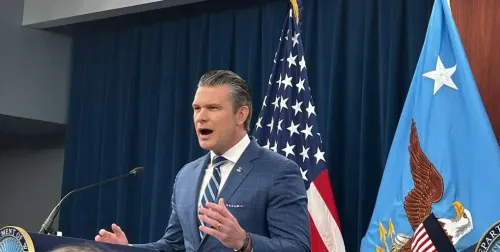
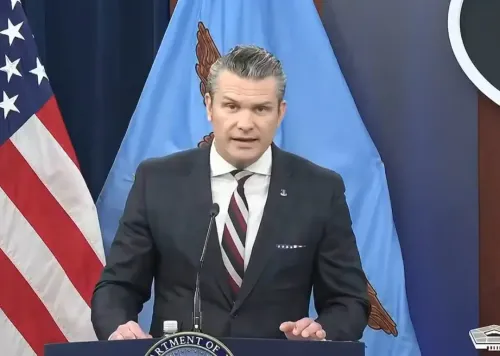
Washington, March 13 (NationPress) U.S. Secretary of Defense Pete Hegseth utilized a portion of a Pentagon briefing regarding the ongoing Iran conflict last Friday to vehemently critique the media's portrayal of the war, even proposing alternative headlines that he believed would more accurately depict the realities on the battlefield.
During a press conference with Gen. Dan Caine, Chairman of the Joint Chiefs of Staff, Hegseth accused segments of the media of inaccurately representing the conflict and concentrating on narratives that, in his opinion, exaggerated Iran's stance while neglecting to acknowledge U.S. military advancements.
“Let me offer a few recommendations,” Hegseth said to the gathered reporters. “People glance at the television and they observe banners. They notice headlines.”
The Secretary of Defense remarked on his previous experience in television, stating, “I have been part of that industry, and I understand that every piece is crafted with intention.”
Hegseth highlighted instances of television graphics that he claimed had appeared in recent reports about the war.
“For instance, a banner or headline stating ‘Mideast war intensifies’ has splashed across screens in the past few days, often accompanied by images of civilian and energy targets that Iran has attacked,” he pointed out.
According to Hegseth, such headlines painted a misleading picture of the war's progression.
“What should the banner read instead?” he questioned.
“How about ‘Iran increasingly desperate’ because that’s the reality.”
The Secretary of Defense also referenced a CNN article that suggested the Trump administration had underestimated the conflict’s potential repercussions on maritime activities through the Strait of Hormuz.
“That’s utterly ridiculous,” Hegseth asserted.
“For decades, Iran has menaced shipping in the Strait of Hormuz.”
He dismissed the article as “a fundamentally unserious report.”
Hegseth also criticized sensational headlines implying that the conflict was expanding throughout the region.
“Another example of a misleading headline that I encountered yesterday was ‘war widening,’” he stated.
“Here’s a more truthful headline for a genuinely patriotic press: ‘Iran contracting, retreating underground.’”
Throughout the briefing, Hegseth consistently stressed that the United States believed Iran’s military capabilities were swiftly declining due to the ongoing operations.
He noted that American and Israeli air forces had executed thousands of strikes against Iranian objectives.
“The collaboration between the world’s two most formidable air forces is unparalleled and invincible,” he emphasized.
“Together, our Air Force and that of the Israelis have targeted over 15,000 enemy locations.”
Hegseth stated that Iranian forces had endured substantial losses across various fronts.
“Iran lacks air defenses. Iran has no air force. Iran has no navy,” he outlined.
“Their missiles, missile launchers, and drones are being dismantled or intercepted.”
Hegseth claimed that Iran’s missile attacks had significantly decreased as a consequence of the strikes.
“Their missile output has dropped by 90 percent,” he reported.
“Their one-way attack drones have diminished by 95 percent.”
The statements were made during a briefing primarily focused on the developments of the U.S. military campaign against Iran, which officials indicated had reached its 13th day.
Gen. Caine disclosed that American forces had targeted over 6,000 sites during the operation and were persistently assaulting Iranian missile, drone, and naval capabilities.
“This morning marks the beginning of the 13th day of Operation Epic Fury, and we are continuing to achieve our military goals,” he announced.
While the Pentagon employed the briefing to detail the military advancements of the campaign, Hegseth's pointed critique of media reporting was an exceptional moment during a formal Department of Defense news conference.
The exchange highlighted escalating tensions between the Trump administration and segments of the U.S. media regarding the coverage of the Iran conflict.
U.S. officials assert that the campaign aims to dismantle Iran's missile launch capabilities, weaken its naval strength, and prevent Tehran from obtaining a nuclear weapon.
Point of View
It's crucial to recognize the ongoing tensions between the Trump administration and media outlets regarding the Iran conflict. Hegseth's outspoken critique underscores the importance of accurate reporting in times of war and the impact of narratives on public perception.
NationPress
3 Oct 2026
Frequently Asked Questions
What did Pete Hegseth criticize during the briefing?
Pete Hegseth criticized media coverage of the Iran conflict, suggesting that it misrepresented the situation and proposed alternative headlines that would reflect the reality on the battlefield.
How did Hegseth describe Iran's military capabilities?
Hegseth emphasized that Iran's military capabilities were rapidly deteriorating, stating that they lack air defenses, an air force, and a navy, and have suffered heavy losses.
What operation is currently underway against Iran?
The ongoing military campaign against Iran is referred to as Operation Epic Fury, which has been active for 13 days, targeting Iranian missile, drone, and naval capabilities.
What alternative headlines did Hegseth suggest?
Hegseth suggested headlines like 'Iran increasingly desperate' and 'Iran contracting, retreating underground' as more accurate representations of the conflict.
What was the media's response to Hegseth's comments?
Hegseth's comments indicate growing tensions between the Trump administration and parts of the U.S. media, highlighting a disconnect in narratives regarding the Iran conflict.