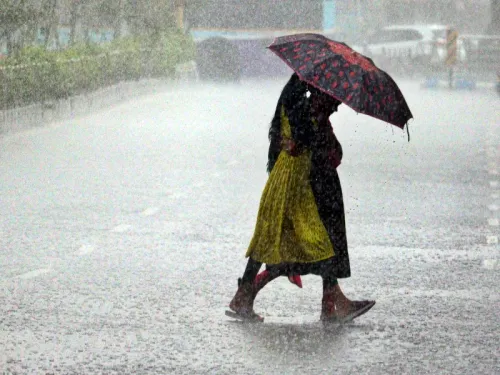
IMD issues red alert for Odisha as Bay of Bengal low pressure intensifies
Synopsis
A low-pressure area over the northwest Bay of Bengal has put Odisha on high alert, with the IMD issuing a red alert for Koraput and Malkangiri and forecasting extremely heavy rainfall between 3 and 6 July. Fishermen have been warned off the sea as wind gusts could reach 60 kmph — making this one of the state's most significant early-monsoon weather events this season.
Key Takeaways
A low-pressure area formed over the northwest Bay of Bengal on 2 July 2025 , driven by an upper-air cyclonic circulation up to 7.6 km above sea level.
The IMD has issued a red alert for Koraput and Malkangiri districts on 3 and 4 July , warning of extremely heavy rainfall.
Peak rainfall is expected between 3 and 6 July across southern and western Odisha, with coastal districts also at risk.
Districts under heavy to very heavy rainfall warning include Nabarangapur , Kalahandi , Rayagada , Gajapati , Ganjam , Kandhamal , Boudh , and Nuapada .
Fishermen advised not to venture into the sea for the next five days ; wind gusts may reach 60 kmph .
Rainfall intensity expected to ease gradually after 8 July .
The India Meteorological Department (IMD) on 2 July 2025 warned of heavy to extremely heavy rainfall across Odisha after a low-pressure area formed over the northwest Bay of Bengal and the adjoining West Bengal coast, driven by an upper-air cyclonic circulation extending up to 7.6 km above mean sea level. The system is expected to intensify over the next two to three days, triggering widespread rainfall activity across the state.
What the Weather System Looks Like
Manorama Mohanty, Director of IMD Bhubaneswar, told reporters that the low-pressure area is likely to become more marked in the coming days. Light to moderate rain accompanied by thunderstorms and lightning is very likely at many places across Odisha over the next four to five days, with heavy to very heavy rainfall expected in several districts.
The peak spell is forecast between 3 July and 6 July, during which widespread rain and isolated extremely heavy showers are expected over southern and western Odisha. Coastal districts are also likely to receive heavy rainfall during this window.
Red, Orange and Yellow Alerts Issued
The IMD has issued a red alert — its highest warning tier — for Koraput and Malkangiri districts on 3 and 4 July, flagging the risk of extremely heavy rainfall. An orange alert and yellow alert have been issued for other districts across the state for the next couple of days.
Districts including Koraput, Malkangiri, Nabarangapur, Kalahandi, Rayagada, Gajapati, Ganjam, Kandhamal, Boudh, and Nuapada are expected to receive heavy to very heavy rainfall. Extremely heavy rainfall is specifically forecast over parts of Malkangiri, Koraput, and adjoining southern Odisha districts during the peak spell.
Fishermen Warned to Stay Off Sea
IMD Director Mohanty advised fishermen not to venture into the sea over the next five days, citing squally weather conditions over the Bay of Bengal. Wind speeds are likely to reach 40–50 kmph, gusting up to 60 kmph, making sea conditions rough to very rough along and off the Odisha coast.
When Will the Rain Ease
According to the IMD forecast, rainfall intensity is expected to gradually decrease after 8 July. Authorities and residents in southern and western Odisha districts — particularly those under the red alert — are advised to remain on high alert through the peak spell. The pattern is consistent with the active monsoon phase that typically intensifies over eastern India in early July.
Point of View
Where infrastructure remains thin and evacuation logistics are perennially stretched. The IMD's early warning is credible and timely, but the real test is state disaster machinery: whether the Odisha Disaster Rapid Action Force is pre-positioned and whether district collectors have activated evacuation protocols before the peak spell hits on 3 July. Odisha has earned a reputation for model disaster preparedness since the 1999 super cyclone, but that reputation is tested anew every monsoon season. The window between now and 3 July is narrow.
NationPress
1 Oct 2026
Frequently Asked Questions
Why has the IMD issued a red alert for parts of Odisha?
The IMD issued a red alert for Koraput and Malkangiri districts on 3 and 4 July due to the risk of extremely heavy rainfall triggered by a low-pressure area over the northwest Bay of Bengal. A red alert is the highest warning level and signals a threat to life and property.
Which districts in Odisha are most at risk from the heavy rainfall?
Koraput and Malkangiri face the highest risk with a red alert for extremely heavy rain. Districts including Nabarangapur, Kalahandi, Rayagada, Gajapati, Ganjam, Kandhamal, Boudh, and Nuapada are also under heavy to very heavy rainfall warnings.
When will the heavy rainfall in Odisha peak and when will it ease?
Rainfall is forecast to peak between 3 and 6 July, with the most intense spells over southern and western Odisha. The IMD expects intensity to gradually decrease after 8 July.
Why have fishermen been warned not to go to sea?
IMD Director Manorama Mohanty advised fishermen to stay off the Bay of Bengal for the next five days due to squally weather, with wind speeds of 40–50 kmph and gusts up to 60 kmph expected to make sea conditions rough to very rough.
What is a low-pressure area and why does it cause heavy rain?
A low-pressure area is a weather system where atmospheric pressure is lower than the surrounding region, drawing in moist air that rises and condenses into clouds and rain. The current system over the northwest Bay of Bengal is reinforced by an upper-air cyclonic circulation up to 7.6 km above sea level, amplifying its rainfall potential over Odisha.