India-Australia defence ties: Joint Maritime Security Roadmap in final stages
Synopsis
India and Australia are no longer just strategic partners on paper — they are building the operational architecture to match. From undersea domain awareness and joint patrol aircraft to a new defence MoU and a Common Operational Picture across the Indo-Pacific, the second Defence Ministers' Dialogue signals a relationship shifting from dialogue to deployment.
Key Takeaways
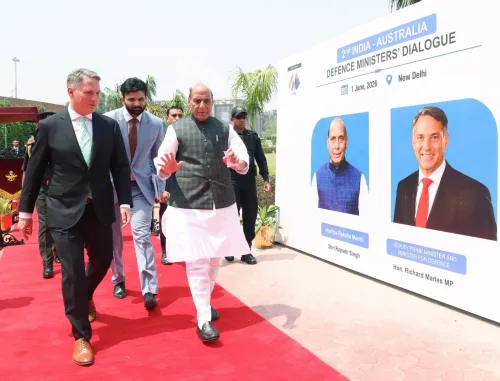
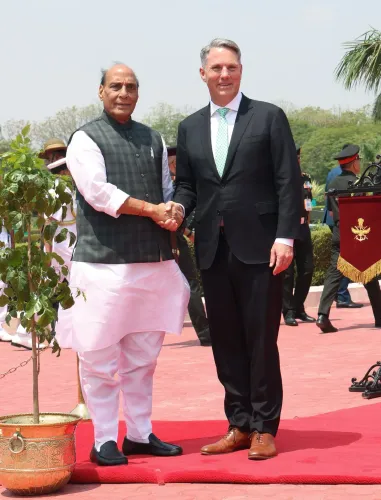
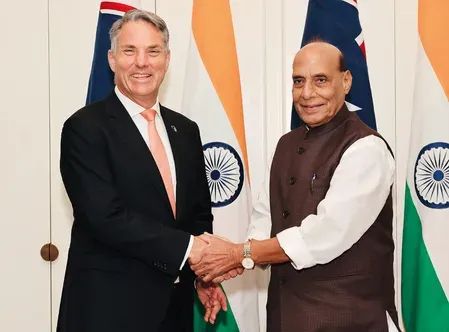
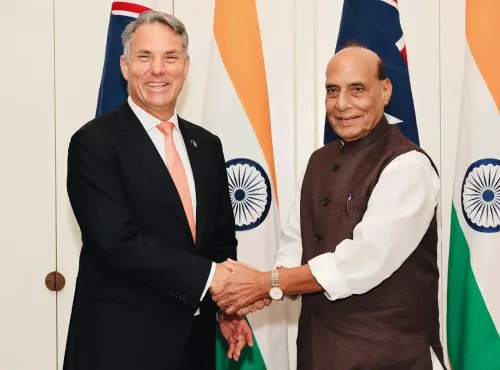
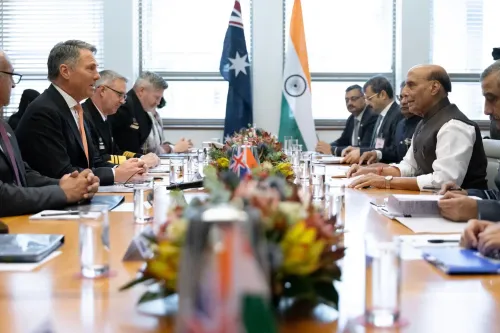
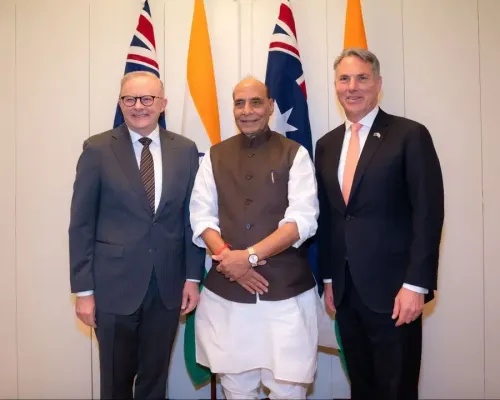
Defence Minister Rajnath Singh and Australia's Richard Marles held the second India–Australia Defence Ministers' Dialogue in New Delhi on 1 June 2025 .
Both sides are working to finalise the Joint Maritime Security Collaboration Roadmap and agreed to advance maritime patrol aircraft cooperation and undersea domain awareness .
India and Australia will begin developing an MoU on the Provision of Defence Articles and Defence Services to deepen industrial collaboration.
A joint SAR tabletop exercise is scheduled at MRCC Chennai later in June under the IORA co-leadership framework.
Both nations reaffirmed support for the Quad IPMSC initiative and agreed to develop a Common Operational Picture across the Indo-Pacific.
Exercise Austrahind has evolved to include amphibious combat and littoral manoeuvre ; India will participate in Exercise Talisman Sabre 2027 .
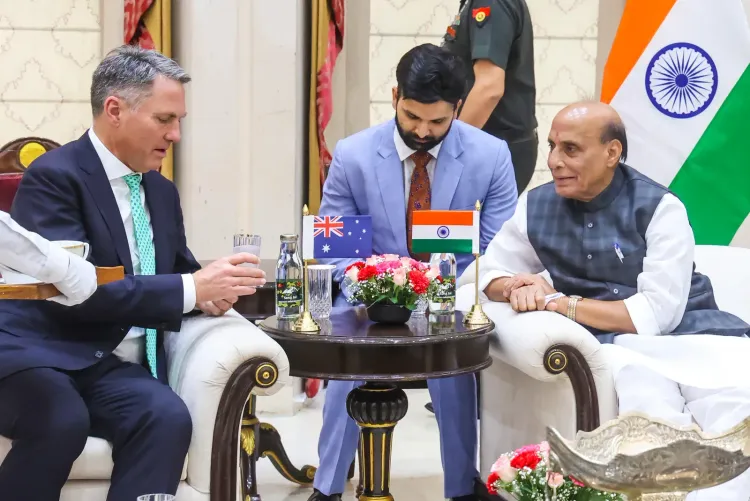
Defence Minister Rajnath Singh and Australia's Deputy Prime Minister and Defence Minister Richard Marles on Monday, 1 June held the second India–Australia Defence Ministers' Dialogue in New Delhi, advancing efforts to finalise the Joint Maritime Security Collaboration Roadmap and deepening bilateral defence cooperation across sea, air, and emerging technology domains.
Maritime Domain Awareness at the Core
Both ministers agreed to progress collaborative maritime domain awareness activities using maritime patrol aircraft and to explore opportunities to enhance undersea domain awareness. They also encouraged further cooperation between the Indian Coast Guard and Australia's Maritime Border Command.
India and Australia, as co-leads of the Indian Ocean Rim Association (IORA) Working Group on Maritime Safety and Security (WGMSS), are set to jointly host a Search and Rescue (SAR) tabletop exercise at the Maritime Rescue Coordination Centre (MRCC), Chennai, later this month. The exercise is aimed at strengthening maritime safety cooperation across the Indian Ocean Region (IOR).
Defence Industrial Collaboration Gets a Boost
A significant outcome of the dialogue was the announcement that both nations will begin developing a Memorandum of Understanding (MoU) on the Provision of Defence Articles and Defence Services — described as the next step in deepening defence industrial ties.
The ministers welcomed Australia's first defence trade mission to India and the Australia-India Defence Industry Roundtable, both held in October 2025, as evidence of growing bilateral defence industry engagement. They agreed to explore further exchanges through the Joint Working Group on Defence Industry, Research, and Materiel.
Both countries are also exploring future defence science and technology cooperation in areas such as sensor technologies. Marles extended an invitation for India to participate in the 2026 Australian Defence Science, Technology, and Research Summit.
Joint Exercises and Interoperability
The ministers noted the expanding footprint of joint military exercises. They looked forward to India's enhanced participation in Exercise Talisman Sabre 2027, while welcoming Australia's participation in India's Exercise Milan in February 2026 and India's participation in Australia's Exercise Kakadu in March 2026.
A notable evolution this year is the Exercise Austrahind, which has expanded its scope to focus on amphibious combat and littoral manoeuvre. Australia welcomed India's inaugural participation in Operation Render Safe 2026, while India welcomed an invitation to join the submarine rescue exercise Black Carillon. The bilateral Implementing Arrangement on Air-to-Air Refuelling is set to be operationalised at Exercise Pitch Black.
Both sides also agreed to explore arrangements to enhance procedural interoperability, building on the 2020 Mutual Logistics Support Arrangement, and to continue aircraft deployments from each other's territories to build operational familiarity. The two ministers also said they look forward to the inaugural Joint Staff Talks later this year.
Quad and Indo-Pacific Strategic Alignment
Both ministers reaffirmed the growing strategic convergence between India, Australia, Japan, and the United States in the Indo-Pacific. They expressed strong support for the Quad Indo-Pacific Maritime Surveillance Collaboration (IPMSC) initiative, to be implemented initially in the Indian Ocean Region.
They welcomed India's operationalisation of the Indian Ocean Region programme of the Quad Indo-Pacific Partnership for Maritime Domain Awareness (IPMDA) through the Information Fusion Centre–Indian Ocean Region in Gurugram. Both sides agreed to work toward developing a Common Operational Picture (COP) across the Indo-Pacific by building on existing IPMDA efforts.
The joint statement also underscored the importance of freedom of navigation and overflight, unimpeded trade, and adherence to international law — particularly the 1982 United Nations Convention on the Law of the Sea (UNCLOS).
What Comes Next
Officials have been encouraged to finalise arrangements for the deployment of an Indian visiting instructor at the Australian Defence College in 2028–2029. With the MoU on defence articles under development and the Joint Maritime Security Roadmap nearing completion, the bilateral defence relationship is entering a more operationally integrated phase — one that carries direct implications for the broader Indo-Pacific security architecture.
Point of View
But as a structural shift in Indo-Pacific security architecture. The move from dialogue to an MoU on defence articles, combined with the operationalisation of the Quad IPMDA through Gurugram, signals that India is embedding itself into a multilateral surveillance and logistics network with real operational consequences. The question is whether India's historically non-alignment-sensitive strategic culture can sustain the political consensus needed to make these arrangements durable — especially as China watches the Quad's maritime footprint expand in its near-abroad.
NationPress
15 Oct 2026
Frequently Asked Questions
What is the India-Australia Joint Maritime Security Collaboration Roadmap?
It is a bilateral framework being finalised by India and Australia to structure and advance their maritime security cooperation, covering areas such as maritime domain awareness, patrol aircraft activities, undersea surveillance, and Coast Guard coordination. The roadmap was a central agenda item at the second India–Australia Defence Ministers' Dialogue held on 1 June in New Delhi.
What did Rajnath Singh and Richard Marles agree on at the dialogue?
They agreed to progress collaborative maritime patrol aircraft activities, explore undersea domain awareness, begin developing an MoU on defence articles and services, and enhance interoperability through joint exercises. They also reaffirmed support for the Quad Indo-Pacific Maritime Surveillance Collaboration initiative.
What is the Quad IPMDA and how does India fit in?
The Quad Indo-Pacific Partnership for Maritime Domain Awareness (IPMDA) is a surveillance-sharing initiative among India, Australia, Japan, and the United States. India has operationalised its Indian Ocean Region programme through the Information Fusion Centre in Gurugram, and both India and Australia agreed to work toward a Common Operational Picture across the Indo-Pacific.
Which joint military exercises are India and Australia planning?
India is set to enhance its participation in Exercise Talisman Sabre 2027. Both countries also participated in Exercise Milan (February 2026) and Exercise Kakadu (March 2026). Exercise Austrahind has been expanded to include amphibious combat, and both sides are participating in each other's multinational air exercises in 2026, including Exercise Pitch Black.
What is the significance of the planned MoU on defence articles?
The MoU on the Provision of Defence Articles and Defence Services marks the next step in deepening India-Australia defence industrial collaboration, building on the 2020 Mutual Logistics Support Arrangement. It reflects growing bilateral defence trade, following Australia's first defence trade mission to India and the Australia-India Defence Industry Roundtable, both held in October 2025.