India's agriculture GVA doubles to ₹48.7 lakh crore in a decade
Synopsis
India's agriculture GVA more than doubled in ten years — from ₹20.9 lakh crore to ₹48.7 lakh crore — but the headline figure carries a caveat: it is measured at current prices, meaning inflation is part of the story. The real test is whether productivity and farmer incomes have kept pace with the nominal surge.
Key Takeaways
Agriculture and allied sector GVA rose from ₹20.9 lakh crore in 2014-15 to ₹48.7 lakh crore in 2023-24 , a CAGR of 8.83 per cent at current prices.
Agriculture accounts for roughly 18 per cent of India's total GVA.
Food grain production reached a record 357.73 million tonnes in 2024-25 , with rice up 42 per cent and wheat up 36 per cent over the decade.
Edible oil import dependence fell from 63.2 per cent in 2015-16 to 56.25 per cent in 2023-24 .
Horticulture output grew from 280.70 million tonnes to 369.05 million tonnes between 2013-14 and 2024-25 .
Oilseed production rose nearly 55 per cent and productivity improved about 31 per cent over the period.
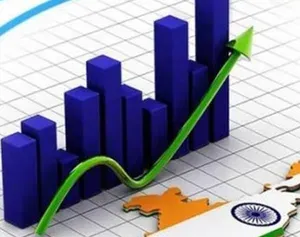
India's agriculture and allied sector gross value added (GVA) more than doubled — from ₹20.9 lakh crore in 2014-15 to ₹48.7 lakh crore in 2023-24 — accounting for roughly 18 per cent of total GVA, according to an official statement released on Friday, 5 June. The decade-long expansion, attributed to sustained policy focus and increased public investment, registered a compound annual growth rate (CAGR) of 8.83 per cent at current prices.
Key Growth Numbers
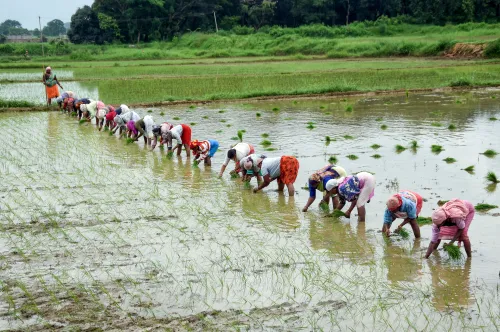
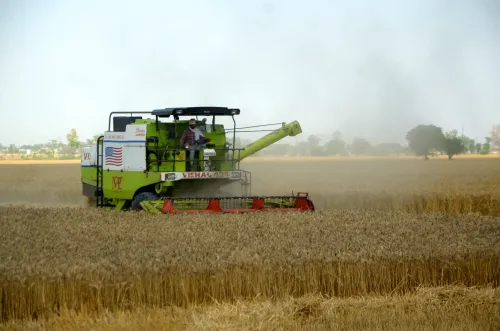
Crop GVA alone climbed from ₹12,92,874 crore in 2014-15 to ₹26,52,891 crore in 2023-24, nearly doubling over the period. Total food grain production rose from 265.05 million tonnes in 2013-14 to 357.73 million tonnes in 2024-25 — a gain of over 35 per cent. Record outputs were logged in both rice (150.18 million tonnes, up 42 per cent) and wheat (117.94 million tonnes, up 36 per cent) in 2024-25.
Policy Drivers Behind the Expansion
The official statement attributed the growth to a broadened policy focus that moved beyond welfare support toward productivity, income security, market access, and institutional resilience. The Pradhan Mantri Krishi Sinchayee Yojana (PMKSY) expanded irrigation coverage and promoted water-use efficiency, while the Soil Health Card Scheme enabled scientific nutrient management. The Rashtriya Gokul Mission supported indigenous breeds and dairy productivity.
Expanded minimum support price (MSP) operations and procurement systems have also strengthened market assurance and supported national food security objectives, the statement noted. Digital platforms, cooperatives, food processing linkages, and climate-resilient initiatives have created new opportunities across the agricultural value chain.
Oilseeds and Horticulture: Progress and Gaps
Edible oil import dependence declined from 63.2 per cent in 2015-16 to 56.25 per cent in 2023-24, indicating gradual — though still incomplete — progress toward self-sufficiency. During the same period, the area under oilseeds increased by over 18 per cent, production rose nearly 55 per cent, and productivity improved by about 31 per cent.
Horticulture output grew from 280.70 million tonnes in 2013-14 to 369.05 million tonnes in 2024-25, reflecting a diversification toward high-value crops supported by improved cultivation practices and rising market demand.
What the Shift Signals
According to the statement, these developments reflect a gradual transition toward a more diversified, technology-driven, and farmer-centric agricultural system. Notably, the GVA figures are at current prices, which means a portion of the nominal doubling reflects inflation rather than volume growth alone — a distinction relevant to assessing real productivity gains.
With agriculture supporting the livelihoods of a significant share of India's population, the sector's performance over the next five years will be closely watched, particularly as climate variability and global commodity cycles introduce fresh uncertainty.
Point of View
And real value-added growth is more modest. India's edible oil import dependence still sits above 56 per cent despite a decade of oilseed missions, which underscores how structural dependencies resist policy pressure. The record food grain numbers are genuine, but the more important question — whether net farm incomes have risen commensurately — is conspicuously absent from official statements. That gap between output metrics and income reality is where agricultural policy most often overpromises.
NationPress
25 Sept 2026
Frequently Asked Questions
What is India's agriculture GVA and how much has it grown?
Agriculture GVA (gross value added) measures the economic output of the farming and allied sector. India's agriculture GVA grew from ₹20.9 lakh crore in 2014-15 to ₹48.7 lakh crore in 2023-24, a CAGR of 8.83 per cent at current prices, according to an official statement.
What drove the growth in India's agriculture sector over the past decade?
Growth was supported by expanded irrigation under PMKSY, the Soil Health Card Scheme, MSP procurement operations, digital platforms, food processing linkages, and climate-resilient initiatives. The Rashtriya Gokul Mission also contributed by boosting dairy productivity.
What is India's current food grain production?
Total food grain production reached a record 357.73 million tonnes in 2024-25, up from 265.05 million tonnes in 2013-14. Rice output stood at 150.18 million tonnes and wheat at 117.94 million tonnes — gains of 42 per cent and 36 per cent respectively.
Has India reduced its dependence on edible oil imports?
Yes, but only partially. Edible oil import dependence declined from 63.2 per cent in 2015-16 to 56.25 per cent in 2023-24. Oilseed area expanded by over 18 per cent and production rose nearly 55 per cent, yet import reliance remains significant.
How has horticulture performed over the past decade?
Horticulture production grew from 280.70 million tonnes in 2013-14 to 369.05 million tonnes in 2024-25, reflecting a shift toward high-value crops driven by better cultivation practices and rising consumer demand.