India joins ITU as pilot country to close AI gap for Global South
Synopsis
India is not just attending the global AI conversation — it is co-leading it. As one of ten ITU pilot countries, New Delhi is putting its ₹10,000 crore IndiaAI Mission, 38,000-plus GPUs at one-third global cost, and its DPI playbook on the table as a replicable model for the Global South, at a moment when 2.2 billion people worldwide are still offline.
Key Takeaways
India has joined the ITU as one of ten pilot countries to bridge the AI divide for the Global South , announced at IMC 2026 on 9 October 2026 .
The IndiaAI Mission , backed by over ₹10,000 crore , has onboarded more than 38,000 high-end GPUs at roughly one-third of the global average cost.
India ranks first globally in relative AI skill penetration; Indian developers account for about 5.2% of GitHub open-source AI projects with 10+ stars.
Sanchar Saathi has disconnected over 7.14 crore fraudulent mobile connections and prevented financial fraud worth over ₹5,000 crore .
India's TEC has established a National Working Group on AI Standardisation aligned with ITU-T global benchmarks.
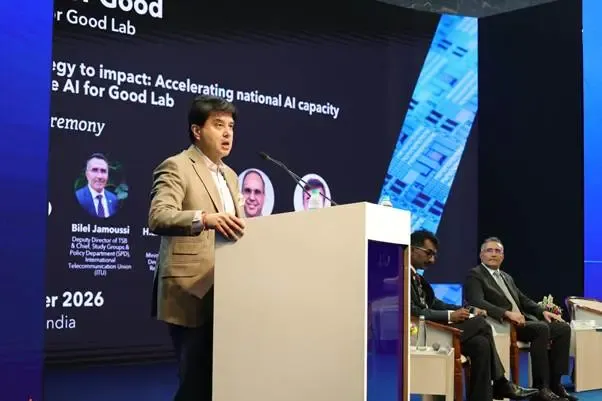
Communications Minister Jyotiraditya M. Scindia on Friday, 9 October 2026, declared that the true measure of artificial intelligence will not be the scale of its models but the number of human lives it transforms — as India formally stepped into its role as one of ten pilot countries partnering with the International Telecommunication Union (ITU) to bridge the AI divide for the Global South. The announcement came at the inauguration of the 'AI for Good Lab Workshop: From Strategy to Impact' at India Mobile Congress (IMC) 2026 in New Delhi, organised jointly by the Department of Telecommunications (DoT) and the ITU.
India's Role in the Global AI Pilot
Alongside partner nations from Africa, Asia, Latin America, and the Gulf, India brings its model of shared compute, open datasets, and Digital Public Infrastructure (DPI) to the table. The pilot is designed to lead cross-regional learning and technical collaboration, with India positioned as a template for emerging economies seeking affordable, scalable AI adoption.
'The journey of the AI for Good Lab from Geneva to New Delhi mirrors the journey that artificial intelligence itself must make — from global conversations to local solutions, from technological possibility to human impact, and from strategy to scale,' Scindia said. 'The distance between AI ambition and AI impact is bridged by skills, compute, data, institutions, and connectivity.'
Workshop Outcomes and AI Sandbox Framework
Structured deliberations at the workshop produced a concrete roadmap covering institutional engagement, priority sector adoption, and Global South knowledge-sharing. Stakeholders reached a shared understanding of AI Sandbox requirements — frameworks designed to support experimentation while validating fairness, robustness, and safety before solutions are scaled to the last citizen.
This comes amid growing global concern that without deliberate intervention, a digital divide could evolve into a far deeper AI divide. Scindia invoked India's guiding philosophy of 'Sarvajan Hitaya, Sarvajan Sukhaya' (for the welfare of all, for the happiness of all), noting that nearly 2.2 billion people worldwide remain offline and that technology must expand rather than concentrate human opportunity.
India's Domestic AI Infrastructure
The minister detailed key milestones under the ₹10,000 crore-plus IndiaAI Mission. On compute infrastructure, more than 38,000 high-end GPUs have been onboarded at approximately one-third of the global average cost, with an additional 20,000 GPUs being added to the pool.
The AI Kosh platform is unlocking datasets and sovereign models across agriculture, healthcare, and education. India currently ranks first globally in relative AI skill penetration, with Indian developers contributing approximately 5.2% of open-source AI projects on GitHub with ten or more stars — a metric that underscores the country's grassroots developer ecosystem rather than just top-down policy.
Telecom Safety and Standardisation
Scindia highlighted how telecom innovation is being paired with trust. The Sanchar Saathi platform has facilitated the disconnection of over 7.14 crore fraudulent mobile connections, traced more than 35 lakh lost handsets, and prevented potential financial fraud worth over ₹5,000 crore.
On the standards front, India's Telecommunication Engineering Centre (TEC) has developed national standards covering AI fairness, robustness, and incident reporting, establishing a National Working Group on AI Standardisation aligned with ITU-T global benchmarks. Key international figures present included Bilel Jamoussi, Deputy Director of the ITU Telecommunication Standardisation Bureau, and Amit Agrawal, Secretary of the Department of Telecommunications.
With the workshop concluded, attention now turns to how India's DPI-led model translates into replicable frameworks for its fellow pilot nations — a test that will define whether the Global South can move from AI strategy to tangible impact.
Point of View
But the claim rests on metrics that need scrutiny. Ranking first in 'relative AI skill penetration' and contributing 5.2% of GitHub stars are proxies, not outcomes — they measure participation, not productivity or welfare impact. The ₹10,000 crore IndiaAI Mission's GPU cost advantage is real and significant, but the harder question is whether open datasets and DPI frameworks will translate into deployable solutions for smallholder farmers or rural health workers in partner nations. With 2.2 billion people still offline globally, the risk is that India exports its model before the model itself has been fully stress-tested at home.
NationPress
9 Oct 2026
Frequently Asked Questions
What is India's role in the ITU AI for Good pilot?
India is one of ten pilot countries partnering with the International Telecommunication Union (ITU) to advance AI adoption across the Global South. It brings its Digital Public Infrastructure model, shared compute infrastructure, and open datasets as replicable frameworks for cross-regional learning.
What is the IndiaAI Mission and how large is its budget?
The IndiaAI Mission is India's flagship initiative to build domestic AI capabilities, backed by an outlay of over ₹10,000 crore. It covers compute infrastructure, open data platforms like AI Kosh, and talent development, with more than 38,000 high-end GPUs already onboarded at roughly one-third of the global average cost.
What did the AI for Good Lab Workshop achieve?
The workshop, held at India Mobile Congress 2026 in New Delhi, produced a concrete roadmap for institutional engagement, priority sector AI adoption, and Global South knowledge-sharing. Stakeholders also reached a shared understanding of AI Sandbox requirements to ensure fairness and safety before scaling solutions.
What is Sanchar Saathi and why is it relevant to AI?
Sanchar Saathi is an Indian government platform that uses AI and data analytics to combat telecom fraud. It has disconnected over 7.14 crore fraudulent mobile connections, traced more than 35 lakh lost handsets, and prevented financial fraud worth over ₹5,000 crore — making it a real-world demonstration of AI deployed for citizen protection.
Why does India's AI push matter for the Global South?
With nearly 2.2 billion people worldwide still offline, there is a risk that AI benefits concentrate in wealthy nations, deepening inequality. India's model of affordable compute, open datasets, and DPI offers a potential blueprint for developing economies to adopt AI without depending on expensive proprietary infrastructure.