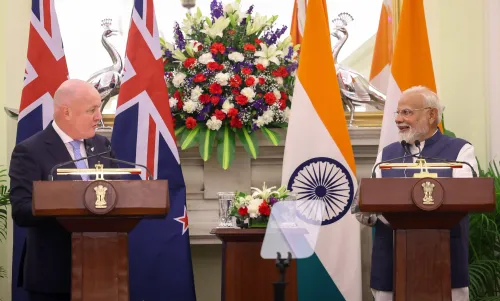
Will India and New Zealand Double Bilateral Trade with the New FTA?
Synopsis
Prime Minister Narendra Modi and New Zealand's Christopher Luxon have successfully finalized a Free Trade Agreement that aims to double bilateral trade over the next five years. This innovative FTA promises significant economic benefits, including a $20 billion investment from New Zealand into India and enhanced market access for both nations.
Key Takeaways
The India-New Zealand FTA aims to double bilateral trade within five years.
New Zealand plans to invest $20 billion in India over the next 15 years.
Tariffs will be eliminated or reduced on 95% of New Zealand’s exports.
The agreement enhances economic engagement and market access.
It opens up opportunities for various sectors including agriculture and education.
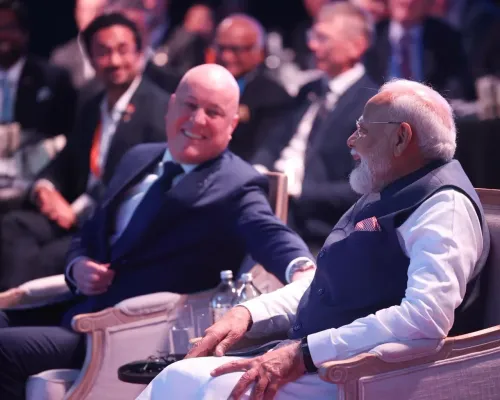
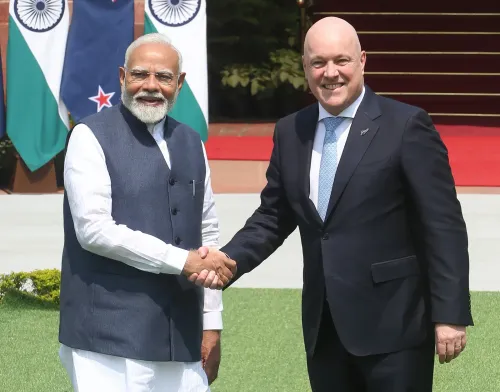
New Delhi, Dec 22 (NationPress) Prime Minister Narendra Modi engaged in a phone call with New Zealand's Prime Minister Christopher Luxon on Monday, where the two leaders announced the successful finalization of the groundbreaking and mutually advantageous India-New Zealand Free Trade Agreement (FTA).
Throughout the dialogue, both leaders expressed their optimism about achieving a twofold increase in bilateral trade within the span of five years, alongside a projected investment of $20 billion from New Zealand into India over the next 15 years.
The initiation of negotiations took place in March of this year, culminating in the FTA's completion within an impressive nine-month timeframe, a testament to the shared ambition and political determination to strengthen relations between the two nations, as conveyed in a statement from the Prime Minister's Office (PMO).
According to the statement, “The FTA will significantly enhance bilateral economic interaction, improve market access, stimulate investment flows, and bolster strategic collaboration between the two nations while creating new opportunities for innovators, entrepreneurs, farmers, MSMEs, students, and youth across various sectors.”
The leaders also acknowledged the advancements made in other domains of bilateral collaboration, including sports, education, and personal connections, reaffirming their dedication to further fortifying the India-New Zealand partnership.
This landmark FTA abolishes and reduces tariffs on 95 percent of New Zealand’s exports—one of the highest rates among any Indian FTA—with nearly 57 percent becoming duty-free from the outset, climbing to 82 percent upon full implementation, and the remaining 13 percent set for significant tariff reductions.
It places New Zealand exporters on an equal or better footing compared to their competitors across various sectors and provides access to India’s burgeoning middle class, as per an official statement from New Zealand.
“The Indian economy is projected to expand to NZ$12 trillion by 2030. The India-NZ Free Trade Agreement unlocks tremendous potential for our top-tier exporters to access the world’s largest nation and will significantly hasten our efforts towards New Zealand’s ambitious target of doubling export values within a decade,” the statement further noted.
Point of View
The finalization of the India-New Zealand Free Trade Agreement marks a pivotal moment in international trade relations. This agreement not only signifies a mutual commitment to fostering economic growth but also strengthens the ties between two democracies. As India moves towards becoming a global economic powerhouse, partnerships like this one are essential for sustainable development and regional stability.
NationPress
13 Oct 2026
Frequently Asked Questions
What is the India-New Zealand Free Trade Agreement?
The India-New Zealand Free Trade Agreement (FTA) is a bilateral agreement aimed at enhancing trade and economic cooperation between India and New Zealand, providing mutual benefits through reduced tariffs and increased market access.
How much investment is projected from New Zealand to India?
New Zealand is expected to invest $20 billion in India over the next 15 years as part of the economic cooperation outlined in the FTA.
How long did the negotiations for the FTA take?
The negotiations for the India-New Zealand Free Trade Agreement were completed in just nine months, starting in March of this year.
What sectors will benefit from the FTA?
The FTA will benefit various sectors, including agriculture, innovation, and education, providing new opportunities for entrepreneurs, farmers, and students.
What percentage of New Zealand's exports will see tariff reductions?
The FTA will abolish or reduce tariffs on 95 percent of New Zealand’s exports to India, with 57 percent becoming duty-free immediately.